Mortimer’s Ulster Reckoning1380 CE
In 1380 Edmund Mortimer, Richard II’s lieutenant and claimant to Ulster and Connacht, brought military resources and royal authority to Ireland. Gaelic rulers, notably Niall Mór Ó Néill, initially accommodated him, but Mortimer’s treacherous arrest of Art Mág Aonghusa damaged confidence and exposed limits to his influence. Campaigning in Ulster coincided with dynastic killings, territorial conflicts and successions among Gaelic and Anglo-Irish lordships across Ireland. In Dublin, Mortimer summoned parliament, secured clerical taxation for defence, and enforced discriminatory religious admissions rules. Murage at Ardee and ecclesiastical deaths reflect administrative and social continuity. The year demonstrated Ireland’s fragmented, contested political order.
Dateline
In 1380, Ireland’s political map was not remade by a single conquest, but it was sharply tested by the arrival of Edmund Mortimer, earl of March and earl of Ulster. Mortimer came as King Richard II’s lieutenant, bringing unusual wealth, rank and military resources to an Irish administration that often lacked all three. His presence briefly made the English lordship a more active force beyond Dublin and Meath. Yet the year’s annals also record killings, night attacks, rival inaugurations and local victories from Ulster to Connacht and Thomond. Their combined message is clear: authority in Ireland remained plural, negotiated and often violently contested.
A Lieutenant Arrives
Mortimer had been appointed lieutenant in October 1379, but modern biographical evidence places his arrival in Ireland in May 1380. He possessed a particular reason to intervene in the north-west: through his wife Philippa, daughter of Lionel of Antwerp, he claimed the great Mortimer inheritance of Ulster and Connacht. These were formidable titles on paper, but much of the territory was controlled in practice by Gaelic dynasties and by autonomous Anglo-Irish lordships. Mortimer’s task was therefore not simply to administer an established royal domain. It was to convert distant claims into obedience, revenue, military service and secure routes.
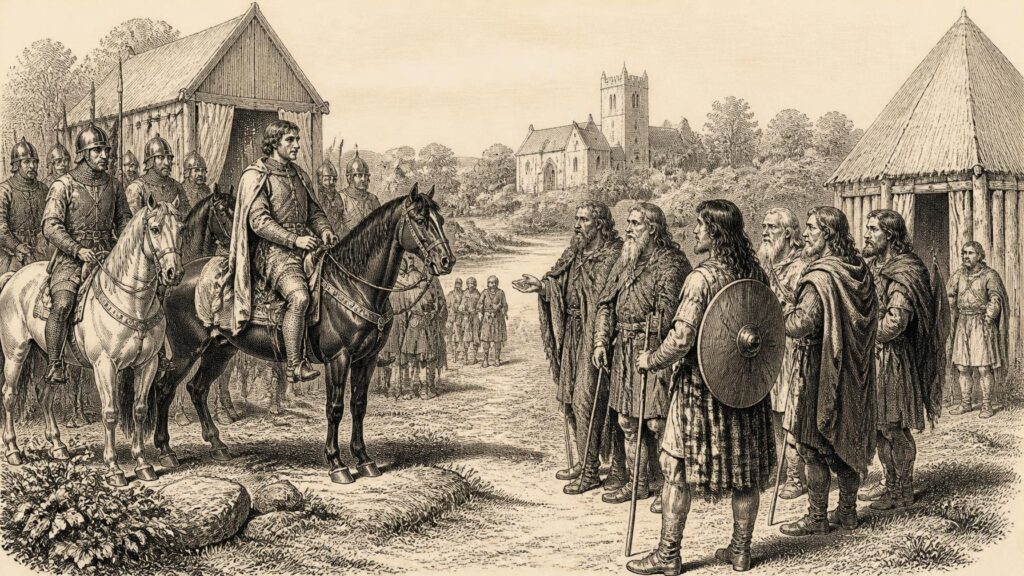
The Annals of Ulster record that Gaelic nobles came into Mortimer’s house, led by Niall Mór Ó Néill. The phrase is important, but should not be mistaken for the submission of a united Irish kingdom. Niall was king of Tír Eoghain and the leading power in much of Ulster; the annal’s description of him as heir to the kingship of Ireland reflects Gaelic political language and prestige, not the existence of a functioning all-Ireland monarchy. Submission could be a practical accommodation between rulers, preserving local lordship while recognising the immediate strength of a visitor with an army.
For a short time, Mortimer’s northern advance seemed promising. Later historical accounts, drawing on annalistic and administrative evidence, associate him with a base at Downpatrick and with campaigning through Ulster. The Annals of the Four Masters, compiled much later from earlier material, says that he led an army into Ulster and damaged forts, towns and religious buildings, naming Urney, Donaghmore, Errigal and Clogher. The detail is valuable but its late compilation cautions against reconstructing the exact route or sequence. What can safely be said is that Mortimer’s intervention was felt as a destructive military incursion, not merely as a formal progress of lordly diplomacy.
Trust Broken in Iveagh
The most consequential episode attached to Mortimer’s northern dealings was the seizure of Art Mág Aonghusa, lord of Iveagh in south Down. The Annals of Ulster says Art was taken treacherously in Mortimer’s house. It then makes an unusually direct judgement on the political consequence: the Gaels of Ireland, and also the English of Ireland, feared Mortimer and avoided him. Whether every group reacted alike is impossible to establish, but the annalist understood the arrest as a breach of the protection expected in a lord’s household. Hospitality was not a minor courtesy in medieval politics; it was a framework through which meetings, agreements and submissions could be made possible.
The capture also struck at Niall Mór’s regional network, since Art was his vassal. Mortimer had won an appearance of northern co-operation, then undermined it by treating one of the participants as a prisoner. This helps explain why his lordship could be impressive without becoming durable. Military pressure could force an encounter or a submission, but could not by itself create the confidence needed for continuing alliance. The diplomatic gain and the political damage both belong firmly to 1380.
War Among Irish Lordships
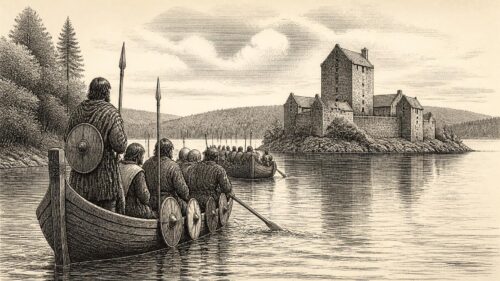
Ulster’s internal politics were no less turbulent than Mortimer’s campaign. At Assaroe, beside the Erne near Ballyshannon, John Ó Domhnaill, king of Tír Chonaill, and his son Máel Sechlainn Dubh were killed in a night attack at the monastery. Their opponents were Toirdhealbhach Ó Domhnaill, sons of Cathal Ó Conchobair and Muintir Duirnín. This was a dynastic coup carried out at a religious site that could also serve as a place of residence, refuge and assembly. Toirdhealbhach’s seizure of the kingship did not end resistance from John’s descendants, but the killings were the decisive opening of his long struggle for supremacy in Tír Chonaill.
The annals place further fighting in the same northern world. Art Mág Aonghusa inflicted a major defeat on the Foreigners and the men of Orior; the king of Orior, Ó hAnluain, was killed along with many others. Here, as elsewhere, Foreigners is the annalists’ term for settlers and people of the English lordship rather than a description of recent arrivals from overseas. The entry demonstrates that the lord of Iveagh was still an active military figure during the year’s conflicts, although the surviving annals do not permit a secure month-by-month order between his victory and his capture by Mortimer.
Other notices reveal similar patterns of local rivalry. Ruaidhrí Ó Conchobair of Breifne was killed while making a night incursion against the Uí Ruairc. In Thomond, Tadhg, son of Muircheartach Ó Briain, was killed by Brian Ó Briain. In Leinster, Art, son of Gerald Caomhánach, was killed by the English, while another Art, of the Mac Murchadha line, was killed by Mac Murchadha, king of Leinster. Such entries do not describe a simple contest between Irish and English. Kin groups, neighbouring lordships, settlers and royal officials all acted within overlapping political worlds, forming alliances when useful and fighting when advantage demanded.
Connacht and the Western Lordships
In Connacht, the Annals of the Four Masters report that Mac William Burke defeated Mac William Uachtarach, Richard Óg Burke, at Áth Leathan, probably Athleague on the Shannon. Mac Jordan de Exeter, lord of Athleague, and John de Exeter were killed. The event belonged to the fragmented politics of the de Burgh inheritance, in which branches of the Burkes had become major regional powers with Gaelic as well as Anglo-Norman connections. It is a reminder that Mortimer’s claimed Connacht lordship was far from a straightforward possession. Control of a crossing, a castle or a local following could matter more immediately than an inherited title.
A precisely dated succession gives another glimpse of regional resilience. On 3 May, Donnall, son of Brian Ó Dubhda, lord of Tireragh and Tirawley, died at his own residence; his son Ruaidhrí succeeded him. Later genealogical material praises Donnall as a defender of his territory against both English and Irish adversaries. The wording should be read as family-centred commemoration, but the succession itself is well anchored in the annalistic record. It shows how lordship depended upon continuity within a ruling lineage, its household and its territorial followers, even amid broader instability.
Dublin, Revenue and Religious Boundaries
Mortimer’s year was not spent solely in the field. He held a parliament in Dublin in November 1380. Clergy were summoned from across the lordship, including bishops, archbishops’ representatives, abbots and priors. A royal writ of 24 December records that the assembled prelates and clergy granted a tenth from taxable spiritual and temporal possessions, together with a charge on certain non-taxed church lands, for the land’s defence. This was a practical measure: campaigning, garrisons, messengers and fortifications required money, while the government’s effective fiscal reach remained strongest in and around the English-controlled areas.
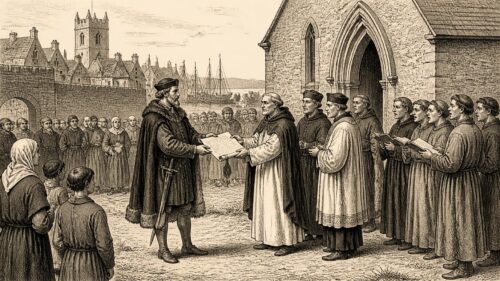
The year also exposes the exclusionary assumptions of that administration. A writ circulated in 1380 to numerous religious houses, including St Mary’s Abbey in Dublin, Mellifont, Baltinglass, Bective, Tintern, Jerpoint, Holy Trinity and All Hallows, ordering observance of earlier rules that barred Irish people, or enemies of the king, from admission to religious houses among the English. The order revived the ethnic and political divisions embedded in the Statutes of Kilkenny. It should not be treated as proof that every monastery observed the restriction perfectly; enforcement varied, and religious communities remained connected to surrounding societies. But the writ shows the government actively attempting to police identity even within institutions devoted to prayer, learning, hospitality and landed management.
Church life continued beyond official policy. The annals record the deaths of the abbot of Holy Trinity on Lough Key and the prior of Lisgoole in Fermanagh. Milo Sweetman, archbishop of Armagh since 1361, also died in 1380, at Dromiskin according to later ecclesiastical tradition. These notices point to the everyday importance of monasteries, episcopal centres and clerical households as landholders, employers, centres of literacy and places where political memory was preserved. Their inclusion beside campaigns and killings reflects an Irish historical culture in which ecclesiastical and secular affairs were inseparable.
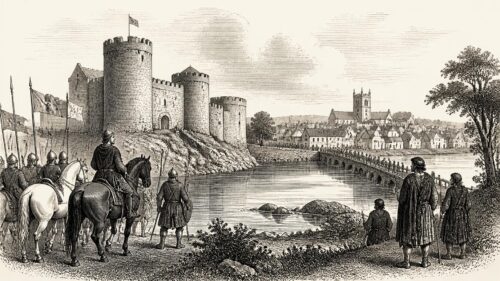
For towns within the lordship, security and maintenance had a material cost. Ardee received a grant of murage in February 1380, allowing tolls to support the repair or construction of its defences. Such grants do not prove a particular emergency at Ardee, but they show that walls, gates and streets were continuing objects of investment. For inhabitants, the consequences of the year’s politics were experienced in more ordinary forms as well: levies, transport of food and supplies, the risk of raiding, dues at crossings and markets, and the demands of lordly households.
A Brief Assertion of Power
By the close of 1380, Mortimer had demonstrated that a well-resourced royal lieutenant could move beyond the narrowest confines of the English lordship, summon a parliament and compel attention in Ulster. But the year also revealed the limits of that achievement. His campaign did not dissolve the power of Ó Néill, Ó Domhnaill, Burke, Ó Conchobair, Ó Briain or Mac Murchadha lordships. The treacherous arrest of Art Mág Aonghusa turned an apparent diplomatic opening into a warning about the hazards of dealing with the lieutenant. Ireland in 1380 was therefore not a land drifting outside politics, but one crowded with political communities whose rival claims could not be settled by one arrival from England.
Primary Sources
- The Annals of Ulster, Year U1380
- CELT Project: The Annals of Ulster
- Annals of the Four Masters, Annal M1380
- CELT Project: Annals of the Four Masters
- Mortimer, Edmund
- O’Neill, Niall Mór
- O’Donnell (Ó Domhnaill), Toirdhealbhach
- O’Donnell (Ó Domhnaill), Conchobhar
- The Rise and Fall of the Clann Éinrí Aimhréidh Uí Néill: Dynastic Feuding and Geopolitics in the Late Medieval Irish Sea World
- The Rise and Fall of the Clann Éinrí Aimhréidh Uí Néill: PDF
- Richard II (1377–99), Records of Convocation
- Annales Hiberniae
- Annales Hiberniae: Digitised Edition
- The Genealogies, Tribes, and Customs of Hy-Fiachrach, commonly called O'Dowda's Country
- CELT Project: The Genealogies, Tribes, and Customs of Hy-Fiachrach
- Memoranda Roll, 4–5 Richard II, Membrane 57, Item 11
- Transcripts from Patent Rolls: Roger Mortimer, Earl of March, King’s Lieutenant in Ireland
- Exploring the Irish Annals
- The Gatehouse Record of a Grant of Murage for Ardee, 8 February 1380
- A Task Too Great for One Dynasty? The Mortimer Earls of March, the de Burghs and the Governance of Ireland
- The Political Role of James Butler, Third Earl of Ormond, 1361–1405
- Armagh Clergy and Parishes