Taughmoling Pilgrimage1348 CE
In 1348, pestilence reached Ireland by sea, devastating Dublin and Drogheda from late summer, though its extent elsewhere remains uncertain. John Clyn recorded a fearful pilgrimage by clergy, magnates and ordinary people to St Moling’s water at Taughmoling, seeking spiritual protection amid mass mortality. Meanwhile, Fulk de la Frêne fortified and coerced Ormond tenants around Nenagh, before James Butler received the earldom. Bishop Richard of Ossory gained independence from Dublin’s archbishop. In Connacht, killings, captures and war between kindreds ravaged Moylurg, while learned poets still travelled for patronage. The year combined disease, warfare, lordship, worship and cultural continuity under strain.
Dateline
In 1348 Ireland entered one of the most traumatic episodes in its medieval history: the first great outbreak of the pestilence later called the Black Death. Yet the year was not defined by disease alone. It also saw local war in Connacht, the repair and coercive reordering of lands in Ormond, changes in lordship, and an extraordinary movement of pilgrims to the water of St Moling at Taughmoling, now St Mullins, on the Carlow–Wexford border. The surviving evidence is uneven. It is fullest for the English-controlled towns and lordships of the east and south, and for the Franciscan annalist John Clyn of Kilkenny. It is therefore important not to turn one vivid chronicler’s testimony into a falsely complete picture of every community in Ireland.
A Pestilence at the Ports
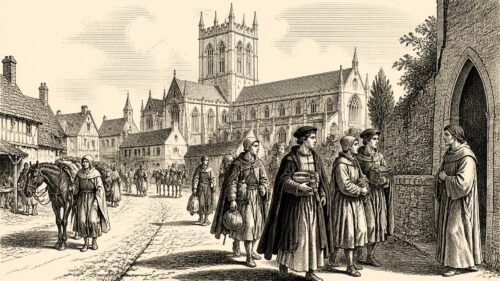
The firmly dated turning point came in the later summer. Clyn placed the first Irish outbreak near Dublin, naming Howth, Dalkey and Drogheda, and stated that it then devastated Dublin and Drogheda. He counted 14,000 deaths in Dublin from the beginning of August until Christmas. The number cannot be treated as a modern demographic total: medieval chroniclers commonly used immense figures to convey calamity, and the population of fourteenth-century Dublin is itself uncertain. Nevertheless, the entry is emphatic evidence that contemporaries experienced a catastrophic mortality in the capital from August 1348.
It is conventional to call this the Black Death, but that was not the language of Clyn or of Irish annalists. They wrote of pestilentia, mortality and plague. The precise biological character of the epidemic, and the proportion of people it killed in particular places, cannot be settled from the sources alone. What is secure is that a fast-moving and terrifying disease reached Ireland by sea in 1348, first striking well-connected coastal settlements. Ships, crews, cargoes, market traffic and the dense human activity of ports linked Ireland to England, Wales, western France and wider European routes; those same connections made the Irish Sea a channel of danger as well as commerce.
Dublin and Drogheda were especially exposed. They were centres of royal administration, trade and shipping, with walled cores but busy suburbs, quays and religious houses beyond or beside their defences. Their loss of inhabitants mattered far beyond their streets. Dublin was the chief seat of English royal government in Ireland; Drogheda was a major port serving the Boyne valley and the north. Disruption there threatened trade, provisioning, tax collection, legal business and communications between the colony and England. It did not require a formal closure of government to make routine administration difficult when clerks, tenants, merchants, clergy and officials were ill, bereaved or afraid to gather.
Fear, Water and Pilgrimage
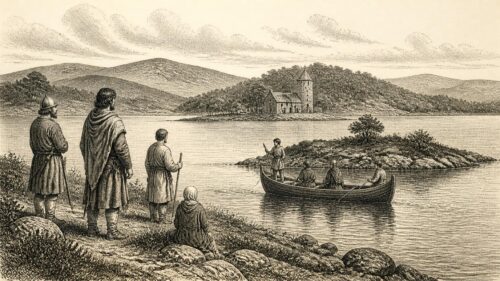
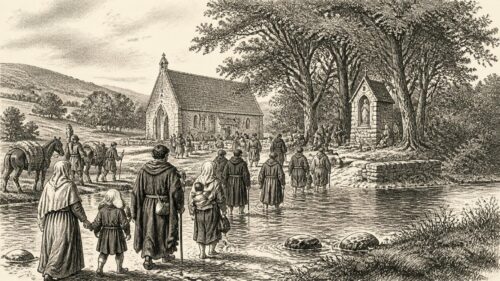
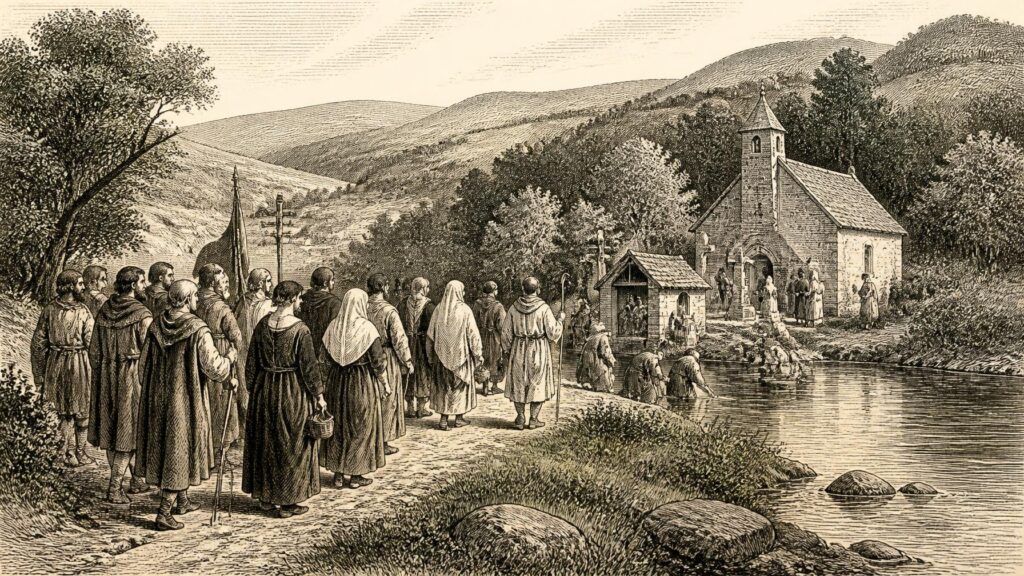
Clyn’s most memorable record of 1348 belongs to September and October. Bishops and other prelates, secular clergy, religious, magnates and people of both sexes came from different parts of Ireland to the pilgrimage and water at Taughmoling. He says that many thousands assembled in companies over several days. Some travelled from devotion; more, he judged, from fear of the pestilence, which was then raging strongly.
This was not an improvised secular refuge. Taughmoling was associated with St Moling and stood within an established landscape of holy places, ecclesiastical memory and local travel. Water, prayer, penance, confession and pilgrimage were familiar means by which medieval Christians sought healing, protection and reconciliation with God. The gathering brought together social ranks usually separated by status and distance: bishops and lords appear beside unnamed women and men. Clyn’s wording does not show that all shared the same expectations, but it does reveal a public religious response on a striking scale.
There is an evident paradox. Pilgrimage answered fear of infection, yet travelling and gathering in crowds could expose people to new contacts. Medieval participants had no germ theory and did not understand transmission in modern terms. They interpreted sudden mass death through religious, moral, natural and astrological ideas available to them. The point is not to dismiss their actions as irrational. In a world where the ordinary protections of household, town and lordship seemed to fail, a holy journey was a practical social act as well as a spiritual one: it offered ritual, companionship, alms, counsel and a place to express terror.
Clyn’s wider plague description records painful swellings and sores, severe headache, and the coughing or spitting of blood. It also conveys the moral anguish caused by contagion: those caring for the sick, including confessors, could perish alongside them, while fear made visiting and burial harder. These observations should be read as contemporary testimony, not as a complete medical diagnosis. They tell us most securely that sickness was rapid, lethal and frightening enough to unsettle the basic Christian duties owed to neighbours and the dead.
Ormond Under Guard
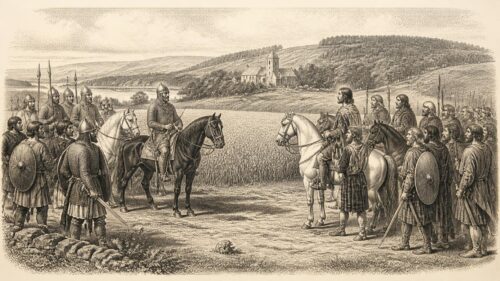
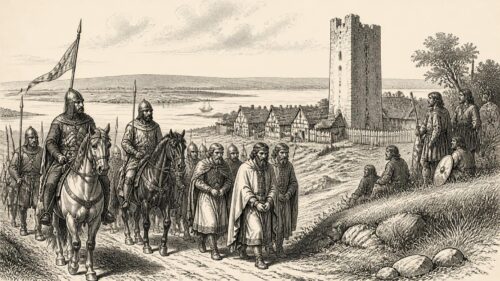
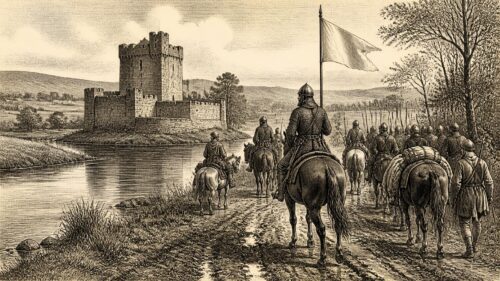
Even as plague reached the eastern ports, warfare and lordship continued to shape daily life. In July and August, Fulk de la Frêne held a substantial guard at Nenagh while responsible for the lands of the absentee earl of Ormond. According to Clyn, he brought back displaced people loyal to the lordship, recalled faithful exiles to their homes, compelled the repair of walls broken by Irish raiders, and extracted heavy payments in cattle and hostages before restoring what the annalist presented as due obedience.
The language is that of a colonial observer and needs to be read critically. ‘Restoration’ for one side could mean exaction and coercion for another. But the entry usefully shows the mechanics of power in a contested frontier lordship. Castles and town walls required labour and supplies; allegiance was reinforced through hostages; cattle were both wealth and a means of payment; and the ability to return tenants or followers to their holdings was politically important. Nenagh’s garrison was not simply a military matter. It was an attempt to re-establish rents, cultivation, security and a lord’s authority after conflict.
On 11 November, the earldom of Ormond and its royal rights were granted to James Butler the younger. This was a significant dynastic and governmental act, though it did not create instant tranquillity on the ground. The Butler lordship lay across a region where English, Anglo-Irish and Gaelic interests overlapped and fought. The events at Nenagh demonstrate that formal grants from the Crown depended on local force, negotiated loyalty and material resources.
Clyn also recorded that Richard, bishop of Ossory, obtained at the papal court an exemption from the jurisdiction and superiority of the archbishop of Dublin. This was a specific ecclesiastical development of 1348, reminding us that church government was not a mere background to political life. Diocesan status, metropolitan authority and access to the papal curia mattered to bishops, chapters and patrons. At the same time, the plague placed exceptional strain on the clergy whose sacramental and pastoral work brought them into close contact with the dying.
Connacht’s Continuing Wars
The west was not silent in 1348, although the detailed contemporary notice of plague belongs principally to the eastern and southern sources. The Annals of Connacht record the death of Cathal Ó Fergail, who had held the chieftainship of Annaly for only half a year; the killing in treachery of Niall Garbh Ó Domnaill by Magnus ‘the Deceitful’ Ó Domnaill; and the deaths of Maelsechlainn Mag Oirechtaig of Muinter Raduib and Donnchad Mag Brátaig of Cúil Brigdin. Such entries show political authority remaining personal, kin-based and vulnerable to sudden death or violence.
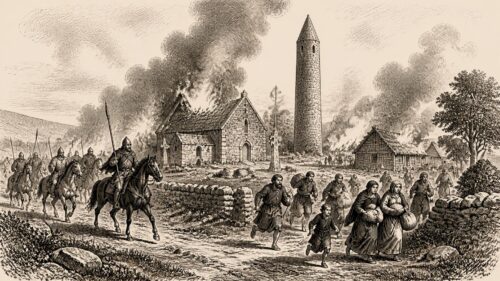
More consequentially, war erupted between Fergal Mac Diarmata and Ruaidhrí, son of Cathal, in Moylurg and its Connacht setting. Ruaidhrí’s side burned Mac Diarmata’s stronghold. Mac Diarmata then assembled allies, pursued his opponent to Ballymote, burned the settlement ‘stone and wood’, and carried off hostages, including a son of Ó Ruairc. The annal’s phrase stresses a destructive raid rather than the capture of a permanently occupied town. Hostages were political securities: their seizure could bind an opponent, compel negotiation or mark a shift in the balance among rival kindreds.
The Annals of Ulster add that Aodh Ó Ruairc was captured while returning from Croagh Patrick by the son of Philip MacWilliam, and that Fergal Mac Diarmata rose in consequence, bringing general war to Connacht and ravaging Moylurg. The same annals record a general summons by William Ó Ceallaigh to the learned poets of Ireland, who came and departed satisfied. That compact notice matters. Amid raids, captures and uncertainty, networks of poets and learned families still crossed lordships, received patronage and maintained the cultural work of praise, genealogy, law and historical memory.
A Year of Thresholds
It would be misleading to claim that all Ireland experienced the plague in the same way or at the same moment in 1348. Later annals place a great plague in Moylurg and throughout Ireland under 1349, while manuscript notes show that the crisis endured into 1350. The difference is meaningful: 1348 was the year of securely recorded arrival, severe mortality in the Dublin–Drogheda zone, and the fearful pilgrimage at Taughmoling; it was not the end of the epidemic’s reach or consequences.
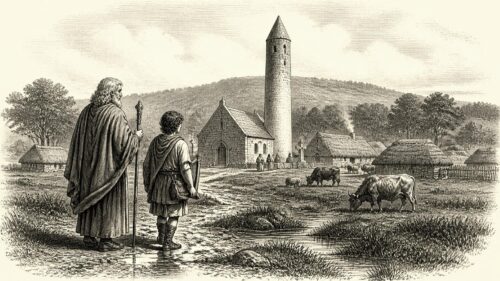
For those alive that year, however, the threshold had already been crossed. Ireland’s ports had carried not only goods, people and royal news but devastating disease. Pilgrims sought divine aid at St Moling’s water. Lords repaired walls, took hostages and tried to reassert control. Connacht kindreds fought for strongholds and securities, while poets still answered a patron’s call. The records preserve these developments side by side, and that is the essential character of 1348: a society still conducting its accustomed business of war, worship, travel and learning, suddenly forced to do so in the shadow of unprecedented mortality.
Source References
Hover over a number to see the source. Select it to open the source.
- [1] The Annals of Ireland
- [2] Annalium Hiberniae Chronicon ad annum MCCCXLIX, annal 1348
- [3] The Annals of Ireland by Friar John Clyn and Thady Dowling
- [4] Annála Connacht
- [5] Annála Connacht, Annal 1348
- [6] Annala Uladh: Annals of Ulster otherwise Annala Senait, Annals of Senat
- [7] The Annals of Ulster
- [8] Annals of Loch Cé
- [9] Annals of Loch Cé, Part 1
- [10] Annals of the Four Masters
- [11] A Tract on the Plague
- [12] Annales Breves Hiberniae
- [13] The Dublin Annals of Prior John de Pembridge OP and his Dominican continuator
- [14] ‘Unheard-of Mortality’… The Black Death in Ireland
- [15] Two Nations, One Order: The Franciscans in Medieval Ireland
- [16] Ireland
- [17] The Identification of Some Pestilences Recorded in the Irish Annals
- [18] Annals of Ireland by Friar John Clyn, ed. Bernadette Williams
- [19] The Hospital in Medieval Ireland, 1170–1540: an Archaeology
- [20] Plagues, Pandemics and Epidemics in Irish History Prior to COVID-19
- [21] St Moling's Holy Well
- [22] Decline of the Norman Colony
- [23] The Annals of Ireland by Friar John Clyn: Edited and Translated with an Introduction by Bernadette Williams
Primary Sources
- The Annals of Ireland
- Annalium Hiberniae Chronicon ad annum MCCCXLIX, annal 1348
- The Annals of Ireland by Friar John Clyn and Thady Dowling
- Annála Connacht
- Annála Connacht, Annal 1348
- Annala Uladh: Annals of Ulster otherwise Annala Senait, Annals of Senat
- The Annals of Ulster
- Annals of Loch Cé
- Annals of Loch Cé, Part 1
- Annals of the Four Masters
- A Tract on the Plague
- Annales Breves Hiberniae
- The Dublin Annals of Prior John de Pembridge OP and his Dominican continuator
- ‘Unheard-of Mortality’… The Black Death in Ireland
- Two Nations, One Order: The Franciscans in Medieval Ireland
- Ireland
- The Identification of Some Pestilences Recorded in the Irish Annals
- Annals of Ireland by Friar John Clyn, ed. Bernadette Williams
- The Hospital in Medieval Ireland, 1170–1540: an Archaeology
- Plagues, Pandemics and Epidemics in Irish History Prior to COVID-19
- St Moling's Holy Well
- Decline of the Norman Colony
- The Annals of Ireland by Friar John Clyn: Edited and Translated with an Introduction by Bernadette Williams