Ballymote’s First Stones1300 CE
In 1300, construction began at Ballymote Castle in County Sligo, probably under Richard de Burgh, the Red Earl of Ulster and lord of Connacht. The fortress signalled and supported de Burgh influence in contested Corran, though Gaelic and settler powers remained varied and interconnected. Annalistic notices associate deaths in the earl’s household with this period, highlighting succession’s importance, but dating is uncertain. Meanwhile, justiciar John Wogan ordered provisions from Irish ports for Edward I’s Scottish war. Castle-building, royal requisitioning, trade, labour, religious institutions, and local violence reveal Ireland as a politically fragmented yet increasingly interconnected island within wider overseas affairs.

Dateline
In 1300, one of the clearest new statements of power in Ireland was made in stone. The Annals of the Four Masters record that construction began at Ath-cliath-an-Chorainn, the site of Ballymote Castle in modern County Sligo, “by the Earl”. Later tradition and surviving historical interpretation identify that earl as Richard de Burgh, earl of Ulster and lord of Connacht, widely known as the Red Earl. The entry does not supply a day or season, nor does it prove that every part of the imposing castle standing today was completed within the year. It does, however, responsibly place the beginning of this major fortress in 1300.
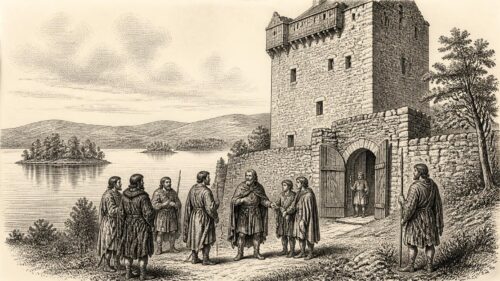
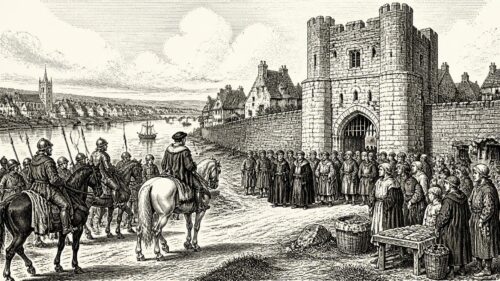
Ballymote mattered because it stood in a contested Connacht. It was not simply a private residence or an isolated military outpost. A castle of this kind was a declaration that de Burgh authority was to be made durable in the landscape: men could be stationed there, supplies collected, local routes observed and a lord’s claims enforced. Its construction expressed the reach of one of the most powerful magnates in Ireland, whose interests joined Ulster, Connacht and the English king’s wider dominions. Yet the need to begin such a fortress also reveals the limits of that power. Western and north-western Ireland remained politically plural, with Gaelic rulers, kindreds and churchmen retaining their own bases of authority.
A Fortress in Corran
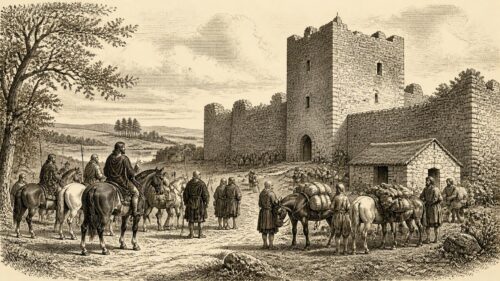
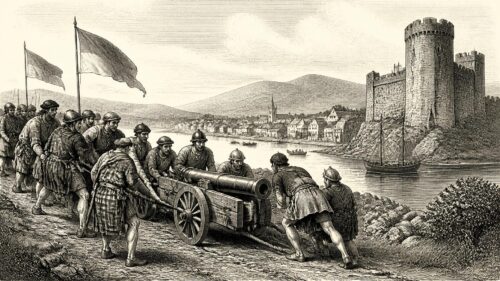
The place later called Ballymote lay in the territory of Corran, on a route between the plains around Boyle and the north-western coast. The surviving castle is an unusually ambitious enclosure: broadly square, with substantial curtain walls, corner towers, additional projecting towers and a twin-towered gatehouse. Such features must not be projected wholesale back onto the first months of work in 1300. Building a great stone castle was a prolonged undertaking, dependent upon quarrying, transport, skilled masons, labourers, timber and food. Nevertheless, the scale of the completed monument helps explain why its commencement was memorable enough to enter the annalistic tradition.
For Richard de Burgh, the project belonged to a longer pattern of castle-building and lordship in Connacht. The de Burgh family’s power had grown through royal grants, marriage, warfare and negotiated relationships with local rulers. Their holdings were not a neatly controlled province. Rather, they were a patchwork of lordships in which castles, towns, rents, alliances and armed followings all mattered. Ballymote was therefore a frontier instrument: a place from which an earl could seek to hold recently acquired influence in Sligo, while also signalling that authority had a physical and permanent form.
It would be misleading to call this a simple confrontation between “Norman” newcomers and an undifferentiated Irish population. By 1300, descendants of the Anglo-French and Welsh settlers of the twelfth century had lived in Ireland for generations; their estates, languages and interests were rooted in the island. Gaelic political society was likewise diverse. Kings and leading men competed within their own dynasties, made agreements across cultural boundaries and could exploit disputes among colonial magnates. Ballymote’s foundation belongs in that changing, interconnected political world.
The Earl’s Household
The year also carried personal losses for de Burgh’s comital household. The Annals of Ulster, under its entry headed U1300, record the death of the countess, wife of Richard de Burgh, and of Walter de Burgh, described as the earl’s heir. There is an important chronological caution here. The annal heading itself is rendered “A.D. 1300–4”, and other genealogical evidence assigns deaths within this family differently. The entries should therefore be treated as evidence that the annalist associated such losses with this short period, not as secure proof that both deaths occurred in the calendar year 1300.
Even with that reservation, the notice exposes a central vulnerability of aristocratic rule: succession. A lordship held together by land, service and personal lordship could be unsettled when a wife, child or designated heir died. The question was not merely who inherited property. It affected marriage alliances, wardship, military leadership and the confidence of tenants and allies. For a magnate investing in a new Sligo stronghold, the stability of the family line was inseparable from the stability of power on the ground.
Resources Drawn North
The most firmly dated documentary evidence from 1300 points eastward, across the Irish Sea, to Edward I’s war in Scotland. John Wogan, justiciar of Ireland since 1295, governed in the king’s name from Dublin and was deeply involved in extracting men, money and supplies for royal campaigns. Ireland was not remote from this conflict. Its ports, merchants, magnates and public revenues were repeatedly drawn into the king’s military requirements.
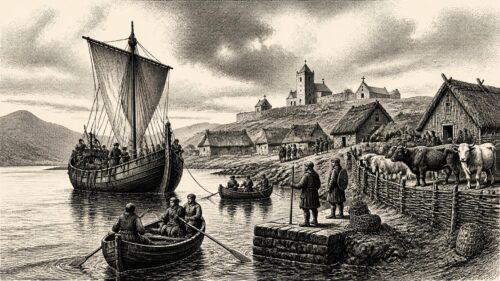
Records preserved in the Calendar of Documents relating to Ireland show Wogan issuing orders at Dublin in late October 1300 for provisions to be bought and shipped to Skinburness, on the Cumbrian coast opposite south-west Scotland. Providers in Waterford were to obtain wheat, malt and wine; comparable purchases were ordered in Dublin and at Drogheda and Meath. These are unusually vivid glimpses of the practical machinery behind distant war. Grain had to be assembled, drink sourced, credit arranged, containers supplied, ships found and cargoes safely dispatched through autumn weather.
The orders should not be mistaken for a full account of Irish commerce, nor do they show that every community benefited from or even encountered the trade directly. They do show that the ports of the lordship could be coordinated for royal supply. Waterford, Dublin and Drogheda connected their agricultural hinterlands with sea routes reaching England and Scotland. Wheat and malt in official requisitioning records also remind us that cultivated grain, brewing and stored food were vital parts of the economy alongside livestock, hides, wool and fisheries.
The burden of royal warfare was real. Edward I’s campaigns placed sustained demands on the Irish administration at a time when government income was under pressure. The crown expected the lordship to provide military help, victuals and cash, while Irish officials still had to maintain courts, castles and local security. In this sense, the first work at Ballymote and the provisioning orders from Dublin were connected developments. One represented a magnate’s investment in regional control; the other the crown’s ability to channel Irish resources into a war beyond the island.
Lordship, Work and Everyday Provision
For most people, 1300 was experienced not through annals or chancery orders but through work and obligation. Labourers cultivated grain, tended cattle and sheep, cut turf and timber, maintained roads and crossings, and carried produce to local markets or lordly stores. Castle construction created demand for food, haulage, quarrying and specialist crafts, but it could also impose demands on neighbouring communities. The sources do not permit a reconstruction of the individual workers who began Ballymote, their wages or whether they came voluntarily. It is safer to recognise the scale of organisation required than to invent a detailed building-site scene.
The late thirteenth-century commercial expansion had brought Ireland’s ports into a broad Atlantic and North Sea trading network. Dublin’s merchant community had contacts extending far beyond Ireland, while hides, wool and other animal products moved outward from port hinterlands. Yet prosperity was uneven. Coined exchange and urban trade were most concentrated within the English lordship, whereas many Gaelic territories continued to operate through distinctive systems of tribute, hospitality, cattle wealth and lordly exactions. The island’s economy was linked, but not uniform.
Church and Commemoration
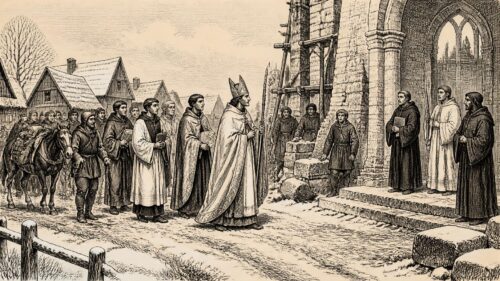
Religion ran through both political and daily life. The Dublin administration’s accounts for 1300 include royal alms for friars in Dublin, Cork, Waterford, Limerick and Drogheda. These payments demonstrate that mendicant religious houses were sufficiently established in the towns to receive recognised support from government. Franciscans and Dominicans preached, heard confession, buried the dead, educated novices and maintained ties with lay patrons. Their urban presence connected Irish towns with the wider religious culture of western Christendom.
The Annals of the Four Masters also place the death of Congalach Ó Lochlainn, bishop of Corcomroe, in 1300, praising him for learning, hospitality and piety. As with many annalistic obituaries, the surviving wording is shaped by the values of the compiler and does not provide a modern biography. Still, its emphasis is revealing. A bishop’s standing was measured not only by sacramental office but by learning, generosity and the protection or feeding of dependants. In a society where ecclesiastical institutions owned land, offered hospitality and preserved learning, the death of a bishop could be a significant local event.
A Year of Foundations
Other notices entered under 1300 include the death of Felim Mac Carthaig, described as heir to the lordship of Desmond, and killings involving John Prendergast, the Ó Flynns and the Mac Maurices. These brief records should not be inflated into evidence for island-wide war. They do, however, show that succession, feud and violence were recurrent features of aristocratic and kin-based politics in Munster as well as Connacht. Annals often preserve the names of the powerful and the slain, while leaving the experience of the wider population largely unrecorded.
What makes 1300 distinctive is the conjunction of a securely dated building initiative at Ballymote and securely dated governmental provisioning for Scotland. Both point to Ireland’s place in a wider political world. The Red Earl’s new castle looked to the consolidation of power in north-west Connacht. Wogan’s orders directed food and drink from Irish towns towards Edward I’s northern war. Neither development ended local autonomy or made the island politically united. Instead, they capture medieval Ireland as it was: a landscape of overlapping lordships, fortified places, busy ports, religious communities and competing claims, bound increasingly to events across the Irish Sea while retaining strong regional worlds of its own.
Primary Sources
- The Annals of Ulster: Year U1300
- Annals of the Four Masters: Annal M1300
- Annals of Inisfallen: Annal AI1300
- Annála Connacht: The Annals of Connacht
- Annales Hibernie ab anno Christi 1162 usque ad annum 1370
- CELT Project: Annals of Ulster Otherwise Annala Senait
- List of Published Texts at CELT
- Calendar of Documents Relating to Ireland, Preserved in Her Majesty's Public Record Office, London, 1171–1307
- Wogan, John
- Butler (le Botiller), Edmund
- Burgh, Richard de
- Ballymote Castle
- Visit Ballymote Castle with Discover Ireland
- Ballymote
- Irish Castles: 1180 to 1310
- From Boom to Bust: The Lordship of Ireland and the European ‘Commercial Revolution’
- English Lords in Late Thirteenth and Early Fourteenth Century Ireland: Roger Bigod and the de Clare Lords of Thomond
- The Impact of the Bruce Invasion, 1315–27
- The Last Kings of Ireland: Material Expressions of Gaelic Lordship c.1300–1400 A.D.
- English Rule in Ireland, c.1272–c.1315
- Inquisitions Post Mortem: Inquisitions and Extents of Medieval Ireland
- Calendar of Ormond Deeds, Volume I, 1172–1350