The Red Earl’s Hostages1295 CE
In 1295, Ireland remained divided among Anglo-Irish lordships, Gaelic kingdoms and church lands, where authority depended on negotiation, hostages and armed force. At Kilkenny, Richard de Burgh, the Red Earl, was released after hostages guaranteed a settlement with John fitz Thomas FitzGerald. Thomas fitz Maurice, acting as royal keeper, secured temporary submissions from Wicklow groups through fines and hostages. John Wogan became justiciar, tasked with preparing Irish resources for Edward I’s Scottish war. Annals also record dynastic killings, contested successions, plunder and expulsions in northern and southern regions, revealing persistent regional conflict despite royal efforts to restore order and stability.
Dateline
The surviving evidence for 1295 reveals no single event that governed the whole island. Instead, it shows Ireland as a patchwork of lordships, Gaelic kingdoms, church lands and colonial districts, connected by diplomacy and war but never governed uniformly. Firmly dated administrative records chart a change of royal personnel and efforts to restrain powerful magnates. The annals, whose chronological systems must be read with care, preserve regional killings, rival successions and the destruction caused by local war. Together they make 1295 a year in which hostages, negotiated settlements and armed followings were central instruments of power.
A Prisoner Released at Kilkenny
The most consequential settlement concerned Richard de Burgh, earl of Ulster and lord of Connacht, remembered as the Red Earl. He had been seized by John fitz Thomas FitzGerald in December 1294 amid a widening struggle for influence in Connacht and Leinster. Contemporary and near-contemporary annalistic traditions describe the capture as a disturbance affecting all Ireland: a revealing phrase, not because every district was at war, but because two of the lordship’s greatest Anglo-Irish powers had turned against one another.
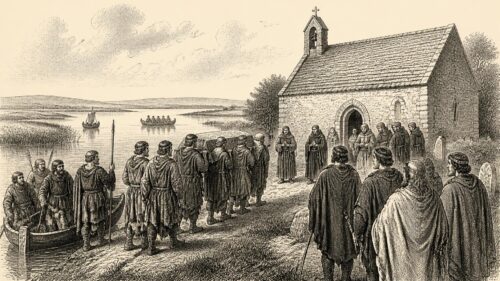
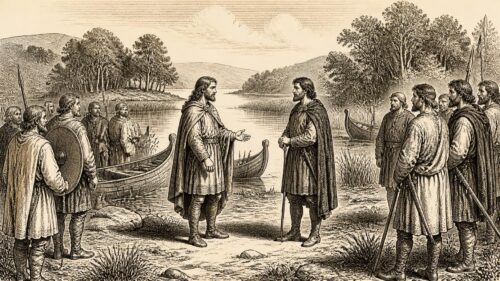
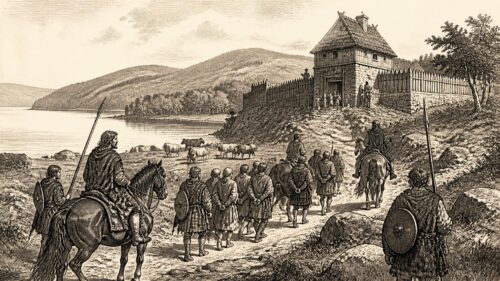
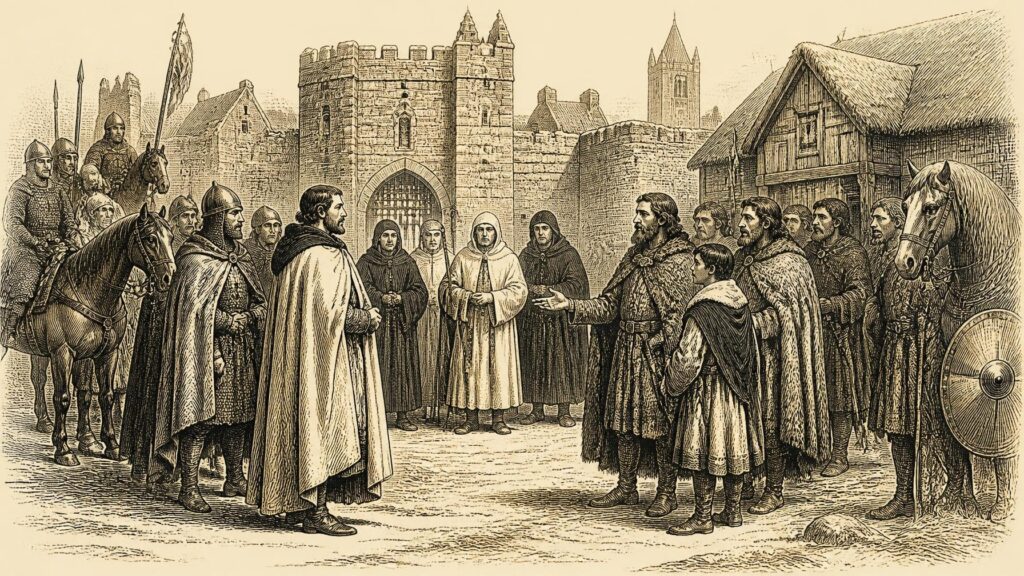
In March 1295, a parliament at Kilkenny negotiated de Burgh’s release. The settlement was made under the king’s authority, and the annals record that the earl went free only when substantial hostages from his own kindred were accepted in his place. Such hostages were political securities. Their delivery bound a lord’s wider family to an agreement, while their continued safety depended on the conduct of the man whose promises they guaranteed. This was therefore not a simple private reconciliation between two aristocrats. It was an attempt to put the king’s authority back into a feud that had disrupted Connacht, Kildare and the wider English lordship of Ireland.
The peace was necessarily limited. John fitz Thomas had built a formidable position through lands and claims in both Leinster and Connacht; de Burgh possessed an earldom, extensive lordship and deep connections across Ulster and the west. Neither could be made politically insignificant. The 1295 arrangement released the earl and created obligations, but it did not erase the competing interests that had produced the crisis. Later agreements would still be required. What mattered in this year was the restoration of a measure of formal order after an extraordinary affront to one of Ireland’s leading magnates.
Castledermot and Royal Order
Royal government did not stand still while the dispute was being settled. On 19 April 1295 Thomas fitz Maurice FitzGerald was appointed custos, or keeper, by the king’s Irish council, following the death of William de Oddingsells. His tenure lasted until the arrival of the new justiciar late in the year. The appointment shows that government in the lordship relied not on a permanent impersonal bureaucracy, but on great landholders who could summon men, travel with armed retainers and exercise judicial authority.
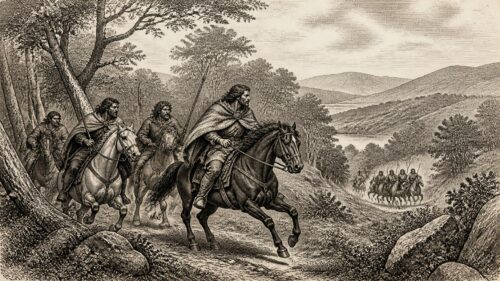
Thomas’s immediate concern lay in the Wicklow mountains and their approaches. He summoned royal service to Castledermot and persuaded both de Burgh and John fitz Thomas to appear with their retinues. By early summer, he had brought the MacMurroughs, O’Tooles and O’Byrnes to terms, taking hostages for future good conduct and imposing fines for damage attributed to their forces. This was neither the conquest of Wicklow nor the end of frontier conflict. It was a practical, short-term settlement: armed pressure, fines and personal guarantees intended to reopen the routes and settlements exposed to raiding from the uplands.
The episode gives a rare view of how politics affected ordinary communities. A call to royal service meant that lords assembled mounted men, servants and supplies; a fine transferred wealth from defeated groups; and hostages brought the consequences of agreement into households and kin networks. Yet the sources do not permit a confident reconstruction of the numbers involved, the precise settlements affected or the burdens on every tenant. Their value lies in demonstrating the mechanisms by which authority was asserted in 1295, rather than in supplying a complete social census.
John Wogan’s Arrival
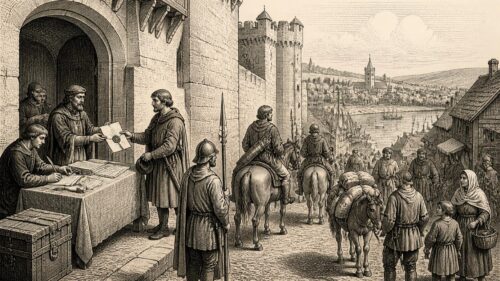
A more enduring change came from outside Ireland. Edward I appointed John Wogan justiciar on 18 August 1295, and Wogan had arrived in the lordship by 3 December. The justiciar was the king’s chief governor in Ireland, expected to supervise administration, justice and military mobilisation. Wogan’s appointment brought a seasoned royal servant to a political environment strained by magnate rivalry and regional warfare.
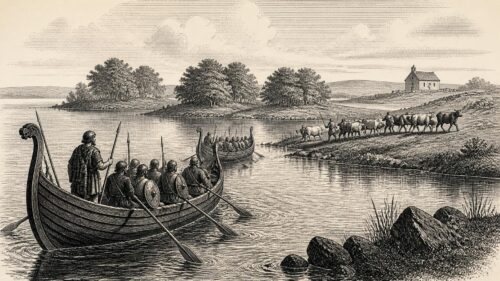
Edward’s first instruction to him was strikingly direct: Ireland was to provide significant forces and supplies for the king’s forthcoming Scottish campaign. This demand places Irish affairs in a wider archipelagic setting. The crown did not regard the lordship only as a territory to be defended; it also expected men, food and logistical support for wars beyond the Irish Sea. No Irish expedition had yet sailed in 1295, so it would be wrong to place the later Scottish campaigning in this calendar year. But by December the administrative preparation had begun, and Wogan’s government was shaped from the outset by that external demand.
Violence and Succession in the North
Outside the royal administration, the annals record political violence of a different kind. In Cenél nEógain, Brian, son of Áed Buide Ó Néill, was killed by Domnall, son of Brian Ó Néill. The annalist adds that a great slaughter was made among the English and Irish who were with him. The entry does not give a secure battle-site or a full explanation of the competing claims, but it makes plain that Gaelic dynastic conflict could draw in mixed forces and could not be reduced to a simple opposition between “Irish” and “English”. Alliances followed lordship, kinship and immediate advantage.
In Tír Chonaill, Hugh, son of Domnall Óg Ó Domhnaill, and his brother Toirrdelbach fought over the lordship. The account is unusually explicit about the cost: much of the country was damaged between them, including both ecclesiastical and lay property. Toirrdelbach was subsequently deposed and expelled from Tír Chonaill towards Cenél nEógain and the Clann Domhnaill. The sequence illustrates the precariousness of succession in a political order where a claimant required not merely ancestry but the active support of kindred, clients and fighting men.
A southern annal records another grave loss in the war of Clann Briain: Áed Ruad Ó Cuiléin, members of Clann Briain and more than twenty of his kinsmen were killed. The notice gives too little detail to assign a precise location, cause or wider outcome, and should not be inflated into a general war across Munster. It nevertheless confirms that 1295 brought lethal conflict to more than one region.
Lordship, Religion and Memory
Deaths recorded in the annals also show how political and religious ideals overlapped. Domnall Ó Cellaigh, lord of Uí Maine, died in the habit of a monk and was buried at Knockmoy. He was praised as a man of wise counsel, language that tells us as much about the values expected of a ruler as about his personal character. A lord was judged not only by military capacity, but by judgement, generosity, piety and the ability to sustain relationships among dependants and allies.
In Corcachlann, Conn Mac Branáin died, and Tomaltach Mac Branáin, chosen to succeed him, was soon killed by Muintir Chonalláin in vengeance for an earlier killing. The compressed entry is a reminder that succession could be immediately contested and that feud could outlast the death of the person who had caused it. At Knockmoy, meanwhile, burial in a religious house linked the memory of a regional ruler to prayer, monastic patronage and a respected sacred landscape.
There is no securely dated evidence for a major new Irish school, manuscript commission, town charter or commercial reform in this particular year. Nor is there a reliable 1295 annal entry allowing a national statement about harvests, prices or weather. That absence matters. The year is best understood through its demonstrable political settlements, military pressures and regional conflicts, rather than through invented claims of island-wide prosperity or crisis.
An Island Drawn Outwards
Irish writers also noticed the wider wars of Edward I. The Annals of Inisfallen record the English king’s campaign against the Welsh and the movement of many Welshmen to the war in Gascony against France. For Ireland, the immediate relevance was the expanding reach of royal warfare. Wogan’s appointment and his orders for Scottish service show that the lordship’s resources were being drawn into the king’s contests in Britain and France.
Thus 1295 closed with two contrasting forms of political action. At Kilkenny and Castledermot, Irish and Anglo-Irish leaders used parliament, service, fines and hostages to contain disputes. In Tír Chonaill, Cenél nEógain and other regions, rivalries were pursued through killing, plunder and expulsion. John Wogan’s arrival did not resolve those fractures, but it marked the beginning of a longer attempt to make the king’s government more present in a land where authority still depended heavily on negotiated obedience.
Primary Sources
- Annals of the Four Masters, Annal M1295 (English translation)
- Annals of the Four Masters, Annal M1295 (Irish text)
- Annals of the Four Masters: CELT edition index
- Annals of Ulster, Year U1290: capture of Richard de Burgh
- Annala Uladh: Annals of Ulster otherwise Annala Senait, Annals of Senat
- Annals of Inisfallen, Annal AI1295
- Annals of Inisfallen: Irish text and bibliographical record
- Annales Hiberniae
- Annales Breves Hiberniae
- Annála Connacht
- Annála Connacht, 1288 entries concerning Richard de Burgh
- Wogan, John
- Burgh, Richard de
- FitzGerald, John fitz Thomas
- FitzGerald, Thomas fitz Maurice
- Butler (le Botiller), Theobald
- Calendar of the Justiciary Rolls or Proceedings in the Court of the Justiciar of Ireland
- The Medieval Irish Plea Rolls: An Introduction
- Henry Savage Sweetman: The Man Who Uncovered Ireland’s Medieval History
- Calendar of the Patent Rolls Preserved in the Public Record Office: Edward I, 1292–1301
- Medieval Maritime Personnel and Ships
- Courting the Past