Connacht Submission1292 CE
In 1292, Richard de Burgh, earl of Ulster and lord of Connacht, sought to enforce authority through campaigning, negotiation and violence. His advance to Roscommon failed to secure hostages from Magnus Ó Conchobair, but Magnus later submitted at Meelick and gained concessions. De Burgh’s raid on Leyney devastated resources without securing Domnall Ó hEgra’s obedience, while Mac Cochlain of Delvin was killed on his orders. Dynastic deaths further unsettled Connacht. In the south, Edward I settled Thomas fitz Maurice FitzGerald’s inheritance, regranting Decies, Desmond and Dungarvan under revised terms. These events exposed Crown authority’s dependence on continually unstable local agreements.
Dateline
In 1292, the most clearly recorded Irish developments lay in Connacht and its borderlands, where the authority of Richard de Burgh, earl of Ulster and lord of Connacht, was tested through campaigning, negotiation and targeted violence. The year did not produce a single island-wide turning point. Instead, its surviving evidence shows how power worked in late thirteenth-century Ireland: through mounted hostings, the taking or withholding of hostages, tribute and submission, castle-centred lordship, and the capacity to damage a rival’s crops, cattle and dependants.
It was also a year in which royal administration made a consequential settlement in the south. On 6 February, Edward I resolved a long-running dispute over the inheritance of Thomas fitz Maurice FitzGerald. The decision reshaped the legal basis of lordship in Decies and Desmond, including the strategically important castle and borough of Dungarvan. Taken together, the Connacht campaigns and the southern settlement reveal an Ireland in which Crown authority, Anglo-Irish magnates and Gaelic ruling families constantly negotiated the practical limits of their power.
Richard de Burgh’s Connacht
The fullest year-entry comes from Annála Connacht, whose annalist records that “the Earl” led a hosting against Magnus Ó Conchobair and reached Roscommon. In this context the Earl was Richard de Burgh, head of the powerful de Burgh lordship in Connacht as well as earl of Ulster. Magnus was king of Connacht, but his position, like that of other Gaelic rulers, depended upon the support of kin-groups and subordinate lords as well as military standing. The expedition reached Roscommon without obtaining either pledges or hostages. That mattered: hostages were not decorative trophies, but a means of enforcing an agreement and deterring renewed resistance.
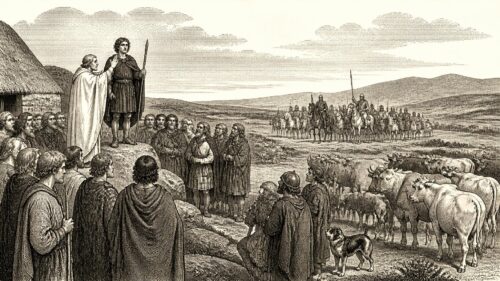
The apparent failure did not end the affair. Magnus followed the earl to Meelick and made submission, despite opposition within Connacht; the annalist says that his petitions were then granted. The wording is unusually revealing. It does not describe a simple conquest, nor an unconditional capitulation. Magnus had to travel to the earl and acknowledge a superior position, but he also secured requests of his own. The settlement was therefore personal and political, made between rulers whose authority still required the co-operation of local followers.
Meelick was a meaningful setting for such an encounter. Situated on the Shannon corridor, it connected the southern approaches to Connacht with routes towards Munster and the midlands. A meeting there illustrates the geographical reach of de Burgh power, but also the difficulty of ruling Connacht merely from castles and garrisons. The earl’s advance to Roscommon had not extracted the guarantees he wanted. A submission concluded afterwards at Meelick was more useful than an extended destructive campaign, provided that it could be honoured.
Raid, Refusal and Food Supply
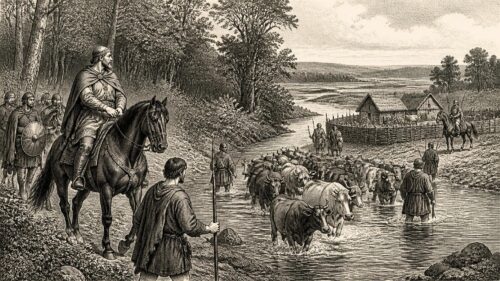
Richard de Burgh then led another hosting into Leyney, the territory broadly associated with the north of modern County Sligo and adjoining districts. His force plundered “the greater part” of the country, yet Domnall Ó hEgra neither submitted nor gave pledge or hostage. The contrast with the Meelick settlement is important. De Burgh could bring armed men into Leyney and inflict material loss; that did not automatically produce obedience.
The annal’s brief language gives a rare glimpse of what warfare meant away from formal encounters between leaders. Plunder was directed at movable wealth and the productive resources that sustained a lord and his people. Crops, livestock, food stores and household goods were vulnerable, while seasonal farming made communities particularly exposed to raiding armies. Such operations were not incidental disorder. They were a deliberate political instrument: to impose costs on resistance, reward followers with booty and demonstrate that a rival could not protect his dependants.
Yet the refusal of Ó hEgra shows the limits of that instrument. A territorial lord who would not provide hostages retained room to manoeuvre, even after devastation. The survival of local autonomy depended less on an abstract frontier between “English” and “Irish” Ireland than on shifting local alliances, access to fighting men, defensible landscapes and the willingness of neighbours to co-operate. In 1292, Connacht was not a passive possession of the earl. It was a lordship in which de Burgh authority had to be enacted repeatedly, and where the outcome of one expedition could remain incomplete.
Violence in Delvin
Elsewhere in the midlands, the annalist recorded a more direct assertion of lordly authority. Mac Cochlain, king of Delvin, was killed by Sefin Mac Feorais at the earl’s command. The entry supplies neither a date nor a detailed cause, so it would be unsafe to invent a battle, a trial or a personal quarrel behind it. Its essentials are nevertheless stark: a ruler of Delvin was killed by an agent acting on the earl’s order.
Delvin More lay in the contested zone west of the Shannon, where Gaelic dynasties, de Burgh influence and other Anglo-Irish interests met. The killing demonstrates that political control could be exercised through delegated violence as well as large hostings. It also helps explain why submission and hostage-giving mattered so much. A ruler who accepted an overlord’s terms might preserve office and lands; one judged dangerous could face dispossession or death. The sources do not permit a conclusion about Mac Cochlain’s alleged offence, but they do place his death within the hard politics of regional lordship.
The year’s Connacht notices also record the killing of Niall Gelbuide Ó Conchobair by Tadc son of Andrias Ó Conchobair and Tuathal son of Muirchertach. Donnchad, son of Eogan Ó Conchobair, died in the same year. These short notices underline the density of rivalry within the wider Ó Conchobair kindred. Kingship in Connacht was not transmitted automatically from father to eldest son. Senior branches, military reputations and alliances with powerful neighbours could all matter. The deaths of prominent kinsmen therefore had consequences beyond private family grief: they altered the field from which future claimants and coalitions might emerge.
Dungarvan and Royal Terms
The southern evidence is of a different kind. On 6 February 1292, the Crown’s long dispute with Thomas fitz Maurice FitzGerald was settled. Thomas formally surrendered his claimed rights in Decies and Desmond, and Edward I regranted the lordship to Thomas and his wife Margaret Berkeley. The terms were substantial but carefully qualified. Thomas lost his claim to the hereditary shrievalties of Cork and Waterford, while the regrant was held at a reduced annual rent of 200 marks. The settlement also included custody of Dungarvan castle.
This was not simply an act of royal generosity or a bureaucratic adjustment. Decies and Desmond contained productive lands, established lordships, ports and routes linking the south coast, Cork, Kerry and Munster’s interior. Dungarvan, with its castle and borough, was particularly valuable as a centre of defence, revenue and local administration. By redefining Thomas’s tenure, the Crown preserved the principle that these lands remained subject to royal authority while restoring a major Geraldine lord to a workable position.
For tenants, clergy, townspeople and lesser landholders, such settlements could have practical consequences. Lordship determined to whom rents, services, homages and legal obligations were owed, who commanded castles, and which officials exercised coercive authority. The surviving record does not describe a celebration in Dungarvan or a sudden alteration in daily routines. It does show that the arrangements governing those routines were being recast at the highest level. Margaret’s inclusion in the grant also matters: aristocratic marriage and joint tenure were central mechanisms through which estates, inheritance and political connections were secured.
An Uneven Political Landscape
William de Vescy remained justiciar of Ireland in 1292, representing the king’s government in Dublin. His administration was active in legal and financial matters, but the year’s events reveal how limited any central government could be in the face of great lordships. De Burgh could negotiate Connacht’s kingship through hostings and submissions; Thomas fitz Maurice could bargain with Edward I over the terms of a vast southern inheritance; local rulers such as Domnall Ó hEgra could still refuse the pledges demanded of them.
The annals also preserve smaller notices which should not be overlooked. Somairle Ó Gairmlegaig was killed by Ó Néill, while Aindiles Ó Dochartaig, chief of Ardmire, died. Such entries remind us that Irish political life extended far beyond the best-documented struggle in Connacht. They also show the character of the evidence: deaths and killings were recorded because rank, kinship and lordship made them historically significant to annalists, whereas the experiences of most cultivators, traders, craftworkers and religious households appear only indirectly.
Care is needed with the chronology. An entry labelled 1292 in the Annals of Ulster describes an expedition in Scotland involving Richard de Burgh and John fitz Thomas FitzGerald, but the campaign it describes belongs to 1296, not to this calendar year. It should not be used to inflate Ireland’s story for 1292. What can responsibly be placed in 1292 is already substantial: a negotiated but unequal settlement at Meelick, devastation and defiance in Leyney, a commanded killing in Delvin, dynastic losses among the Ó Conchobairs, and a Crown-sanctioned restructuring of lordship around Dungarvan.
These were connected developments. They show that power in Ireland rested not on fixed boundaries but on the continuing ability to secure obedience, hostages, rent, service and recognition. In 1292, neither Richard de Burgh’s army nor Edward I’s legal settlement erased local interests. Each instead created a new, temporary arrangement in a political landscape that remained intensely competitive.
Source References
Hover over a number to see the source. Select it to open the source.

- [1] Annála Connacht, Annal 1292
- [2] The Annals of Ulster, Year U1292
- [3] Annala Uladh: Annals of Ulster otherwise Annala Senait, Year U1292
- [4] Annals of the Four Masters, Annal M1292
- [5] Annals of Loch Cé, Part 13
- [6] Annals of Loch Cé A.D. 1014–1590, Part 13
- [7] Annales Hiberniae
- [8] Annales Breves Hiberniae
- [9] Burgh, Richard de
- [10] Vescy (Vesci), William de
- [11] FitzGerald, John fitz Thomas
- [12] FitzGerald, Thomas fitz Maurice
- [13] Burgh, William Liath de
- [14] Butler (le Botiller), Theobald
- [15] The Development and Evolution of the Medieval Borough and Port of Dungarvan, Co. Waterford, c. 1200 to c. 1530
- [16] Calendar of Documents Relating to Ireland: Volume 3, 1285–1292
- [17] Calendar of Documents Relating to Ireland: National Library of Ireland Catalogue Record
- [18] Close Roll 20 Edward I (1291–1292), Item 22
- [19] CIRCLE: A Calendar of Irish Chancery Letters, c. 1244–1509
- [20] English Rule in Ireland, c.1272–c.1315
- [21] The Minority, 1298–1314
- [22] Sefraid Ó Fearghail and Anghaile, 1271–1318
- [23] Corpas na Gaeilge: Annals Text Search
- [24] Calendar of Documents Relating to Ireland, Volume 4
Primary Sources
- Annála Connacht, Annal 1292
- The Annals of Ulster, Year U1292
- Annala Uladh: Annals of Ulster otherwise Annala Senait, Year U1292
- Annals of the Four Masters, Annal M1292
- Annals of Loch Cé, Part 13
- Annals of Loch Cé A.D. 1014–1590, Part 13
- Annales Hiberniae
- Annales Breves Hiberniae
- Burgh, Richard de
- Vescy (Vesci), William de
- FitzGerald, John fitz Thomas
- FitzGerald, Thomas fitz Maurice
- Burgh, William Liath de
- Butler (le Botiller), Theobald
- The Development and Evolution of the Medieval Borough and Port of Dungarvan, Co. Waterford, c. 1200 to c. 1530
- Calendar of Documents Relating to Ireland: Volume 3, 1285–1292
- Calendar of Documents Relating to Ireland: National Library of Ireland Catalogue Record
- Close Roll 20 Edward I (1291–1292), Item 22
- CIRCLE: A Calendar of Irish Chancery Letters, c. 1244–1509
- English Rule in Ireland, c.1272–c.1315
- The Minority, 1298–1314
- Sefraid Ó Fearghail and Anghaile, 1271–1318
- Corpas na Gaeilge: Annals Text Search
- Calendar of Documents Relating to Ireland, Volume 4