Connacht Hosting1286 CE
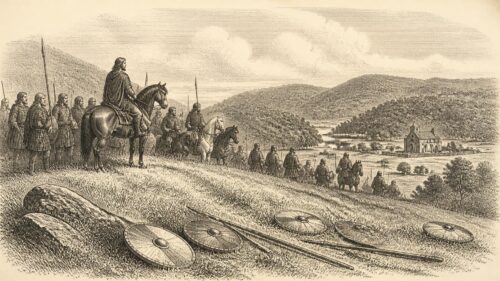
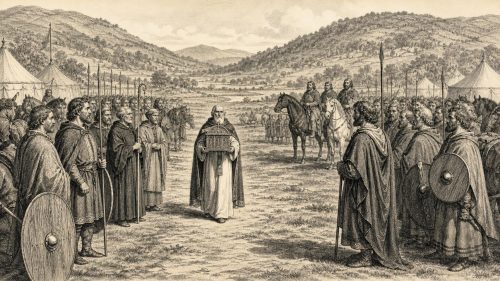
The surviving Irish annals make 1286 look, at first sight, like a year dominated by one extraordinary movement of armed power. Their central notice is a mórshluaiged, or great hosting, led by the Earl of Ulster into Connacht. The earl was Richard de Burgh, later famous as the Red Earl: lord of Connacht through his inheritance and one of the greatest magnates in the English lordship of Ireland. Yet the evidence must be handled closely. No source supplies a day, a route, a battle-site, a list of troops or a full explanation for the expedition.
Dateline
A year recorded through a single campaign
The surviving Irish annals make 1286 look, at first sight, like a year dominated by one extraordinary movement of armed power. Their central notice is a mórshluaiged, or great hosting, led by the Earl of Ulster into Connacht. The earl was Richard de Burgh, later famous as the Red Earl: lord of Connacht through his inheritance and one of the greatest magnates in the English lordship of Ireland. Yet the evidence must be handled closely. No source supplies a day, a route, a battle-site, a list of troops or a full explanation for the expedition. What can securely be said is that, during 1286, de Burgh’s host entered Connacht, obtained hostages from across the province, then pressed northwards into the political worlds of Cenél Conaill and Cenél nEógain.
That was a formidable assertion of authority. Ireland was not governed as a single, smoothly administered territory from Dublin. The English crown, whose lord was Edward I, possessed towns, castles, courts and sheriffs in some regions; powerful settler lords exercised wide local influence; and Gaelic kings and lordly kindreds retained or recovered authority across much of the island. Richard de Burgh’s position joined several of these worlds. As earl of Ulster and lord of Connacht, he was a magnate of the lordship, but his strength also depended on alliances, submissions and rivalries among Irish dynasties. The campaign of 1286 demonstrated how far a great lord could turn those relationships into military reach.
Richard de Burgh’s great hosting
Annála Connacht, the Annals of Ulster and the later Annals of the Four Masters agree on the broad outline. The Earl of Ulster led a great host into Connacht; churches and monasteries suffered; he prevailed wherever he went; and he took pledges or hostages from all Connacht. The agreement of independent annalistic traditions gives the episode considerable weight, even if their compressed wording leaves much unknown.
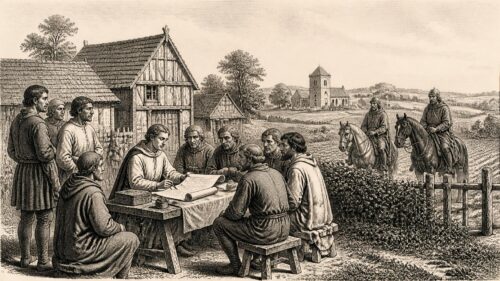
“Hostages” in this setting were political securities. A ruler or community that submitted could deliver leading people into the victor’s custody as a guarantee of future obedience, tribute or peace. Their taking was therefore not merely a by-product of raiding. It was a public way of translating armed success into an ongoing claim over the defeated. The annals do not name the hostages, describe their treatment or say how long they remained in custody. They do, however, make clear that de Burgh’s purpose went beyond a quick plundering expedition. He sought acknowledgements of superiority throughout Connacht.
The phrase “all Connacht” should not be mistaken for proof that every district obeyed in the same fashion or that resistance ended. Medieval annalists could use expansive language to convey the scale of a victor’s success. Nevertheless, the subsequent movement north is striking. De Burgh took the Connacht host with him, according to Annála Connacht, and then exacted hostages from Cenél Conaill and Cenél nEógain. In practical terms, this meant that an army gathered or compelled in the west became part of a wider display of de Burgh power. Connacht was not simply a target: its people and resources were drawn into the earl’s expeditionary system.
An imposed O’Neill settlement
The campaign culminated in a direct intervention in the kingship of Cenél nEógain, the polity centred on much of present-day Tyrone. The annals say that de Burgh deposed Domnall, son of Brian Ó Néill, and gave the kingship to Niall Cúlánach Ó Néill. The nickname Cúlánach, conventionally rendered “long-haired” or “with long back-hair”, distinguished Niall from other men of his name. It is a small reminder that annalistic political history was intensely personal: succession depended upon competing branches of a ruling kindred, followers, military capacity and outside patrons.
Richard’s intervention was not accidental. Modern biographical research connects the expedition to the succession of Domnall Ó Néill against the earl’s wishes after the death of Áed Buide Ó Néill. In 1286 de Burgh was able to use armed force to replace the unwanted king. The wording in Annála Connacht adds an important qualification: Niall was installed “for the nonce”, that is, for the time being. The settlement was an expedient assertion of lordly influence, not evidence of a permanent constitutional conquest of Cenél nEógain.
Nor should the removal of Domnall be described as a simple English conquest. Richard de Burgh was acting as an Anglo-Irish earl, but the contest itself was among members of the Ó Néill dynasty, and its outcome rested on the participation or submission of Irish forces as well as de Burgh’s own following. The political map of late thirteenth-century Ireland was made through such layered arrangements: royal claims, comital lordship, kinship rivalries, clientage and coercion overlapped rather than replacing one another.
Damage to religious communities
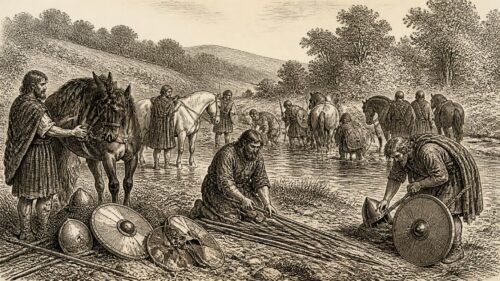
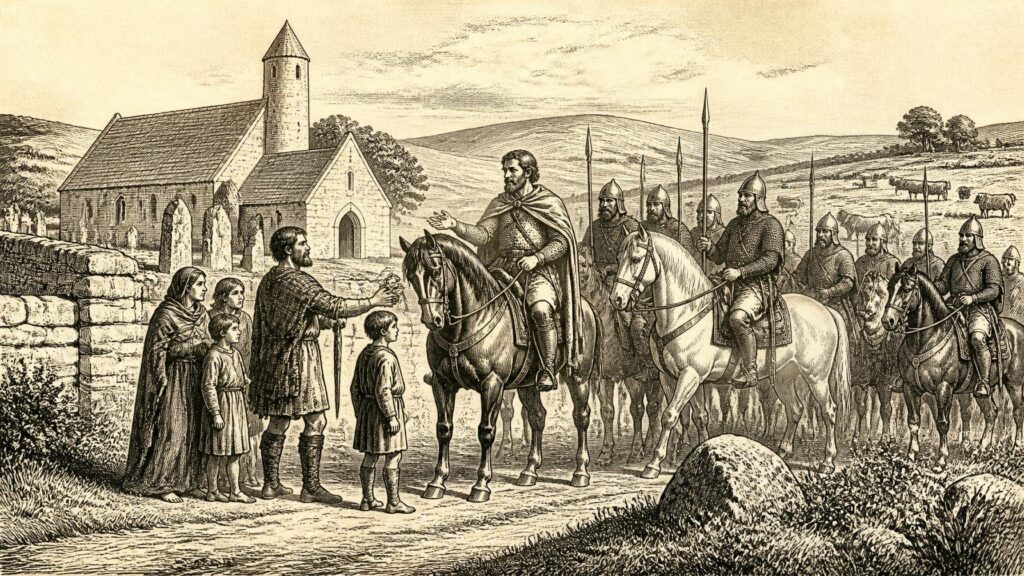
The annals’ most sombre statement is that many of Connacht’s churches and monasteries were despoiled or destroyed during the hosting. It is neither possible nor responsible to attach a list of named houses to that sentence: the sources do not provide one. Nor can the entry tell us whether damage meant the burning of buildings, seizure of livestock and food, taking of valuables, the disruption of tenants, or several of these together. What is certain is that religious institutions were not insulated from large-scale campaigning.
This mattered beyond the cloister. Churches and monasteries were places of worship, burial and memory, but they were also landholders and centres of local obligation. An attack upon them could unsettle surrounding communities as well as clergy and religious. The annals’ decision to record the damage indicates that it was understood as a grave feature of the earl’s progress, even though the same record stresses his military ascendancy. Its language preserves no comforting division between political warfare and religious life.
Cattle plague in spring
Another short notice carries an equally serious implication: “The spring of the cattle-plague was this year.” This is firmly assigned to 1286 by Annála Connacht, but the wording gives no geographical range, no number of animals lost and no diagnosis in modern veterinary terms. It should therefore be called cattle plague, as the annalist calls it, rather than identified with a particular disease.
For households across Ireland, cattle were central stores of wealth and sustenance. They provided milk, hides, traction and breeding stock, and they mattered in rents, tribute, hospitality and compensation. A disease affecting cattle in spring, when herds were emerging from winter and agricultural work was beginning, could sharpen the pressures already created by military exactions. The surviving notice does not prove famine or a nationwide collapse, and neither should be asserted. It does establish that the political violence of the year unfolded alongside an environmental and economic threat visible enough to enter the historical record.
Deaths, succession and the limits of dating
1286 also brought the death of Maurice fitz Maurice FitzGerald, known in the annals as Maurice the Bald. He had been a major magnate with interests in Connacht and Munster and had served briefly as justiciar of Ireland in 1272–73. Documentary evidence places his death before 10 November 1286; the annals simply place it within the year. His passing removed an experienced figure from the politics of the lordship, although it would be unsafe to claim that it directly caused de Burgh’s campaign or determined its timing.
On 26 March, Annála Connacht records the death of Domnall Ó hAnluain, chief of Cenél Dobtha. This precisely dated local obituary is valuable in its own right. It shows that the annals did not register only the largest lordships: the death of a regional leader also mattered to the political memory of the Irish midlands and north-east.
One caution is especially revealing. Annales Breves Hiberniae places the capture of Gerald fitz Maurice by Irish opponents in Offaly, and a bloody encounter at Rathcoffey or Ratoath, under 1286. A modern Dictionary of Irish Biography account dates Gerald’s capture to 1285. Since the evidence conflicts, the episode cannot safely be narrated as a firm event of 1286. The discrepancy is not a minor technicality. It demonstrates why an annual history must distinguish a securely dated development from material merely assigned to a year by one chronicle.
An Irish Sea connection
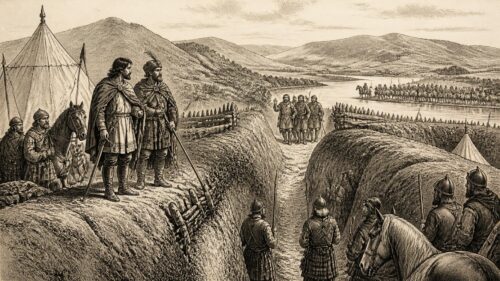
A firmly dated event beyond Ireland nevertheless touched Irish affairs directly. On 20 September 1286, Richard de Burgh and Thomas de Clare, lord of Thomond, were parties to the agreement known as the Turnberry Band at Turnberry in Carrick, south-west Scotland. Scottish magnates, including members of the Bruce and Stewart circles, pledged support to the two Anglo-Irish lords in their affairs. The agreement came six months after the death of Alexander III of Scotland on 19 March, a death that opened a grave succession crisis.
The document proves that de Burgh’s interests belonged to an Irish Sea political network, linking Ulster and Connacht with western Scotland. It does not, however, state that Scottish forces served in the Connacht hosting, nor does it explain the campaign’s immediate objectives. The association may have concerned Irish disputes, Scottish succession politics, western seaways, or several concerns at once. For 1286, the prudent conclusion is that Richard’s authority was being reinforced not only by hostages and armed movement within Ireland, but also by high-level connections across the sea.
Thus the year is best understood not as a settled conquest but as a moment of conspicuous, fragile dominance. Richard de Burgh extracted pledges across Connacht, carried his influence into the northern dynastic struggle and left religious communities damaged in his host’s wake. At the same time, cattle disease exposed the vulnerability of ordinary rural wealth, while deaths and disputed chronologies remind us how quickly power could change hands. The annals preserve 1286 as the year when an earl made his reach felt from Connacht to the north; they also preserve the costs, uncertainties and incompleteness of that achievement.
Source References
Hover over a number to see the source. Select it to open the source.

- [1] Annála Connacht: Annal 1286
- [2] Annals of Connacht
- [3] The Annals of Ulster
- [4] Annals of the Four Masters: 1286
- [5] Annals of the Four Masters: Irish text, 1286
- [6] Annales Breves Hiberniae
- [7] Burgh, Richard de
- [8] FitzGerald, Maurice fitz Maurice
- [9] FitzGerald, Maurice (‘Muiris Ruadh’)
- [10] FitzGerald, Maurice fitz Gerald
- [11] English Rule in Ireland, c.1272–c.1315
- [12] Ireland and Scotland in the Late Thirteenth Century
- [13] After Bannockburn: Operation Ireland 1315–1318
- [14] Alexander III (r. 1249–1286)
- [15] Convention of Bruce the Competitor, and his friends at Turnberry
- [16] Richard de Burgh and the Conquest of Connaught
- [17] From Boom to Bust: The Lordship of Ireland and the European ‘Commercial Revolution’
- [18] CELT: Annála Connacht
- [19] CELT: Annals of the Four Masters
- [20] CELT: Annales Breves Hiberniae
- [21] The Acts of Alexander III King of Scots 1249–1286: Regesta Regum Scottorum Vol. 4, Part 1
Primary Sources
- Annála Connacht: Annal 1286
- Annals of Connacht
- The Annals of Ulster
- Annals of the Four Masters: 1286
- Annals of the Four Masters: Irish text, 1286
- Annales Breves Hiberniae
- Burgh, Richard de
- FitzGerald, Maurice fitz Maurice
- FitzGerald, Maurice (‘Muiris Ruadh’)
- FitzGerald, Maurice fitz Gerald
- English Rule in Ireland, c.1272–c.1315
- Ireland and Scotland in the Late Thirteenth Century
- After Bannockburn: Operation Ireland 1315–1318
- Alexander III (r. 1249–1286)
- Convention of Bruce the Competitor, and his friends at Turnberry
- Richard de Burgh and the Conquest of Connaught
- From Boom to Bust: The Lordship of Ireland and the European ‘Commercial Revolution’
- CELT: Annála Connacht
- CELT: Annals of the Four Masters
- CELT: Annales Breves Hiberniae
- The Acts of Alexander III King of Scots 1249–1286: Regesta Regum Scottorum Vol. 4, Part 1