Arklow’s Broken Safe Conduct1282 CE
In 1282, Muirchertach Mac Murchada, king of Leinster, and his brother Art were murdered at Arklow on 21 July while travelling under safe conduct to meet Roger Bigod in England. Evidence links the killing to justiciar Stephen de Fulbourn’s frontier policy, exposing the insecurity of agreements between Gaelic rulers and royal government. Their deaths temporarily weakened Leinster unrest but did not end contested lordship. Annals also record Taichlech Ó Dubhda’s killing, Lasarfina Ó Conchobair’s death, chieftaincies changing hands, and prolonged winter snow. These events reveal Gaelic, Anglo-Irish and royal worlds, while annalistic dating cautions against assigning uncertain conflicts to 1282.

Dateline
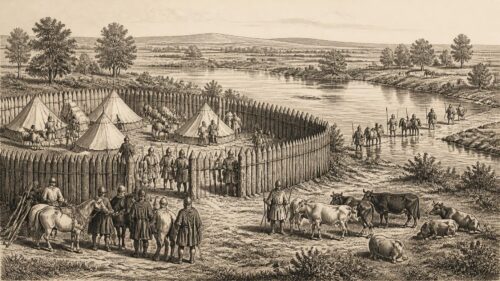
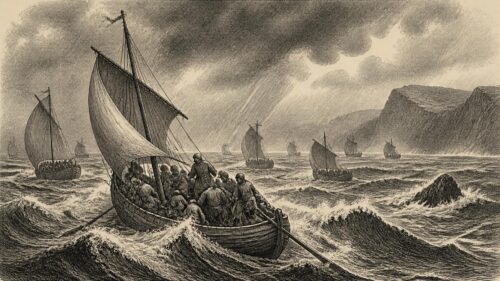
In 1282, the most clearly dated Irish political event was not a battle or a parliament but a killing at a harbour. On 21 July, Muirchertach Mac Murchada, king of Leinster, and his brother Art were murdered at Arklow while preparing to cross the Irish Sea. They had travelled under safe conduct, intending to go to England and meet Roger Bigod, earl of Norfolk and lord of the liberty of Carlow. Their deaths removed the two most prominent Gaelic leaders on the troubled eastern frontier of the lordship of Ireland. The event exposed both the reach and the insecurity of royal government: a promise of protection could be overridden where a chief governor judged political expediency more important than law.
Elsewhere, the annals record the death of important regional rulers, the killing of Taichlech Ó Dubhda at Beltra Strand in north-west Connacht, and a long snowy spell lasting from Christmas into the opening weeks of February. These notices are brief, but together they show an Ireland of several overlapping political worlds. Gaelic kings and chieftains, Anglo-Irish lords, royal officials, churchmen, seaboard communities and farming households all faced the consequences of local conflict, changing lordship and a harsh winter.
A Journey Ended at Arklow
The Mac Murchada brothers’ murder is exceptionally well anchored in the calendar. A later scholarly reconstruction from administrative evidence places it at Arklow on 21 July 1282; the Gaelic annals agree on the essentials, recording that Muirchertach, king of Leinster, and Art were killed by the Galls, meaning the English or Anglo-Irish settlers. The killing was therefore not simply a family feud or an obscure local affray. It was understood as the removal of a king and his brother by men associated with the colonial political order.
Muirchertach’s standing rested on the long history of Uí Cheinnselaig, the south-eastern Leinster dynasty from which the Mac Murchadas descended. Yet he was not outside the structures created after the twelfth-century conquest. His family had maintained useful connections with the Marshal inheritance and, later, with Roger Bigod, its successor in Carlow. Bigod had recognised Muirchertach’s leadership among the Irish of his liberty and had tried accommodation: gifts, offices and negotiated relationships had all been employed alongside military pressure. Such arrangements reveal that the frontier was not a simple line between two separated peoples. Authority depended on tribute, service, kinship, hostages, protection and personal alliances, often crossing linguistic and legal boundaries.
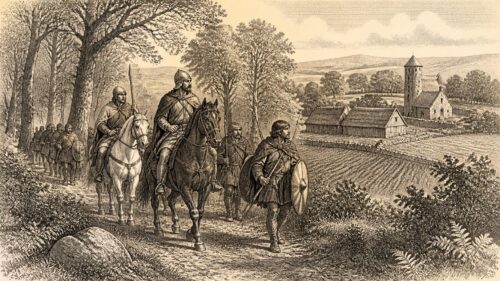
That accommodation had frayed badly during the 1270s. Muirchertach and Art operated in a landscape stretching from the Wicklow uplands towards Carlow and Wexford, where the roads, woods and mountain approaches made large expeditions difficult and where settler communities could be exposed to raids. Muirchertach had been imprisoned more than once; Art had taken a leading military role during his brother’s captivity. By 1282 the Dublin administration suspected the brothers of encouraging the renewed unrest of the Leinster Irish. Stephen de Fulbourn, the justiciar and bishop of Waterford, evidently regarded their removal as a solution.
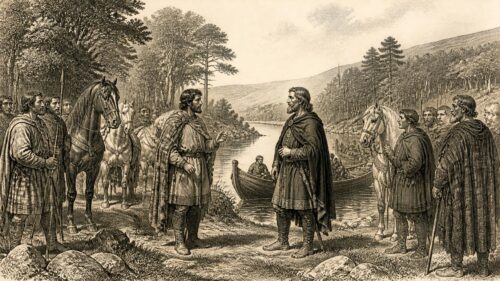
Modern historians are careful about the chain of command, but the evidence strongly connects Fulbourn to the killing. The name Geoffrey de Pencoyt is attached to the act in later testimony, while the circumstances point to official instigation rather than an accidental breach of the peace. The brothers were waiting to board a ship for England. Their supposed protection made their murder particularly striking: safe conduct was a practical instrument through which a king’s government enabled travel, negotiation and submission. To destroy men under it sent a contrary message—that security depended on power, not merely on a written or spoken guarantee.
Leinster After the Brothers
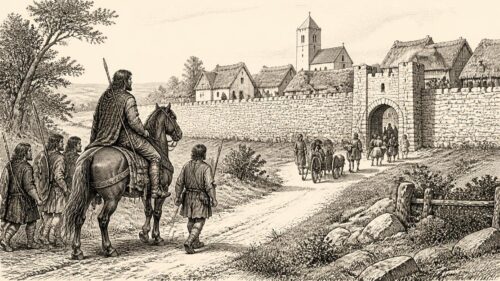
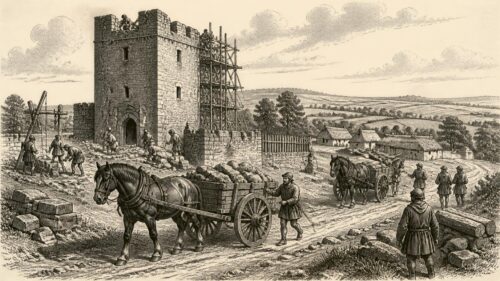
The immediate result was a quieter eastern Leinster, at least in the narrow sense recorded by government-centred sources. Fulbourn’s policy had eliminated two experienced leaders who could unite or represent discontented communities. But quiet did not mean that the underlying issues had vanished. The crown’s Irish lordship was strongest in ports, towns, manors, castles and the more settled lowlands; its capacity weakened across upland borders and in districts where Gaelic lordships retained land, followers and local legitimacy. The brothers’ fate demonstrated the fragility of any settlement made between the administration and a Gaelic ruler.
Nor should the event be converted into a claim that a single coherent “Irish” resistance had been crushed. Muirchertach was king of Leinster in the annalists’ language, but political action remained local and dynastic. His allies, rivals, tenants and dependants had their own interests. The later emergence of further Mac Murchada leadership shows that the dynasty endured, while the survival of the Wicklow and Carlow frontier as a contested zone shows that murder could remove individuals without resolving the conditions that had made them influential.
The episode was also connected to politics beyond Ireland. In the summer of 1282 Edward I was confronting a major Welsh rising. Successes against English forces in Wales heightened official anxiety around the Irish Sea. It would be unsafe to claim that events in Wales alone caused the Arklow murder, but the timing helps explain a climate in which officials were inclined to see unrest in Leinster as a wider threat. Ireland was not an isolated colony: its rulers, soldiers, lords and merchants moved through a political world that joined Ireland, Wales, England and the western seaways.
Deaths and Lordship Beyond Leinster
The Annals of Connacht place several other deaths within 1282. Taichlech, son of Máelruanaid Ó Dubhda, ruler of Uí Fiachrach Muaide in what is now north Mayo and south Sligo, was killed by Adam Cusack at Beltra Strand. The annalist praised him as a man of generosity and valour who had struggled in defence of his country against Galls and marauders. Such praise was conventional, but it is still revealing. Generosity was political as well as moral: a lord needed the resources and reputation to feed, reward and retain followers. His death at a strand also suggests the strategic importance of coastal corridors, landing places and routes connecting local lordships with the wider Connacht shore.
Lasarfina, daughter of Cathal Crobhderg Ó Conchobair, also died in 1282. Other annalistic traditions identify her as wife of Domnall Mór Ó Domnaill and mother of Domnall Óg. Her commemoration records more than private bereavement. As the daughter of a celebrated king of Connacht and the wife of a leading northern ruler, she embodied marital links between powerful dynasties. Medieval Irish political life did not rest on male succession alone: women of ruling families carried kinship, inheritance claims, hospitality networks and diplomatic significance across provincial boundaries.
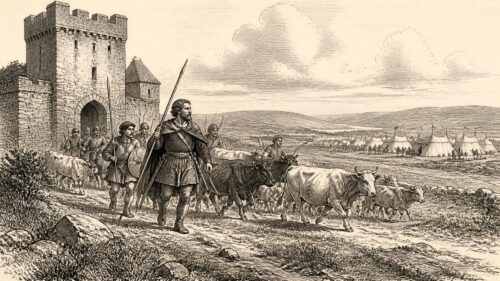
In the midlands and Breifne, the annals note the deaths of Matha Ó Ráigillig, chief of Muintir Máelmórda, Gilla Ísa Mag Tigernáin of Tellaig Dunchada, and Cathal Ó Fearghail, chief of Anghaile. Cathal’s son Sefraid succeeded him. These were not minor details to contemporaries. A change of chieftain could alter the handling of tribute, grazing rights, military obligations and alliances with neighbouring lords. The account of Cathal’s death on Inis Cuan, on the river by Clonliss, preserves a story of prophecy and place: he had avoided a location called the Long Ridge because he believed it foretold as the place of his death, only to die at a different site explained by the same phrase. The anecdote shows how political memory, sacred expectation and landscape could be joined in annalistic writing.
Snow and the Limits of the Record
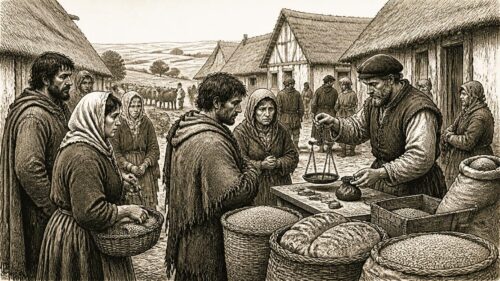
The same Connacht annal reports “a great deal of snow” from Christmas until St Brigid’s Day, 1 February. This belongs partly to the winter spanning 1281 and 1282, but its continuation into the new year makes it a genuine condition of early 1282. For rural households, prolonged snow could obstruct travel, restrict access to pasture and fuel, and complicate the movement of people, animals and supplies. It was especially unwelcome in a society whose political and economic routines depended heavily on seasonal journeys, cattle and the carriage of food by road, river and sea.
Yet the evidence does not permit a claim of famine, epidemic or national catastrophe. The annalist records snow, not its consequences. That restraint matters. The surviving sources are much fuller for the deaths of rulers and confrontations of armed men than for the daily calculations of cultivators, herders, fishers or town-dwellers. The winter notice is valuable precisely because it gives a brief glimpse of weather as a shared constraint across social ranks, while also reminding us how much ordinary experience remains unrecorded.
Dating Ireland’s Annals
1282 also illustrates why medieval Irish chronology must be handled carefully. The Annals of Ulster place several Connacht conflicts under a heading which itself signals a dating displacement, while the Annals of the Four Masters assign matching incidents to 1285. Those battles should therefore not be presented as securely belonging to 1282. By contrast, the Arklow murder is supported by a precise documentary date and by several narrative traditions, while the Connacht annal’s notices of deaths and snow fit its year entry. Responsible history means allowing uncertainty to remain visible instead of filling a calendar year with attractive but misdated events.
The year’s firm centre is consequently Arklow: two Leinster rulers killed while travelling under protection, in a decision apparently shaped by the justiciar’s frontier policy. Around it stand the deaths of regional leaders, a dynastic woman remembered across provinces, a succession in Anghaile, and a difficult winter. Together they show that Ireland in 1282 was governed neither by a single political system nor by permanent division. It was a country of negotiation and coercion, sea crossings and local lordships, in which a promise of safe conduct could be both an indispensable diplomatic tool and, at Arklow, a fatal deception.
Primary Sources
- Annála Connacht, Annal 1282
- The Annals of Ulster, Year U1282
- Annals of the Four Masters, Annal M1282
- Annals of the Four Masters, Irish text, Annal M1282
- Annales Breves Hiberniae
- Annalium Hiberniae Chronicon ad annum MCCCXLIX
- MacMurrough (Mac Murchada), Muirchertach
- Fulbourn, Stephen de
- Burgh, Richard de
- O'Connor Faly (Ó Conchobair Failge), Muirchertach
- MacMurrough (Mac Murchadha), Muiris
- XXIX The Justiciar and the Murder of the MacMurroughs in 1282
- English Rule in Ireland, c.1272–c.1315
- Calendar of Documents Relating to Ireland, Volume 2, Item 1965
- Parchment Conquest, 1171–1307
- Annála Connacht: The Annals of Connacht (A.D. 1224–1544)
- Annals of Ulster Otherwise Annala Senait, Annals of Senat
- Annála Connacht: Background Details and Bibliographic Information
- Sefraid Ó Fearghail and Anghaile, 1271–1318
- Arklow Castle CMF22-1-WI002