Ruaidrí’s Escape1275 CE
In 1275, Ireland experienced regional conflict rather than a single national crisis. In Connacht, Tadc Ó Conchobair captured his brother Ruaidrí, raided Mac Diarmata territory, and lost his prisoner after Ruaidrí escaped with Conchobar Ó hAinlide, who was killed in pursuit. In Breifne, Art Ó Ruairc died at Granard during conflict involving Anglo-Norman forces. Annals also note killings among Gaelic kindreds, an Ulster victory over the Galls, and the deaths of bishops of Raphoe and Killala. Meanwhile, Edward I supported Justiciar Geoffrey de Geneville, ordering defence measures, an inquiry, and appointments. Sources caution against misdating events assigned differently in annals.
Dateline
In 1275, Ireland’s political life was shaped less by one national contest than by several overlapping struggles: rival branches of Gaelic dynasties competed for authority; English royal government attempted to sustain order and defend its interests; and local communities bore the immediate costs of raiding, pursuit and killing. The most clearly dated evidence comes from Annála Connacht and the Annals of Loch Cé, both of which place a sharp internal crisis in Connacht in this calendar year. Royal English records, meanwhile, reveal a Dublin administration worried enough about the state of the lordship to seek armed support and an official investigation from King Edward I.
A Brother Taken and Freed
The year’s central Connacht episode concerned two sons of Toirrdelbach Ó Conchobair: Tadc and Ruaidrí. The annals state that Tadc captured Ruaidrí, his own brother. He also plundered the lands of another Tadc, son of Cathal Mac Diarmata. These compressed notices leave much unsaid: they do not name a battlefield, give a date, or explain precisely how the capture was achieved. Yet their sequence is revealing. A struggle within the Ó Conchobair kindred was accompanied by a strike against Mac Diarmata territory in Magh Luirg, the important lordship centred on what is now north Roscommon.
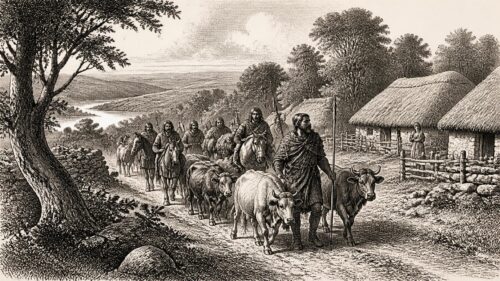
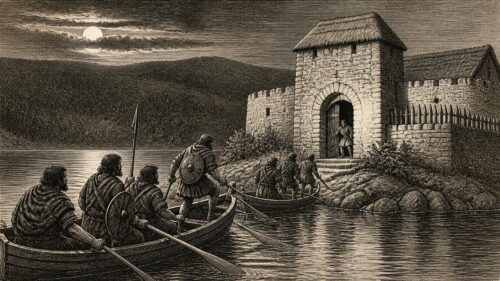
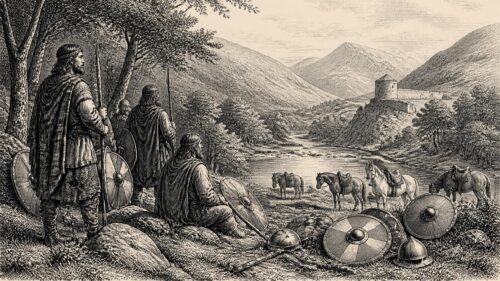
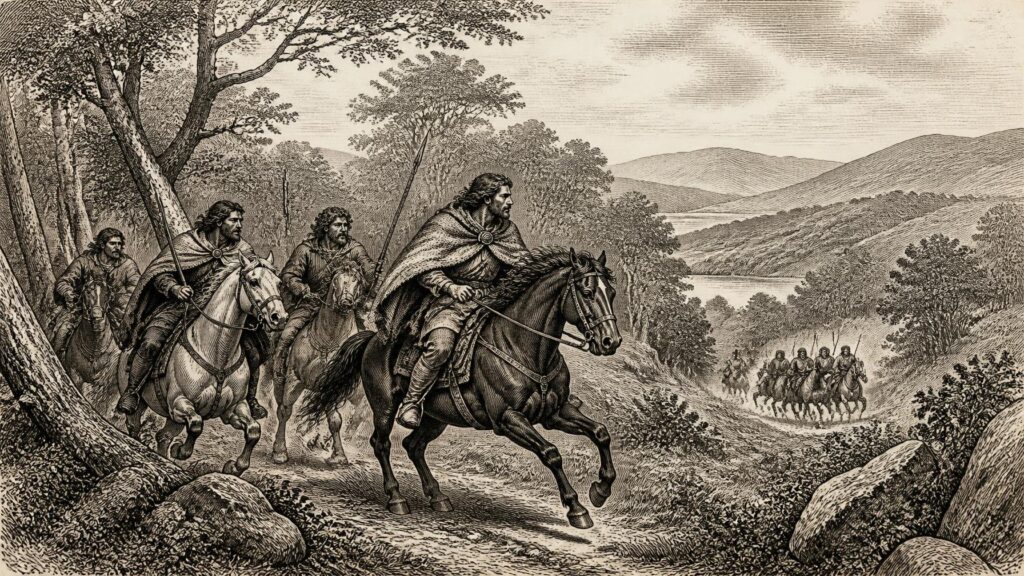
Ruaidrí did not remain in captivity. He escaped, and Conchobar Ó hAinlide took him away. Their flight ended in pursuit: Conchobar was killed, while Ruaidrí evidently got clear. The entry records neither a formal reconciliation nor an immediate settlement. What it does show is the dangerous practical meaning of dynastic competition. Authority depended not simply upon descent, but upon the ability to hold allies, move safely through hostile country, punish opponents and protect dependants. An ally who escorted a fugitive prince could pay with his life.
It would be wrong to turn this brief annal into a fully described civil war. Still, the incident has a wider significance. Tadc’s seizure of Ruaidrí and attack on Mac Diarmata lands suggest that control in Connacht was being pursued through both family coercion and pressure on neighbouring lordships. Later annalistic retrospective material says that Tadc had held the rule of Connacht for three years when he was killed in 1278. That later statement supports the view that he was a major provincial claimant by 1275, but it does not allow an exact inauguration date to be assigned within this year.
Violence Across Breifne
Connacht’s turmoil was not isolated. Conchobar, son of Fergal, son of Donnchad, son of Muirchertach, was killed by his own kinsmen. The annalist supplies no place or fuller motive, a reminder that family solidarity could coexist with lethal rivalry. Two further killings involved the political world north and east of Connacht. Tomás Mac Samradáin was killed by the Cenél Luachain, while a son of Cú Chonnacht Ó Raigillig was, in the annalist’s emphatic phrase, killed “craftily” by Clann Cathail. Such entries register political loss and grievance, but their terseness prevents responsible reconstruction of a wider campaign.
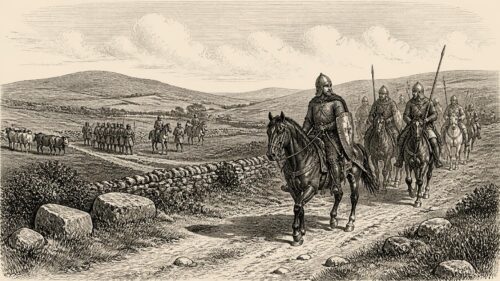
The death of Art Ó Ruairc, king of Breifne, was more plainly consequential. Art was killed at Granard by Mag Finnbhairr and the Muinter Geradáin, accompanied by Galls—the annals’ term here for Anglo-Norman or English forces—and a slaughter of his followers followed. A modern biographical study, drawing on the annals, identifies the encounter as taking place while Art was raiding Granard. That interpretation fits the frontier character of the place, on the approaches between Breifne and the Anglo-Irish lordship of Meath, but the contemporary annal itself gives only the location, the coalition of opponents and the heavy losses.
Art’s killing demonstrated the vulnerability of kingship in Breifne. He had only recently returned to the kingship after the death of a rival in 1273. His career had already been marked by deposition, captivity and restoration amid shifting Ó Ruairc and Ó Conchobair alliances. In 1275, a king could still lead or accompany a raiding force, but the expedition might end in his death and the destruction of his war-band. The succession of Art’s son Amlaib belongs to the consequences of the killing, rather than to an event independently dated within the surviving 1275 notices.
Ulster and the Language of Victory
Annála Connacht also records a defeat inflicted on the Galls in Ulster. Its stated tally is dramatic: two hundred horses and two hundred heads. The notice does not identify the combatants, battlefield or date within the year. Nor should its count be treated as a modern casualty return. Medieval annals commonly used such figures to express the scale and prestige of a victory; the reference to heads may reflect trophy-taking as well as deaths. Even so, the entry confirms that armed resistance to the Anglo-Irish presence remained active in Ulster and that horses, portable military assets of high value, were central to the gains claimed after a successful encounter.
The same record offers a glimpse of how violence affected ordinary people without pretending to describe individual experience where the evidence is silent. Raids and counter-raids endangered household goods, animals, harvest stores and the security of travel. The killing of escorts, retainers and unnamed followers was not incidental: political power depended upon such people. A prince’s escape, a king’s defeat, or a lord’s plundering expedition could change who controlled local resources and whose protection communities were compelled to seek.
Churches Through Political Change
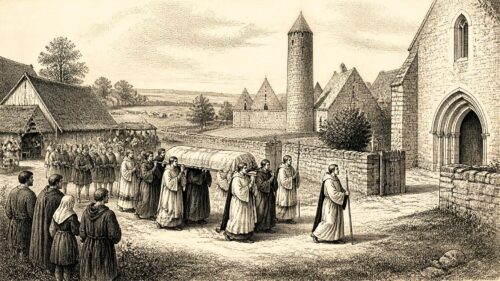
Two episcopal deaths were entered for 1275: Cairpre Ó Scoba, bishop of Raphoe, and Ó Laidig, bishop of Killala. The notices are restrained, stating that each “rested in Christ”. They do not name successors or describe vacancies, elections or funeral rites. Nevertheless, they show the continuing importance of diocesan institutions across regions experiencing political instability. Raphoe lay in the north-west, within the wider orbit of Tír Chonaill; Killala served a diocese on the north Connacht coast. Their bishops belonged to a church organised through territorial dioceses, religious houses, parish churches and clerical networks, rather than standing apart from secular politics.
The annals themselves are evidence of that learned ecclesiastical world. Their annual headings, calculations of lunar and solar cycles, and concise memorial notices reflect literate habits of record keeping. For 1275, the Connacht annalist begins by noting that 1 January fell on a Tuesday and by giving the lunar day and cycles. This was not decoration. It placed local events within a Christian chronological order shared across medieval Europe, while the body of the annal preserved the intensely regional affairs of Connacht, Breifne, Ulster and the western dioceses.
Dublin’s Uneasy Administration
Beyond the Gaelic lordships, Geoffrey de Geneville remained justiciar of Ireland in 1275, governing for Edward I from the institutions of the lordship. The royal rolls preserve several securely dated acts involving him. On 5 January, the king ordered Geneville to give Thomas de Moleton and his wife Edmunda seisin of Irish lands to which she had inherited title, subject to the rights of the crown and others. This routine-looking order matters because it shows government operating through written commands, inheritance law, wardship and the transfer of landed rights even during wider insecurity.
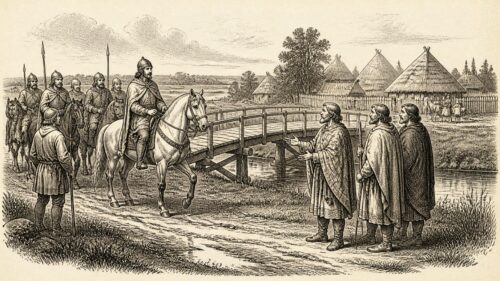
By 11 September, the tone was more urgent. A royal writ of aid stated that Geneville had been commanded to attend to the defence of Ireland and to harry the Irish and the king’s enemies, while acknowledging his need for counsel and assistance. The same enrolment provided letters of credence for Imbert de Monreal, a royal knight sent to Ireland to inspect the condition of the land and report for the king. This was not a detached English concern. It was a direct response to the difficulties of maintaining royal authority, military capacity and administrative co-operation across the Irish Sea.
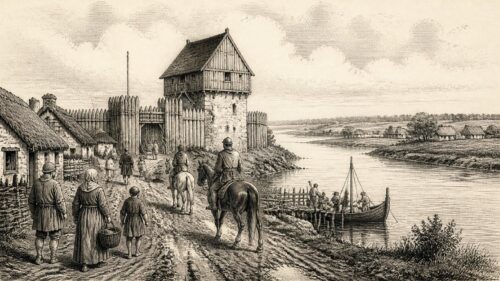
Late in the year, on 27 December, Edward ordered Geneville to allow Walter de la Haye to retain office as sheriff of Waterford and constable of Limerick Castle, provided he remained faithful to the justiciar. The instruction joined port-city administration, royal castles and personal loyalty in a single decision. Waterford and Limerick were among the lordship’s major urban and maritime centres. Their sheriffs, fortifications and revenues were essential to the government’s capacity to move men, goods, messages and money. The record does not demonstrate calm: rather, it shows an administration continually maintaining the people and offices on which its limited reach depended.
What Belongs to 1275
Chronology requires particular care for this year. The Annals of Ulster place the defeat of Cuinche, the capture of Brian Ruad Ó Briain and several deaths beneath a heading labelled 1275. However, the closely related sequence in the Annals of Loch Cé and the Annals of the Four Masters places those events under 1278, while the securely calendared Connacht and Loch Cé notices for 1275 instead concern Ruaidrí’s capture and escape, Art Ó Ruairc’s death, episcopal obits and northern conflicts. They should therefore not be presented as occurrences of calendar year 1275.
The dependable picture is consequently one of regional instability, not a single island-wide turning point. Connacht saw a brother seize and fail to hold a brother; Breifne lost a king at Granard; Ulster witnessed a claimed victory over the Galls; two dioceses lost bishops; and the English crown reinforced its justiciar while ordering an inquiry into conditions in Ireland. These records are brief, but together they show a country in which lordship was contested at close range and government—Gaelic and Anglo-Irish alike—rested on fragile networks of kinship, force, land and loyalty.
Source References
Hover over a number to see the source. Select it to open the source.

- [1] Annála Connacht: Annal 1275
- [2] Annals of Loch Cé: Annal LC1275
- [3] Annals of Ulster: Year U1275
- [4] Annals of Loch Cé A.D. 1014–1590: Irish Text, Annals LC1277–LC1278
- [5] Annala Uladh: Irish Text, Years U1275–U1277
- [6] Annals of the Four Masters: Irish Text, Annals M1276–M1278
- [7] Geneville (Joinville), Geoffrey de
- [8] O'Rourke (Ó Ruairc), Cathal Riabach
- [9] Vaucouleurs, Ludlow and Trim: the role of Ireland in the career of Geoffrey de Geneville (c. 1226–1314)
- [10] Patent Rolls: 11 September 1275
- [11] Close Rolls: 5 January 1275
- [12] Patent Rolls: 25 March 1275
- [13] Patent Rolls: 27 December 1275
- [14] Geoffrey de Gyenvill, Named 1254 to 1299
- [15] Annales Hiberniae
- [16] Exploring the Irish Annals
- [17] The Irish Annals: Their Genesis, Evolution and History
- [18] The Irish Annals: Sources and Textual Development
- [19] Annála Connacht: Annal 1259
- [20] Annála Connacht: Annal 1228
- [21] Annála Connacht: Annal 1225
- [22] English Rule in Ireland, c.1272–c.1315
- [23] From Boom to Bust: The Lordship of Ireland and the European ‘Commercial Revolution’
- [24] Calendar of Documents Relating to Ireland, 1171–1307
Primary Sources
- Annála Connacht: Annal 1275
- Annals of Loch Cé: Annal LC1275
- Annals of Ulster: Year U1275
- Annals of Loch Cé A.D. 1014–1590: Irish Text, Annals LC1277–LC1278
- Annala Uladh: Irish Text, Years U1275–U1277
- Annals of the Four Masters: Irish Text, Annals M1276–M1278
- Geneville (Joinville), Geoffrey de
- O'Rourke (Ó Ruairc), Cathal Riabach
- Vaucouleurs, Ludlow and Trim: the role of Ireland in the career of Geoffrey de Geneville (c. 1226–1314)
- Patent Rolls: 11 September 1275
- Close Rolls: 5 January 1275
- Patent Rolls: 25 March 1275
- Patent Rolls: 27 December 1275
- Geoffrey de Gyenvill, Named 1254 to 1299
- Annales Hiberniae
- Exploring the Irish Annals
- The Irish Annals: Their Genesis, Evolution and History
- The Irish Annals: Sources and Textual Development
- Annála Connacht: Annal 1259
- Annála Connacht: Annal 1228
- Annála Connacht: Annal 1225
- English Rule in Ireland, c.1272–c.1315
- From Boom to Bust: The Lordship of Ireland and the European ‘Commercial Revolution’
- Calendar of Documents Relating to Ireland, 1171–1307