Sligo’s Castle Burden1245 CE
In 1245, Maurice fitz Gerald, justiciar of Ireland, built Sligo Castle with Síl Muiredaig, compelling King Fedlimid Ó Conchobair of Connacht to meet much of the cost and appropriating ecclesiastical materials. The fortress strengthened lordship over strategic north-western routes. Other castles at Áth an Chip and Caisleán Suicín reflected intensified frontier militarisation. Fedlimid joined Henry III’s Welsh campaign, gaining royal recognition despite continuing Anglo-Irish pressure. Maurice was replaced by John fitz Geoffrey. Church disputes, killings, raids and successions revealed regional instability, while Elphin’s episcopal dispute reached Pope Innocent IV at Lyons. Severe snow before Christmas disrupted travel, livelihoods and supplies.

Dateline
A Connacht Stronghold
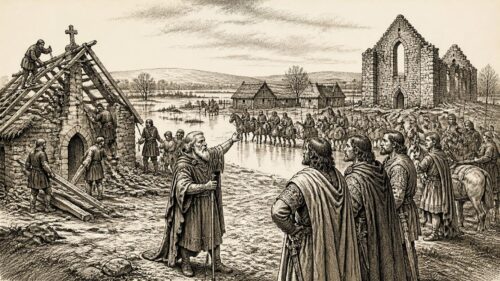
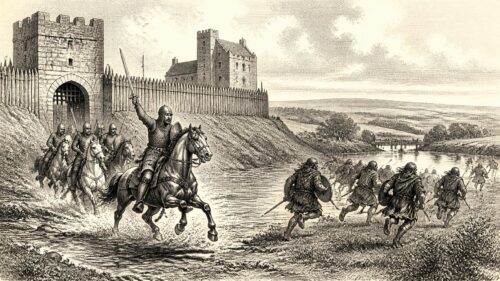
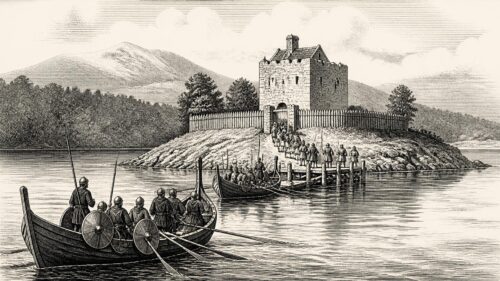
The most consequential Irish development securely recorded for 1245 was the construction of a castle at Sligo. The annals attribute the work to Maurice fitz Gerald, justiciar of Ireland, acting with the Síl Muiredaig, but they make equally clear that Fedlimid Ó Conchobair, king of Connacht, bore a heavy part of the burden. He was ordered to build the castle at his own expense. This was not simply a new fortification appearing in an empty landscape. It was an assertion of lordship in north-west Connacht, where sea routes, the crossing of the Garavogue, roads inland and the approaches towards Tír Conaill could be watched and controlled.
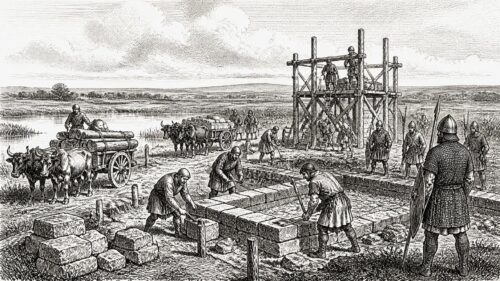
The wording of the record is unusually revealing. Stone, lime and even the buildings of the Hospital of the Holy Trinity were taken for the work, although Maurice had earlier granted that religious site to Clarus Mac Máelín in honour of the Trinity. A castle was therefore made not only through military direction and the labour of those compelled to provide it, but by diverting materials from an institution of care and devotion. The episode shows how closely power, resources and ecclesiastical property could intersect. It also warns against treating the foundation as a straightforward act of urban improvement: in 1245 its immediate purpose was strategic command, and its costs fell substantially upon a Gaelic king whose authority had already been constrained by the expanding lordship.
Sligo had a settlement and a crossing before this date, but the annalistic evidence firmly dates the castle, not the formal creation of a town. Later medieval growth around the river, bridge, port and burgage plots would give the place a more recognisable urban shape. In 1245, however, the new stronghold was chiefly a hard military fact: a base for Maurice fitz Gerald’s ambitions in Connacht and beyond, and a conspicuous reminder that co-operation with the crown’s administration could entail onerous obligations for an Irish ruler.
Fortresses on the Frontier
Sligo was not the only castle recorded that year. The annals also place the building of Áth an Chip, on the border of Moynish, in 1245, crediting Milid Mac Goisdelb; later historical writing identifies the builder with Miles de Nangle. The site lay in the Shannon–Leitrim borderland, near the routes connecting Connacht, Breifne and the midlands. A further fortress, called Caisleán Suicín, is simply said to have been built in the same year. Its location is uncertain in the surviving evidence, so it should not be assigned confidently to a modern place.
Together these entries point to a year of intensified castle building rather than to isolated construction projects. Castles housed garrisons, safeguarded stores, served as administrative centres and offered protected points from which a lord’s men could collect renders, move troops or threaten neighbouring territories. Yet such works could provoke as well as secure. In the unsettled frontier between north Connacht and Tír Conaill, the new chain of positions helped convince neighbouring rulers that accommodation with Maurice’s regime was becoming ever more dangerous.
Connacht in Henry’s War
Irish affairs in 1245 were also tied directly to King Henry III’s war in Wales. The Irish annals record that the king summoned the justiciar, the Anglo-Irish magnates and Fedlimid Ó Conchobair to join his campaign against the Welsh. Maurice fitz Gerald and the settlers of the lordship went across the Irish Sea, while Fedlimid brought a substantial Gaelic force. The Annals of Ulster independently preserve the essentials: there was war between the king of the English and the Welsh, and the justiciar and Fedlimid crossed in aid of Henry.
This was politically significant. Fedlimid was not merely a defeated provincial ruler at the edge of English power; he was a king whose military assistance Henry actively sought. The Connacht annalist says he was received with honour by Henry and returned westward pleased with the encounter. Royal recognition had practical value. Fedlimid had spent years seeking confirmation of his reduced position in Connacht while powerful Anglo-Irish interests, above all the de Burgh inheritance and Maurice fitz Gerald’s circle, pressed westward. Service overseas offered an opportunity to display loyalty, establish personal access to the king and perhaps secure support against local rivals.
The campaign itself did not yield the decisive submission Henry wanted. The Irish account says that the royal army devastated the country but obtained neither hostages nor pledges from the Welsh. For Ireland, its importance lay less in its outcome in Wales than in what it demonstrates: the lordship of Ireland could furnish ships, provisions and fighting men for Plantagenet warfare, and Gaelic rulers could participate within that wider political world. The relationship was nevertheless unequal. Fedlimid’s prominence at Henry’s side did not remove the local pressures represented by the Sligo building programme.
A Change at Dublin
By November, Maurice fitz Gerald had been replaced as justiciar by John fitz Geoffrey. The change ended a long justiciarship that had begun in 1232 and during which the Dublin administration became more closely organised on English models. It did not mean that Maurice ceased to matter. His personal estates, claims and military following remained formidable, especially in the west and north-west. Indeed, being freed from the day-to-day duties of chief governor left him able to pursue his own northern ambitions more directly.
The replacement is an important distinction between royal office and regional power. A justiciar governed in the king’s name, but magnates such as Maurice also possessed their own lordships, alliances and objectives. The castle at Sligo was built before his departure from office, yet it would remain central to the ambitions and conflicts of his wider affinity. In that sense, the year joined royal administration in Dublin to a local transformation on the Atlantic side of Connacht.
Church, Learning and Appeal
Religious affairs in 1245 reveal a Church both deeply local and connected to the highest courts of western Christendom. Domnall Ó Flannacáin, abbot of Cong, died. In the south-west, the Annals of Inisfallen record the death of Gilliberd, archdeacon of Limerick, and a violent dispute within the Mac Carthaig kindred in which Domnall Ruad, son of Cormac Liathánach, was handed over by his own brother and put to death. Such notices are brief, but they show that political competition and ecclesiastical office remained entwined with leading families and regional institutions.
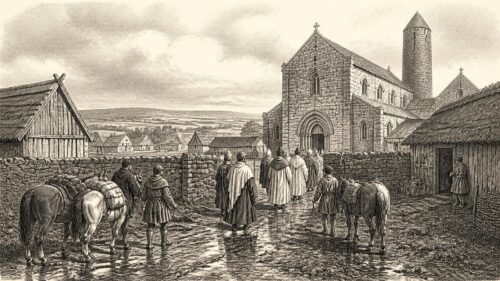
The most detailed church episode concerned Elphin. After the death of Bishop Donnchad Ó Conchobair in 1244, rival claims emerged. Master John, supported by the archdeacon, dean and sacristan and described as elected by the senior clergy, travelled to Pope Innocent IV at Lyons. The pope was then resident there amid his conflict with Emperor Frederick II and the Council of Lyons of 1245. According to the Connacht annalist, Innocent rejected the competing election backed by younger canons, confirmed Master John’s claim and instructed the archbishop of Tuam to consecrate him.
This was not a minor procedural matter. It demonstrates cathedral personnel using canon law, literacy, travel and papal jurisdiction to determine an Irish episcopal succession. The surviving account names office-holders within Elphin’s chapter and presents the appeal as a victory for proper order. Its celebratory tone belongs to the source, but the wider point is secure: an Irish diocesan dispute reached Lyons, and its resolution depended on the papal court.
Violence, Kinship and Monastic Refuge
Not all politics were conducted through castles or royal audiences. Conchobar Ruad Ó Conchobair was stabbed by his own steward after a quarrel at Port na Leice. The steward was then killed in retaliation. Conchobar was carried to Boyle monastery, where he died after receiving the rites of the Church and was buried. The account captures the unstable intimacy of aristocratic households, where a dispute between lord and servant could become lethal, and where a monastery offered spiritual care, burial and a public language of repentance.
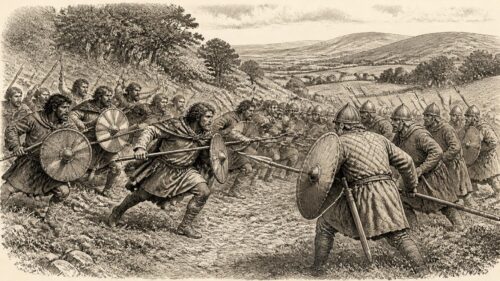
Other Connacht notices record the killing of Muirchertach Mac Diarmata by the men of Breifne, the death of Ragnall Ó Máelmiadaig at Connacht hands, and the accession of another Muirchertach Mac Diarmata to the kingship of the Rock. Maelsechlainn Ó Domnaill also raided the English and Irish of Lower Connacht, carrying off cattle and other goods. Cattle raiding was both warfare and economic extraction: animals represented food, wealth, breeding stock and portable prestige. These incidents should not be inflated into a single island-wide war, but they show that the new castles rose amid continuing contests over people, territory and movable resources.
Snow Before Christmas
The year ended with a severe weather event recorded in the Connacht annals. Heavy snow fell on the eve of St Nicholas and lay until Christmas; people walking in it reportedly lost heels and toes. The dramatic detail may reflect the annalist’s wish to emphasise hardship, and it cannot safely be converted into modern measurements of temperature or snowfall. Even so, the notice is strong evidence that the winter of 1245 was remembered locally as unusually punishing.
For rural households, travellers, herdsmen and those responsible for moving food or building supplies, prolonged snow could disrupt roads and tracks, endanger livestock and make journeys hazardous. Coming after a year of enforced construction, campaigning and raiding, the account offers a final reminder that political power operated within environmental limits. In 1245, Sligo’s castle embodied an expanding lordship; the snow showed the physical vulnerability shared by everyone living around it.
Primary Sources
- Annála Connacht, Annal 1245
- Annals of the Four Masters, Annal 1245
- Annals of Ulster
- Annals of Inisfallen, Annal 1245
- Annales Breves Hiberniae
- Annales Hiberniae
- FitzGerald, Maurice fitz Gerald
- O'Connor (Ó Conchobair), Fedlimid
- O'Donnell (Ó Domnaill), Maelsechlainn
- O'Donnell (Ó Domnaill), Gofraid
- Burgh, Richard de
- Calendar of Documents Relating to Ireland, 1171–1307
- Close Rolls of the Reign of Henry III
- Close Rolls of the Reign of Henry III: Table of Contents
- Inquisitions and Extents of Medieval Ireland: Richard de Burgh
- Sligo Gaol Archaeological Impact Assessment
- Robbers Lane, Sligo: Archaeological Assessment
- Underwater Archaeological Impact Assessment: Sligo Harbour
- National Monuments in State Care
- The First Council of Lyons (1245)
- First Council of Lyons – 1245 A.D.
- Ireland in the Thirteenth Century: A Thesis on Politics and Kingship
- Calendar of the Liberate Rolls: Table of Contents
- Records, Administration