Tadhg’s Martinmas Betrayal1243 CE
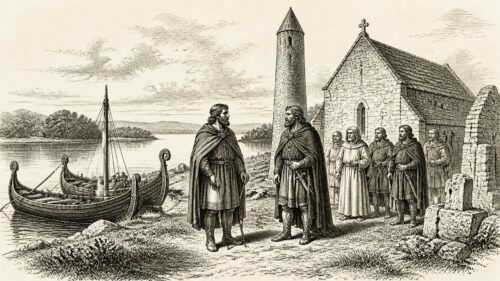
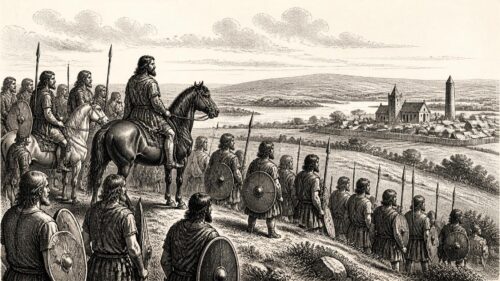
In 1243, Connacht and its borderlands saw political violence centred on Tadhg Ó Conchobair, grandson of Cathal Crobderg. Released by Cú Chonnacht Ó Raigillig, Tadhg seized Cormac Mac Diarmata and his own mother, Étáin, delivering her to Ó Raigillig as ransom. At Martinmas, Ó Raigillig treacherously recaptured Tadhg and killed his followers, worsening Connacht-Bréifne tensions. Raids by Cathal Ó Conchobair deepened conflict. Ecclesiastical notices record clerical deaths, overseas learning, and enlargement of Ardcarne church. Richard de Burgh died campaigning for Henry III in France. Annalistic confusion over Hugh de Lacy’s death requires caution, illustrating limitations of medieval chronology in sources.
Dateline
The surviving record for 1243 is unusually concentrated in Connacht and its borderlands. It does not offer a complete survey of Ireland, nor does it report harvests, prices or weather. Instead, the annals preserve a connected sequence of captivity, coercion, raiding and ecclesiastical change around Lough Key, Magh Réin and Bréifne. At its centre was Tadhg Ó Conchobair, a grandson of Cathal Crobderg, whose short-lived release from imprisonment produced one of the year’s starkest demonstrations of how family, fosterage, marriage and violence could all be instruments of political power.
A Release Bought Dearly
Tadhg had been a dangerous member of the wider Ó Conchobair dynasty. In the preceding year he had been seized by Cú Chonnacht Ó Raigillig of east Bréifne, apparently at the request of Fedlimid, king of Connacht. That background matters: Tadhg’s actions in 1243 did not occur in a vacuum, but in a province where the royal kindred contained competing claimants and where powerful neighbouring rulers could decide the fortunes of a Connacht prince.
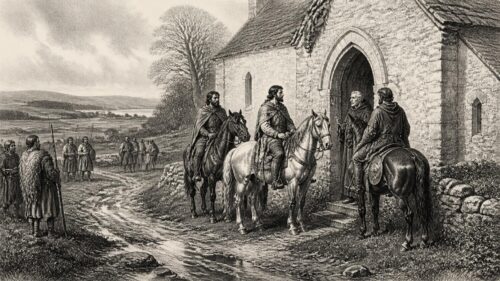
During 1243 Ó Raigillig released Tadhg. The annals then place him at the monastery of Boyle, on the eastern side of Lough Key, before he travelled with followers to the household of Cormac Mac Diarmata, lord of Muintir Máel Ruanaid in Moylurg. There Tadhg captured Cormac and, more startlingly, took Cormac’s wife Étáin, daughter of Finghin Mór Mac Carthaig. Étáin was also Tadhg’s own mother. He delivered her to Cú Chonnacht Ó Raigillig as the price of his own ransom, and the source says that she was given to Ó Raigillig as a wife.
The episode needs to be described carefully. The annals record an aristocratic woman being transferred under compulsion between men who were connected by marriage and kinship; they do not tell us Étáin’s wishes. Nor should the language of ransom obscure the human reality. Hostages, marital alliances and captives were not marginal features of high politics. They were among the means through which rulers secured obedience, settled obligations and humiliated rivals. Étáin’s Munster ancestry also indicates the breadth of elite networks: the Mac Carthaigs were a major southern dynasty, while the struggle being played out here lay around Connacht and Bréifne.
The Meeting at Martinmas
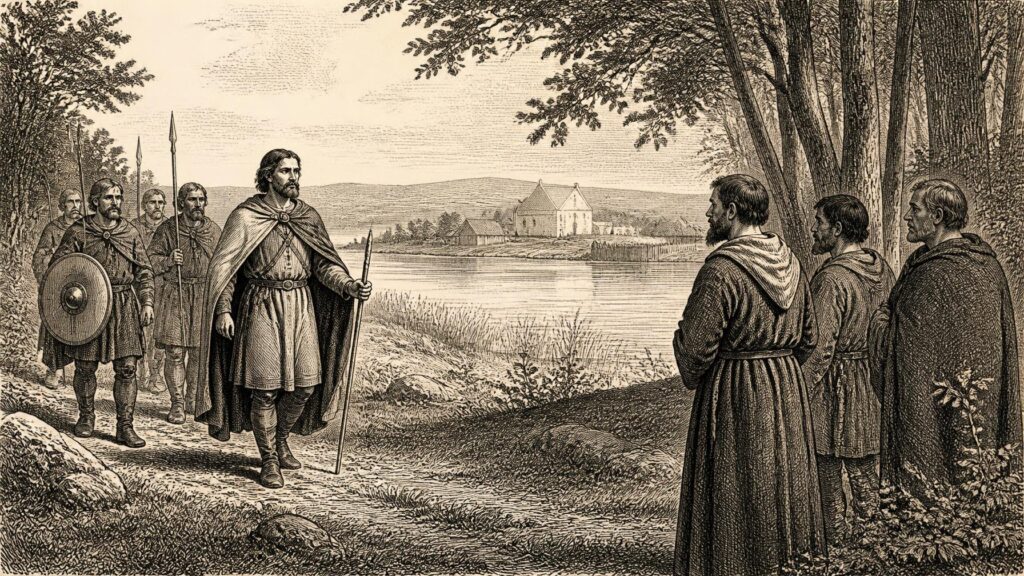
Tadhg’s recovery of freedom did not last. At Martinmas, 11 November, he went with only a small company to a meeting arranged with Ó Raigillig. The annals describe what followed as treachery: Tadhg was seized, his followers were killed, and he remained a prisoner into the following spring. This is one of the year’s most securely placed moments, because both the Annals of Connacht and the Annals of the Four Masters connect it explicitly with the feast of St Martin.
It was not, however, a private quarrel confined to two men. Tadhg’s seizure had immediately widened the rift between the Ó Conchobairs and the Ó Raigilligs. The following year’s annals record his mutilation and execution at the feast of St Berach, and a retaliatory expedition by Fedlimid into Bréifne. Those later events should not be compressed into 1243, but they show why the Martinmas arrest mattered: it removed a potential Connacht contender and turned an uneasy relationship between neighbouring powers into open conflict.
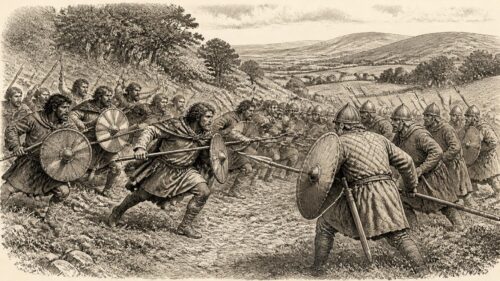
The year also saw a rapid change of allegiance by Cathal, son of Áed Ó Conchobair, who had been fostered by Muintir Raigillig. Fostering was a durable political bond, creating obligations between a child’s natal family and the household that raised him. Yet Cathal turned against his foster-kin. He raided Muirchertach Mac Gilla Súiligh in Magh Nise, captured and killed him at Cill tSesin, and then attacked Clann Fermaige and Dartry. A further raid on Magh Réin was followed, the Annals of Connacht state, by war between Ó Conchobair and Ó Raigillig.
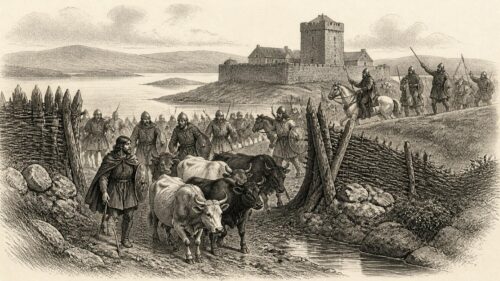
Such notices reveal the practical texture of conflict. A crech, or raid, was not simply a battlefield encounter. It threatened livestock, food stores, dependants and the authority of a local lord, while compelling communities to provide protection, supplies and intelligence. The sources do not permit a reconstruction of each raid’s material losses, and they give no evidence for famine or environmental crisis in 1243. They do show, nonetheless, that insecurity reached beyond dynastic leaders into the territories from which those leaders drew wealth and followers.
Boyle, Ardcarne and Learned Clergy
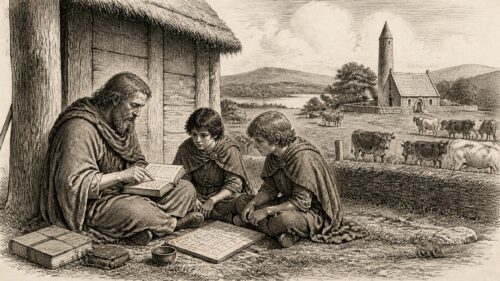
The year’s ecclesiastical notices offer a different view of the same region. Petrus Mac Raith died after dedicating his life to the canons of Trinity Island on Lough Key and was buried at Martinmas. His burial connects religious life to the lake landscape and to a community of regular canons that had strong local patrons. Boyle monastery, where Tadhg had gathered his force earlier in the year, appears in the political record as well as the devotional one. Monastic houses could offer burial, hospitality, literacy and a recognised place for negotiation, but their proximity did not guarantee immunity from secular conflict.
Several clerical deaths were recorded with striking precision of office and place. Máel Eóin Ó Crecháin, archdeacon of Tuam, died in Dublin after returning from overseas as a magister, or master. The wording strongly suggests advanced study abroad, followed by a return to Ireland’s principal colonial town. Finnachta Ó Lugadha, coarb of St Benén and archdeacon of Tuam, died around Martinmas. Cathasach Ó Snedhusa, dean of Muintir Máel Ruanaid, died at Ardcarne on 10 August, the feast of St Lawrence.
These were not interchangeable titles. A coarb held a hereditary or successor’s ecclesiastical office associated with a saint; an archdeacon and dean belonged to the developing diocesan structure. Their appearance together in one year’s notices demonstrates that older Irish ecclesiastical traditions and continental-style church administration operated side by side. Máel Eóin’s study overseas further reminds us that Irish clerics moved through wider intellectual networks, even while local church offices remained embedded in dynastic society.
Ardcarne itself was altered in 1243. Clarus Mac Mailin enlarged its church. The annal supplies no architectural description, so it would be unsafe to claim a new nave, tower or monastic foundation. Enlargement alone is significant: it records investment in a religious building amid political violence and after the death of the local dean. The work points to an institution capable of attracting patronage and labour, and to a landscape in which churches remained central places of worship, commemoration and local status.
An Overseas Death
Irish affairs were also linked directly to Henry III’s continuing war with the French crown. The campaign had begun in 1242 in an attempt to recover influence in Poitou; in 1243 the annals record that envoys came from the king of England seeking assistance from the English of Ireland. Richard, son of William de Burgh, lord of Connacht and a leading Anglo-Irish magnate, went overseas and died on the expedition.
Richard de Burgh’s death was consequential for Ireland, although it took place abroad. His family’s lordship in Connacht had been built through royal service, land grants and participation in the conquest of the province after 1235. The Irish annalists’ decision to note his death within an account otherwise dominated by Connacht politics shows that the Irish Sea was not a boundary to political life. Military obligation to Henry III could remove a major lord from Ireland, while royal campaigns in France drew on the resources and loyalties of the Lordship of Ireland.
It is important to avoid a common error here. Richard’s successor in 1243 was his eldest son, also Richard; Walter de Burgh did not become lord of Connacht until his elder brother died later in the decade. Walter’s eventual prominence as earl of Ulster should not be projected backwards onto this year.
A Problem of Dating
The Annals of Connacht also enter the death of Hugh de Lacy, earl of Ulster, under 1243 and attach to it a vivid account of a killing at Durrow. Modern scholarship identifies a chronological problem. Hugh, earl of Ulster, died in late 1242 or very early 1243, while the Durrow murder narrative belongs to his father, Hugh de Lacy, lord of Meath, who was killed there in 1186. The notice is valuable evidence of how later annalistic memory could combine men of the same name, but it is not secure proof that the earl was murdered at Durrow in 1243.
That caution is essential to the year as a whole. The principal annals preserve contemporary-looking calendar entries, but they were compiled and copied later, and their chronology occasionally requires checking against documentary and modern scholarly evidence. For 1243, the clearest picture is therefore not a neatly unified national story. It is a connected Irish world: a Connacht prince betrayed at Martinmas; Bréifne and Connacht moving towards war; churches and clerics sustaining institutional life; and an Anglo-Irish lord dying while serving a king across the sea.
Primary Sources
- Annála Connacht: Annal 1243
- The Annals of Connacht
- Annals of the Four Masters: Irish Text, Annal 1243
- Annals of the Four Masters: English Translation, Annal 1243
- The Annals of Ulster: Year U1243
- Annála Connacht: Bibliographical and Editorial Background
- Burgh, Richard de
- Burgh, Walter de
- Lacy, Hugh de
- Conclusion – Hugh de Lacy, First Earl of Ulster
- Fine Roll C 60/40A, 27 Henry III (1242–1243)
- Close Rolls: Calendar of the Close Rolls, Henry III, 1242–1247
- Rôles Gascons, Tome I
- Gazetteer of Markets and Fairs to 1516: Full Introduction
- Abbeyknockmoy Cistercian Abbey
- Religious Orders
- Letter from Stephen of Lexington to the Abbot of Shrule (Letter 55)
- Farming and Archaeology: The Irish Historic Landscape
- The Medieval Rural Settlement Project
- Buttevant Archaeological Report: Introduction
- Youghal Town Wall Conservation and Management Plan
- Newtown Jerpoint, County Kilkenny: Conservation Plan
- Cork Trade
- Saintonge Green Glazed Wine Jug