Druim Grecraige’s Decisive Rout1233 CE
In 1233 Feidlimid mac Cathail Chrobderg Ua Conchobair regained Connacht after his coalition, assembled with Cormac Mac Diarmata at Druim Grecraige, routed and killed his cousin Áed mac Ruaidrí and leading supporters. The victory displaced Ruaidrí Ua Conchobair’s descendants, despite Anglo-Norman involvement on both sides. Annalists interpreted Áed’s defeat through alleged crimes against churches, but their accounts also record political propaganda. Feidlimid destroyed four rival castles, including Bun Gaillme and Dunamon, asserting territorial control and imposing praised order. In Breifne, Cathal Ua Ráigillig’s forces defeated William de Lacy’s raiders. Obituaries illuminate church households’ roles in landholding, hospitality, mediation and welfare.
Dateline
The decisive Irish development of 1233 was the violent recovery of Connacht’s kingship by Feidlimid mac Cathail Chrobderg Ua Conchobair. In an encounter whose precise date and exact battlefield cannot now be fixed, Feidlimid’s coalition routed the followers of his cousin Áed mac Ruaidrí Ua Conchobair. Áed, recognised in the annals as king of Connacht, was killed, together with close kinsmen and numerous adherents. The victory ended the immediate predominance of the descendants of Ruaidrí Ua Conchobair, the last high king of Ireland, and installed Feidlimid as the effective ruler of the province.
This was no simple contest between an Irish kingdom and an outside conqueror. Connacht’s politics had been fractured by rivalry within the Ua Conchobair dynasty and by the interventions of Anglo-Norman magnates, especially Richard de Burgh. Feidlimid’s rise had itself been shaped by that unstable relationship. He had been imprisoned by de Burgh at Meelick in 1231, while Áed mac Ruaidrí was restored. Political changes in the wider English realm then weakened de Burgh’s position. Feidlimid had been released by 1232, and the following year he was able to turn a return from captivity into a bid for provincial supremacy. That preceding background explains the crisis of 1233, but it should not obscure the fact that the year’s outcome depended upon Connacht alliances and fighting on the ground.
A Camp at Druim Grecraige
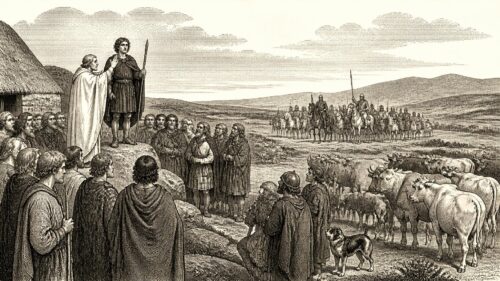
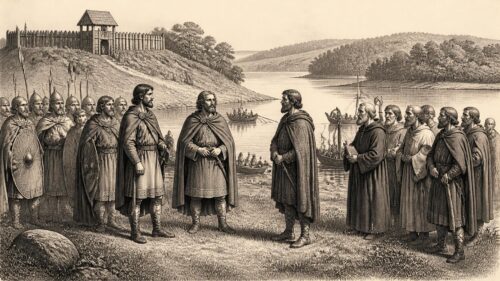
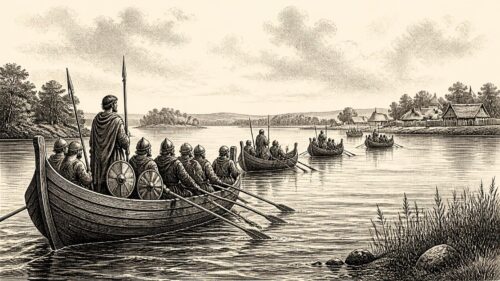
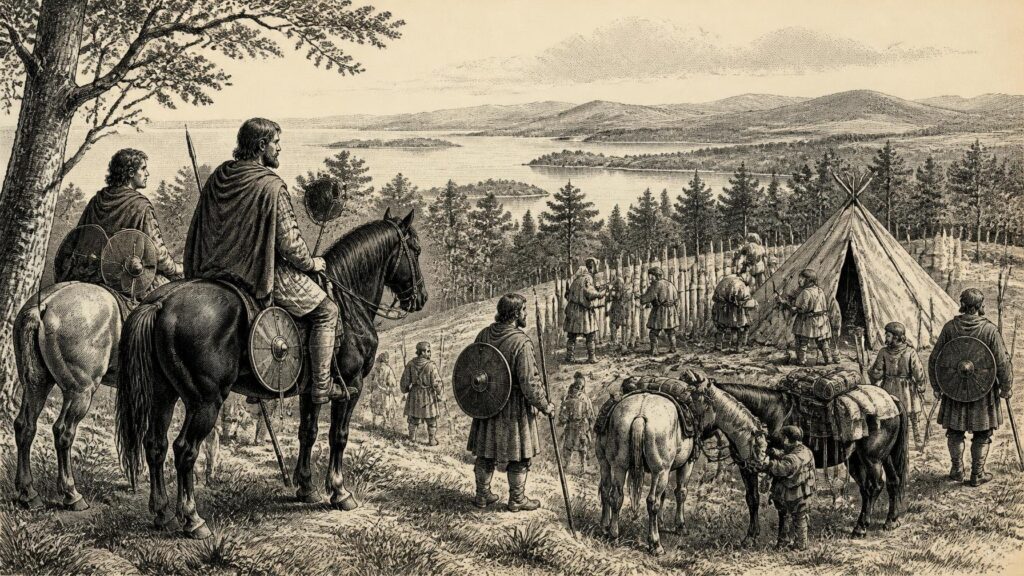
The fullest accounts are preserved in the Annals of Connacht and the Annals of Loch Cé, later chronicles drawing on regional traditions. They agree that Feidlimid entered Connacht and was met by Cormac mac Tomaltaig Mac Diarmata, king of Moylurg. Cormac brought him into Moylurg, centred around the later Lough Key region, where they made camp at Druim Grecraige. Their gathering included Cormac’s son Conchobar, the “three Tuatha”, and Donnchad and Muirchertach, sons of Muirchertach Mac Diarmata. The names matter: Feidlimid’s victory was made by a coalition of kin-groups and local lordships, not by a permanent national army.
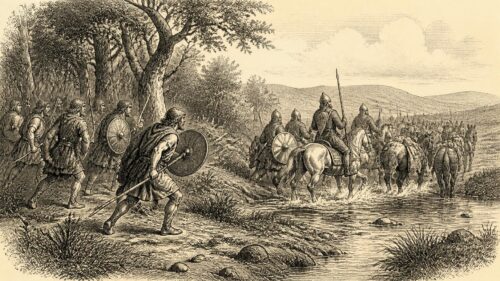
From the camp, the allies resolved to pursue Áed mac Ruaidrí and the wider branch of Ruaidrí’s descendants. The annals call the resulting defeat a rout and dispersal. They name the dead: Áed himself; his brother Áed Muimnech; the latter’s son; Donnchad Mór, son of Diarmait and grandson of Ruaidrí; and many others left uncounted. Raghallach Ua Flannacáin also fell. Several men described as Galla—foreigners, normally Anglo-Norman settlers or soldiers in this context—were killed alongside Áed’s party, including Thomas Biris, called constable of Ireland, and his brother. Their presence demonstrates that Connacht dynastic warfare crossed the supposed boundary between Gaelic and settler politics. Lords and fighting men made alliances according to immediate advantage.
No source supplies troop totals, tactics, or a securely identifiable battle site beyond the campaign’s association with Druim Grecraige. It would therefore be wrong to imagine a set-piece battle with known formations. Yet the political result is unambiguous. The Connacht annalist says that kingship and sovereignty were taken from Ruaidrí’s line “on that day”. A short commemorative verse records that Áed had ruled Connacht for five years before falling to Feidlimid. Such language reflects the annalist’s judgement, but it captures the scale of the dynastic reversal.
Churches, Curses and Political Memory
The victory was narrated as more than an armed success. The Connacht and Ulster annals state that Áed Muimnech had violated the sanctuary of Tech Báethín, usually identified with Tibohine in modern County Roscommon, and that churches and ecclesiastical sites had been plundered. The chroniclers accordingly presented the deaths of Áed’s party as retribution for offences against saints and churches. They also say that the foreign supporters killed in the fighting had previously been cursed and excommunicated by Connacht churchmen; the Annals of Loch Cé adds the image of extinguished candles.
These claims reveal the force of ecclesiastical authority in political language, though they should not be repeated as neutral proof that divine judgement caused the outcome. Church sanctuary was a practical protection as well as a sacred principle, and attacks on churches were serious acts in the political morality of the period. Annalists could condemn enemies, validate a victor and explain a changing fortune through the same religious framework. The year’s accounts thus preserve both evidence of violence against ecclesiastical property and a carefully fashioned moral interpretation of it.
The same caution is needed for a striking story attached to the extinction of Ruaidrí’s line in Connacht. The Annals of Connacht says that a pope had offered Ruaidrí the right to Ireland, hereditary succession and six lawful wives if he would renounce adultery; because he refused, God supposedly deprived his descendants of rule. This is not corroborated as a papal negotiation and should be read as retrospective, moralising political commentary. Its importance lies in what it says about the annalist’s values: legitimate rulership, sexual conduct and divine favour were presented as inseparable.
Breaking the Castles
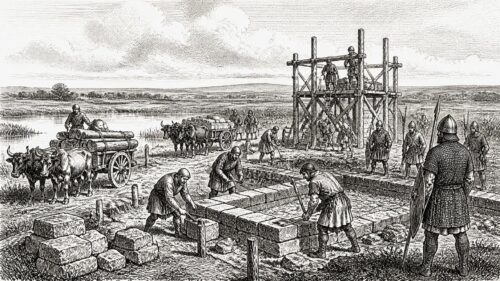
Feidlimid followed victory with an emphatic attack on rival power bases. The Connacht annals list four castles demolished under his authority: Bun Gaillme at the mouth of the Galway, Hen’s Castle, Hag’s Castle and Dunamon. The Annals of Ulster independently confirms the razing of Hag’s Castle and Bun Gaillme. These were not interchangeable buildings in a blank landscape. They stood at river crossings, lake-islands or coastal and inland routes where a lord could shelter a garrison, control movement, protect stores and project a claim over surrounding people and resources.
The demolition of Bun Gaillme is especially revealing. A castle there had been erected in 1232, and the place-name evidence connects it with the earlier fortification at the mouth of the River Galway—not with the later medieval town as a finished urban centre. Dunamon, on the River Suck, had likewise been fortified in 1232. Destroying such recently established positions denied opponents secure footholds and made visible Feidlimid’s rejection of the arrangements associated with Richard de Burgh and the sons of Ruaidrí. It was a policy of territorial politics, not merely vengeance after battle.
The annalist then declares that peace and discipline were immediately imposed on Connacht’s armed bands and “malefactors” during the rule of the young king. This should be treated as praise for Feidlimid rather than a measurable report of crime. Still, it indicates what contemporaries expected from a successful provincial king: restraint of predatory followers, settlement of disputes and security for communities exposed to raids. In a society where cattle, food stores and hostages were central instruments of wealth and coercion, those expectations had direct consequences for ordinary households.
Defeat in Breifne
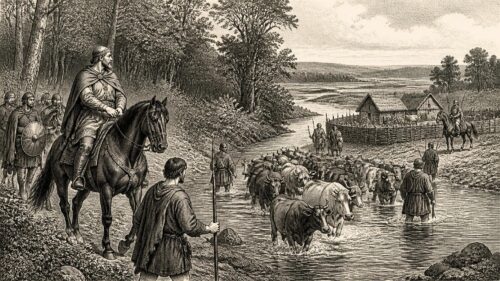
Elsewhere, 1233 showed that Anglo-Norman military power was far from irresistible. William de Lacy, son of Hugh de Lacy and of a daughter of Ruaidrí Ua Conchobair, led a large force of men from Meath into Breifne against Cathal Ua Ráigillig and his brother Cú Chonnacht. The expedition took substantial prey, probably livestock, but an Ua Ráigillig force attacked the raiders as they withdrew at Móin Crandchain. William Brit and other prominent foreigners were killed. William de Lacy, Charles son of Cathal Gall Ua Conchobair, Piers the Fair-haired and Diarmait Bernach Ua Máel Sechlainn were wounded; the Connacht and Loch Cé annals say that leading wounded men died later at home.
The invaders returned without pledges or hostages, the formal tokens through which lords sought to enforce submission. The episode is a useful corrective to any picture of a one-directional conquest. The lordship based in Dublin had considerable resources, but its forces relied upon local alliances, vulnerable supply and retreat routes, and the ability to turn plunder into durable political obedience. In Breifne, the raiders achieved the first and failed at the last.
Households of Church and Land
The year’s obituaries offer a quieter view of authority. Donn Cathaig, erenagh of Aghagower, died on 15 December. An erenagh was a leading hereditary church official, closely connected to the management of ecclesiastical lands and local obligations. The annalist praised him as a giver of cattle and food, a protector of both weak and powerful, and a reconciler of disputes. However formulaic the language, it points towards the social work expected of a prosperous church household: hospitality, relief, patronage and mediation.
Máel Ísu Ua Máenaigh, a priest said to recite his psalter every day except Sunday, also died, as did Fergal Mac Cormaic. The Annals of Ulster additionally records the death of Geoffrey Ua Dáighri, herenagh of Derry, linking 1233’s local Connacht narrative to the wider ecclesiastical geography of Ireland. These notices do not describe ordinary life in detail, but they show the institutions through which learning, liturgy, landholding and social care were maintained.
For Ireland, 1233 was therefore a year in which power changed hands dramatically in Connacht while remaining contested everywhere around it. Feidlimid’s triumph at Druim Grecraige, the destruction of rival castles and the setback suffered by de Lacy’s expedition all demonstrate that lordship rested on shifting alliances, fortified places, church approval and the capacity to control armed men. The settlement was real, but not final: the contest for Connacht would resume with force in the years ahead.
Primary Sources
- Annála Connacht: Annal 1233
- The Annals of Ulster: Year U1233
- Annals of Loch Cé: Annal LC1233
- Annála Connacht: original Irish text, Annal 1233
- Annals of Loch Cé: original Irish text, Annal LC1233
- O'Connor (Ó Conchobair), Fedlimid
- O'Melaghlin (Ó Máel Shechlainn), Cormac
- Annála Connacht: Annals 1224–1228
- The Annals of Ulster: entries for 1231–1235
- Annála Connacht: CELT project and edition information
- Annals of the Four Masters: CELT project and edition information
- Annals of the Four Masters: English translation edition
- Gaillimh/Galway
- Castlekirk Castle
- Heritage Audit of Creggs & District
- Ireland in the Middle Ages
- Annals of Connacht (AD 1224–1544)
- The Annals of the Four Masters, MS C iii 3
- Exploring the Irish Annals
- The Annals of the Kingdom of Ireland: table of contents