A Year of Unsettled Succession1198 CE
1198 in Ireland saw contested succession, ecclesiastical change and continuing regional conflict, though annalistic sources disagree over dates. Ruaidrí Ua Conchobair died around 1198–99 after retirement, symbolising the decline of an older high-kingship amid divided Connacht and entrenched English lordship. Cathal Carrach killed a dynastic rival, while a temporary peace with Cathal Crobderg sought to restrain their struggle. Gilla-Crist Ua Cernaigh succeeded Gilla Mac Liac Ua Brenáin as comarba of Colum Cille, affirming northern church authority. A castle at Ardpatrick reflected expanding lordship. Gaelic rulers, churches and Anglo-Norman magnates retained competing power across a politically fragmented island during this period.
Dateline
For Ireland, 1198 is a year best understood through a small number of carefully recorded changes rather than a single island-wide turning point. The surviving annals place a disputed royal death, a killing within the Connacht dynasty, an important ecclesiastical succession associated with Colum Cille, and several political settlements or campaigns in this year. Yet the evidence also demonstrates a perennial difficulty of medieval Irish chronology: different annalistic compilations sometimes assign the same occurrence to adjacent years. The result is not an empty year, but a year that calls for caution. It reveals a politically divided island in which Gaelic dynasties, church communities and the expanding English lordship all exercised authority, often in close proximity and sometimes in conflict.
Evidence and Its Limits
The Annals of Ulster, whose entry is explicitly headed 1198, records three matters: the resignation of Gilla Mac Liac Ua Brenáin from the succession of Colum Cille; the ordination of Gilla-Crist Ua Cernaigh in his place by the clergy and laity of northern Ireland; and the killing of a son of Brian of Bréifne, himself a son of Toirdelbach Ua Conchobair, by Cathal Carrach, son of Conchobar Máenmaige. The annal then remarks that this may be the proper year for the death of Ruaidrí Ua Conchobair. That last phrase is unusually revealing: even a learned annalistic tradition could preserve uncertainty about the proper placement of a major death.
Other compilations are fuller, but must not be treated as simple contemporary diaries. The Annals of the Four Masters, compiled centuries later from earlier material, places Ruaidrí’s death at Cong in 1198, adds his burial at Clonmacnoise, and records a peace between Cathal Crobderg and Cathal Carrach. It also assigns northern warfare involving John de Courcy and Áed Ua Néill to 1198; the closely related Annals of Ulster places that campaign under 1199. Mac Carthaigh’s Book similarly places several events, including a castle at Ardpatrick and a change of ruler in Thomond, under 1198. These discrepancies are not a licence to choose whichever date is most dramatic. They mean that firmly dated annual events must be separated from developments connected to 1198 by one important medieval chronology but allocated elsewhere by another.
Connacht: A Dynasty Under Pressure
The killing reported in the Annals of Ulster belonged to the prolonged struggle for Connacht within the powerful Síl Muiredaig branch of the Ua Conchobair dynasty. Cathal Carrach, the killer, was a son of Conchobar Máenmaige, who had been assassinated in 1189. His rival was Cathal Crobderg, brother of the former high king Ruaidrí. Neither man represented a tidy succession. Kingship in Gaelic Ireland was not automatically inherited by the eldest son: eligibility rested within a wider ruling kin-group, and authority depended on alliances, hostages, military following and the recognition of subordinate rulers.
The victim in 1198 was another member of this extended royal family. His death therefore indicates not a distant feud but the continuing removal of potential rivals in a contested political field. Such killings had consequences beyond a single household. Connacht’s rulers drew revenue and military service from subject territories, controlled access to routes across the Shannon and western midlands, and negotiated with neighbouring kingdoms and English lords. Instability at the centre could alter the calculations of local kings, churchmen and outside powers alike.
A settlement between the two Cathals is reported under 1198 by the Annals of the Four Masters: Cathal Crobderg made peace with Cathal Carrach, brought him into the country and granted him land. Because the Annals of Ulster assigns a comparable peace to 1199, the agreement is best treated as belonging to the 1198–99 moment rather than securely dated to a particular day or season. Its significance is clear nonetheless. It was a pragmatic effort to contain a dynastic dispute, not a final resolution. The contest would reopen, drawing in English and Gaelic allies and culminating only in 1202 with Cathal Carrach’s death.
Ruaidrí’s Death and a Changed Ireland
Ruaidrí Ua Conchobair’s death is the year’s most resonant event, although its exact annalistic placement is contested. The Annals of Ulster signals uncertainty under 1198 and enters his death under 1199. The Annals of the Four Masters and Mac Carthaigh’s Book place it in 1198, describing him as dying after religious retirement at Cong. The broad conclusion is secure: Ruaidrí died around the end of 1198 or at the beginning of 1199, after having withdrawn long before from the active exercise of power.
His passing nevertheless marked the fading of a political generation. Ruaidrí had been king of Connacht and had exercised high-kingship during the years in which Diarmait Mac Murchada sought overseas assistance, Anglo-Norman forces arrived, and Henry II came to Ireland in 1171. His political world had been one of overkingship, negotiated submission and shifting inter-provincial alliances. By the time of his death, the claims associated with a high king of Ireland had not vanished, but no ruler commanded the authority Ruaidrí had once sought to exercise. His own dynasty was divided, while English royal claims and lordships had become a durable part of the political landscape.
The traditional account that Ruaidrí died as a penitent among the canons at Cong should not obscure his earlier stature or reduce his career to inevitable decline. Nor should it imply that English power had conquered Ireland as a whole. In 1198, much of the island remained under Gaelic rulers. What had changed was the framework in which they acted: Connacht, Meath, Leinster, Munster and Ulster were increasingly connected by campaigns, alliances and claims that crossed the Irish Sea.
Colum Cille’s Succession in the North
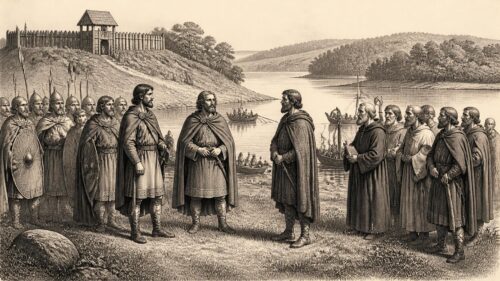
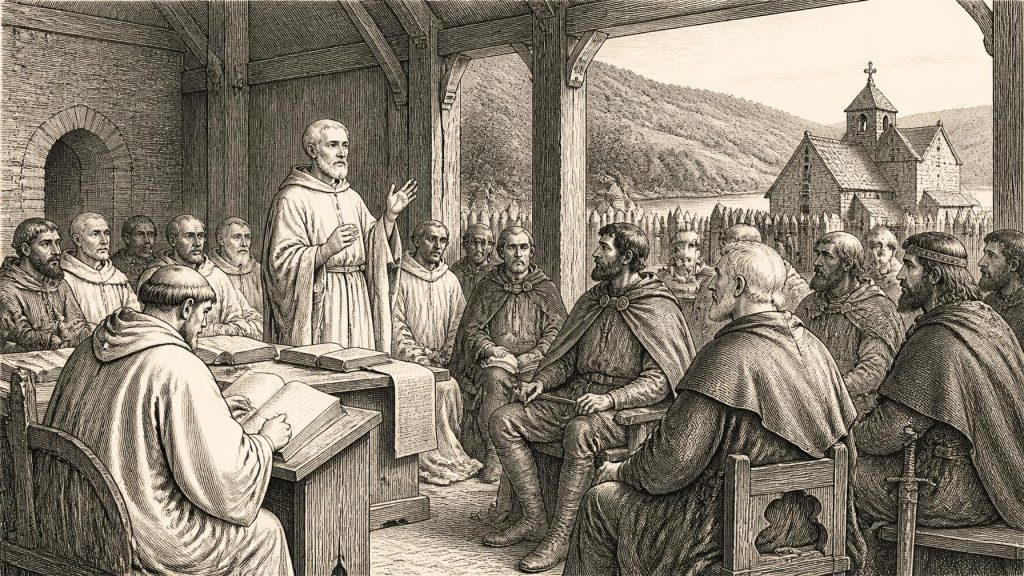
The clearest securely placed event of 1198 is ecclesiastical. Gilla Mac Liac Ua Brenáin gave up the succession, or comarba, of Colum Cille, and Gilla-Crist Ua Cernaigh was ordained in his stead through the choice of the laity and clergy of northern Ireland. The annal calls this the abbacy of Colum Cille. In this period, such an office was not merely devotional. The Columban federation linked major churches, dependent communities, landholding, relics, learning and regional influence. Its leading office-holder could command spiritual prestige and practical resources.
The wording deserves notice. The selection was made by both clergy and laity, suggesting a public, corporate process rather than the private appointment of an isolated cleric. It also points to the continued importance of older Irish ecclesiastical structures alongside the diocesan reforms of the twelfth century. Bishops, dioceses, Augustinian houses and other reforming institutions were growing in prominence, but the great federations associated with saints such as Patrick and Colum Cille still mattered deeply. Derry, the chief Columban church in Ireland, stood within a northern zone where religious institutions were vulnerable to warfare yet remained crucial mediators of legitimacy and memory.
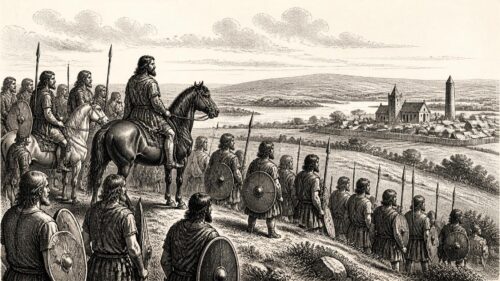
The event should not be mistaken for evidence of a peaceful north. Only the previous year, John de Courcy’s forces had campaigned as far as Derry and Inishowen. The following annalistic year records another destructive expedition and a successful response by Áed Ua Néill. Whether that second campaign belongs precisely to 1198 or 1199, the new Columban successor entered office amid regional insecurity. The election therefore had a practical importance: continuity in the leadership of a major church could help preserve claims, property and communal authority when secular power was contested.
English Lordship, Castles and Regional Change
The English lordship in Ireland was established but far from uniform. Its strongest urban and landed bases lay in and around Dublin, the south-east, Meath and parts of Munster; its northern frontier rested heavily on the personal power of John de Courcy in eastern Ulster. Lord John, later King John of England, held the title Lord of Ireland, but he did not govern the island through a settled central administration capable of directing every local lord. Magnates such as de Courcy and Walter de Lacy exercised substantial initiative, while Gaelic rulers remained indispensable actors.
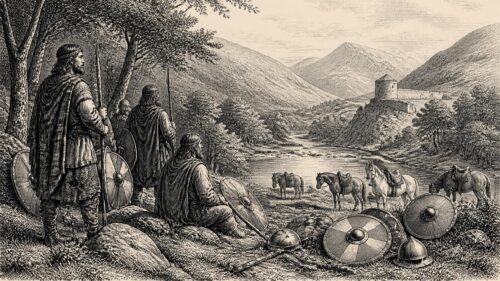
For 1198 itself, Mac Carthaigh’s Book records a castle built by ‘the foreigners’ at Ardpatrick in Munster. The notice is brief and should not be expanded into a detailed story of construction, garrison or conquest that the evidence cannot bear. Still, it fits the wider regional pattern. Castles were instruments for asserting lordship, protecting routes, storing supplies, receiving renders and concentrating settlement. They did not simply replace existing Irish society. In areas of intensive colonisation, newcomers founded or reshaped manors and boroughs, while many Irish cultivators and local elites remained on the land, adapting to altered obligations and opportunities.
Everyday life was consequently varied. Most people lived in rural communities, producing livestock, cereals, dairy goods, fuel and craft materials from their local landscapes. Cattle remained central to wealth and raiding in Gaelic politics, while grain, mills, markets and rents were increasingly important in manorial districts. Dublin, Waterford, Wexford, Limerick and smaller ports connected Irish producers and consumers with Britain and the wider Irish Sea. Nothing in the sources permits a special harvest, famine or commercial boom to be assigned to 1198; the responsible picture is one of continuing work and exchange under unequal, locally changing systems of power.
A Year Between Settlements
1198 was thus neither a year of national collapse nor a pause between more important events. It was a year in which the death of an old high king, violence among Connacht claimants and the succession to Colum Cille’s abbacy exposed the institutions through which medieval Ireland was governed. Dynastic power rested on kinship and force, but also on negotiated peace. Churches were places of worship and learning, but also centres of property, authority and political memory. English castles and lordships added a new layer of control without extinguishing Gaelic kingship.
The year’s uneven record is itself historically meaningful. Annalists preserved deaths, appointments, campaigns and settlements because these events disturbed, or restored, the expected order of society. Their differing chronologies caution against false precision. Read together, they show Ireland in 1198 as an island of many political communities: connected, contested and changing, but not yet commanded by any single power.
Primary Sources
- The Annals of Ulster: Year U1197
- The Annals of Ulster: Year U1198
- The Annals of Ulster: Year U1199
- The Annals of Ulster: Year U1200
- The Annals of Ulster: CELT Edition and Prefatory Material
- Annals of the Four Masters: Annal M1198 (English translation)
- Annals of the Four Masters: Annal M1198 (Irish text)
- Mac Carthaigh's Book: Annals 1196–1203
- Annals in Cotton MS. Titus A. XXV: 1198–1201
- Ruaidrí Ua Conchobair
- Ua Conchobair, Cathal Carrach
- Ua Conchobair, Cathal Mór Crobderg
- Courcy, John de
- Lacy, Walter de
- John
- Ua Conchobair, Tommaltach
- Iona and the Shrine of Columba, c. 800–1200
- From Kingdom to Colony: Framing the English Conquest of Ireland
- NARRATIVE: 1169 and all that
- The Transformation of the Irish Church in the Twelfth Century
- Medieval Rural Settlement: The Carlow Module
- The Dublin Region in the Middle Ages: Settlement, Land-Use and Economy