Great Wind1191 CE
In 1191, Ireland experienced political fragmentation, local violence and severe environmental disruption. Ruaidrí Ua Conchobair, the displaced former king of Connacht, travelled north and apparently sought wider support to recover power after dynastic conflict, but gained land rather than a decisive coalition. In Munster, Muirchertach son of Cathal Odar was treacherously killed by incoming Anglo-Norman forces, illustrating unstable frontier relations. Annals also record construction of Rath-cuanartaigh castle and deaths of prominent churchmen. Most notably, a great wind destroyed churches, homes and woodland, killing people and livestock, exposing communities’ dependence on vulnerable material resources amid competing Gaelic and foreign rival lordships.
Dateline
In 1191, Ireland’s surviving records preserve no single island-wide battle, royal settlement or great ecclesiastical assembly. Instead, they reveal a year in which political weakness, local violence and environmental shock exposed the fragile workings of power. The clearest political episode concerns Ruaidrí Ua Conchobair, formerly king of Connacht and, in an earlier generation, acknowledged by many contemporaries as king of Ireland. His unsuccessful search for allies showed how far his position had fallen. Meanwhile, an annalist in the south recorded the killing of a local noble by the recently arrived foreign power, and a violent wind was said to have brought down churches, houses and woodland and caused heavy mortality among people and livestock. These were not separate worlds: lordship rested upon people, animals, harvests, buildings and obligations, all vulnerable to warfare and weather.
A Dispossessed King
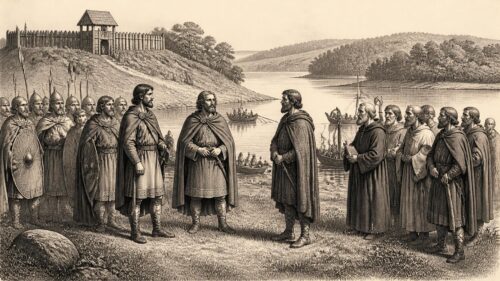
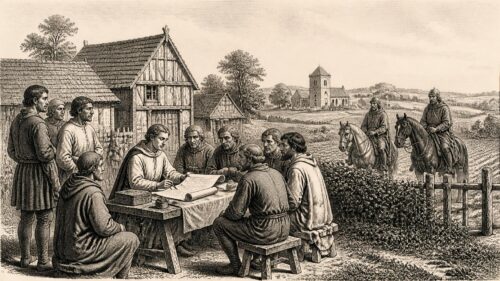
The most substantial narrative assigned to 1191 is Ruaidrí’s journey from Connacht. The Annals of Ulster and Annals of Loch Cé, which preserve a terse common notice, state that he left Connacht and went into Cenél Conaill, the powerful kingdom centred on what is now much of Donegal. The much later Annals of the Four Masters expands this into a striking itinerary: Ruaidrí sought forces first in Tír Chonaill, then in Tír Eógain, from the Ulstermen, from the English of Meath, and finally in Munster. That expanded account says that the northern rulers and the English of Meath declined to help him recover Connacht, while Síl Muiredaig, Ruaidrí’s own wider dynastic community, granted him lands in Tír Fhiachrach and in Cineaál Echtge instead.
The difference in detail matters. It is secure that annalistic tradition placed Ruaidrí’s departure for Cenél Conaill in 1191. The fuller route and reported refusals are valuable evidence, but come through a seventeenth-century compilation whose medieval chronology sometimes requires careful handling. Even so, the broad sequence accords with modern reconstruction of Connacht politics: Ruaidrí, an elderly and displaced ruler, was attempting to regain influence after the death of his son Conchobar Máenmaige in 1189, while his half-brother Cathal Crobderg was emerging as the principal claimant to the provincial kingship. The year should therefore not be presented as the restoration of an old high king. It was a failed bid for backing in a political landscape where kinship, regional interest and military calculation outweighed memories of former supremacy.
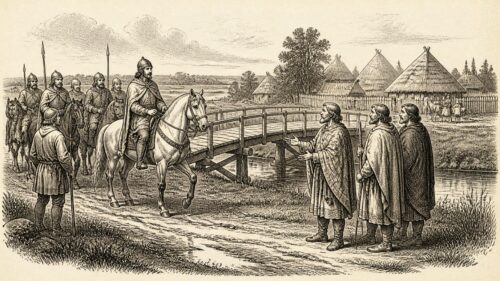
Ruaidrí’s appeal also illuminates the geography of Irish politics. His prospective supporters lay across the island: Cenél Conaill and Cenél nEógain in the north, Meath in the centre-east, and Munster in the south. Such movement was neither symbolic nor easy. A travelling king required escorts, provisions, messengers and trusted hosts; he had to negotiate access through territories controlled by rivals and allies alike. In this sense, the report tells us as much about the connectedness of elite Ireland as about its division. Yet those connections did not produce a coalition. The refusal attributed to the English of Meath is particularly revealing. Anglo-Norman settlement and lordship in Meath had created a formidable new military and political presence, but its leaders did not automatically commit resources to every Gaelic dynastic dispute. Their interests could be cautious, local and contingent.
Connacht’s Contested Crown
Connacht in 1191 was not a vacuum waiting to be filled by foreign conquest. It was a kingdom contested within the Ua Conchobair dynasty. Cathal Crobderg and Cathal Carrach, grandson of Ruaidrí through Conchobar Máenmaige, represented competing lines of succession; their uneasy relationship had already required negotiation at Clonfert in 1190. Ruaidrí’s own intervention was therefore one claim among several, albeit the claim of a man who had once stood at the summit of Irish kingship. Síl Muiredaig’s reported decision to give him land rather than an army may be read as a practical accommodation: it acknowledged his status and needs without overturning the emerging balance of power in Connacht.
This was dynastic politics rather than modern territorial government. Kingship depended on the ability to protect clients, extract renders, secure hostages and reward followers with land and cattle. A claimant without a reliable armed following could retain prestige but not command. Ruaidrí’s 1191 journey demonstrates that political legitimacy was negotiated afresh in each region. It also warns against treating Gaelic rulers and the English of Meath as two uniform blocs. Ruaidrí’s opponents, kinsmen, potential patrons and foreign neighbours all pursued overlapping interests, and alliances could cross linguistic and cultural boundaries.
Violence in Munster
The Annals of Inisfallen, written from a Munster perspective, records a separate and firmly year-dated killing: Muirchertach, son of Cathal Odar, was “treacherously slain” by the Gaill Ghlasa, rendered in the standard English translation as the “grey foreigners”. In the late twelfth-century context this designation refers to the incoming Anglo-Norman or English-associated military population, not to the earlier Viking categories with which the word Gall had long been associated. The entry does not name the place, motive, or the rank and affiliations of Muirchertach beyond his parentage. It would be unsafe to turn the notice into a detailed campaign. But its language of treachery records the human cost of the new power relations taking shape in southern Ireland.
The previous year’s Inisfallen entry gives essential but limited context. It describes the same foreign force raiding Durrus, taking a great prey, and then being defeated by Domnall Mac Carthaig and the men of Desmond, who recovered the booty. In 1191 no comparable battle is recorded; nor does the annal allow us to assume that Muirchertach’s death formed part of a general conquest. Rather, the two notices show that raiding, counter-raiding and targeted killing continued around the frontiers of lordship. Control was uneven. Foreign lords and settlers possessed armed capacity and coastal connections, but local Irish rulers could mobilise resistance and inflict serious reverses.
The Great Wind
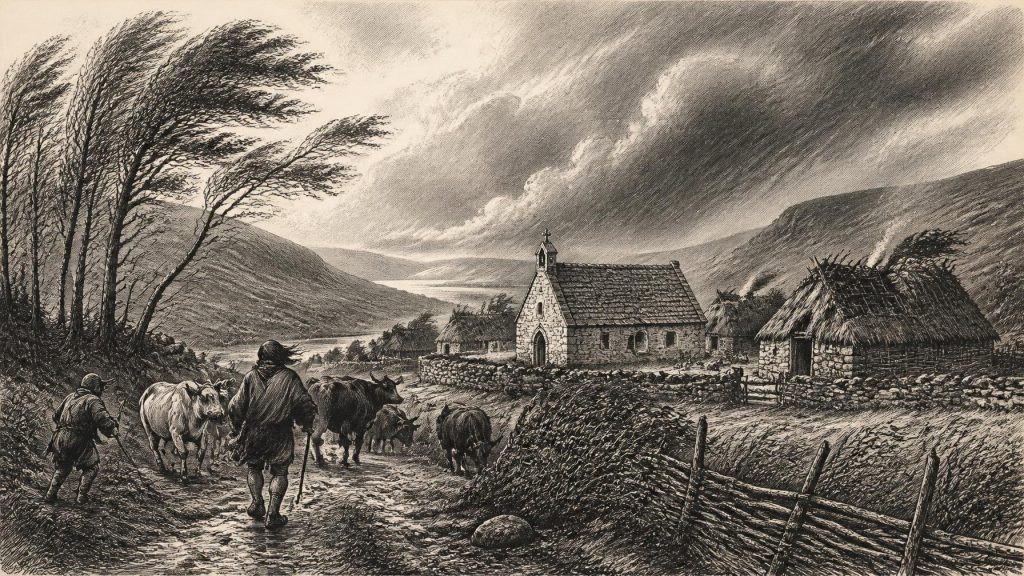
The year’s most far-reaching recorded experience was environmental. The Inisfallen annalist reports a violent wind that blew down churches, houses and woods and caused “great mortality” among the people and livestock of Ireland. Loch Cé independently preserves the shorter notice, “Great wind in this year.” The wording should not be converted into modern measurements of a nationwide storm, nor can the evidence tell us its precise date, duration or track. Medieval annals are selective human records rather than meteorological logs. Nonetheless, the unusually emphatic Inisfallen entry plainly treats the event as exceptional and socially consequential.
Its effects would have reached deeply into everyday life. Most people lived through mixed farming, pastoralism and the labour of households whose buildings were vulnerable to wind damage. The loss of cattle, sheep or horses threatened food supplies, dairy production, traction and a family’s capacity to meet dues. Fallen trees could block routes, damage fences and deprive communities of valuable timber, while ruined churches were both a spiritual affront and a practical burden on local congregations and patrons. The annal’s inclusion of houses alongside churches is especially important: it records disruption extending beyond aristocratic or monastic institutions. Yet the source does not report famine, and it cannot establish the scale of losses in every district. What can responsibly be said is that weather became one of the defining pressures of 1191, alongside war and succession.
Fortification and Religious Life
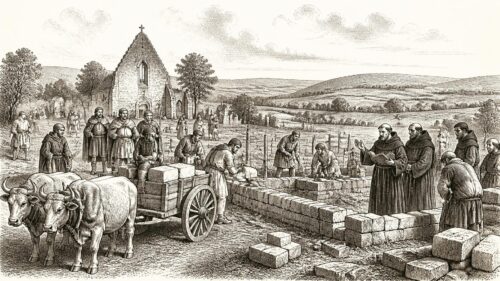
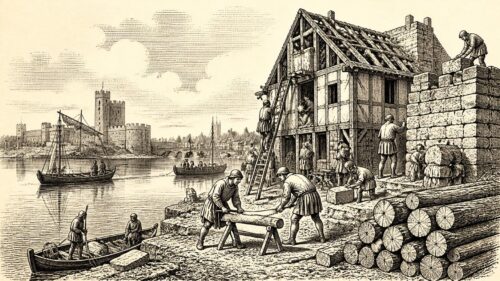
Loch Cé also records that “the castle of Rath-cuanartaigh was built” in 1191. No builder, location, material or political purpose is supplied in the entry. It must therefore remain an important but opaque sign of regional change, not evidence for a confidently mapped campaign or an identified Anglo-Norman foundation. In late twelfth-century Ireland, however, castles—often initially earth-and-timber works—were increasingly instruments through which lords watched routes, stored resources, protected followers and asserted claims over surrounding land. Their spread was concentrated especially in the east, north-east Munster and parts of Ulster, while their relative scarcity in the west reflects the limits of colonial penetration. Rath-cuanartaigh belongs to that larger era of fortified lordship, even though its particular story is lost.
The annals also mark religious continuity amid disorder. Inisfallen records the deaths of Abbot Mac Muige and Bishop Ua Muirchertaig. Loch Cé adds the death of Domnall, son of Máel Ísu Mac an Abaid, and of Echthigern, described as a senior ecclesiastic of Ireland associated with Clonard. Such obituaries are brief, but they remind us that monasteries, churches and episcopal centres remained places of learning, record-keeping, commemoration and political influence. The very survival of these notices owes much to ecclesiastical scribes. Their priorities shape the picture: deaths of churchmen, the destruction of sacred buildings and extraordinary weather could be as historically significant to them as the movements of kings.
A Year of Exposure
1191 was therefore not a quiet interval between more dramatic events. Ruaidrí Ua Conchobair’s fruitless search for assistance exposed the fragmentation of authority in Connacht and beyond. Muirchertach son of Cathal Odar’s killing revealed continuing danger on Munster’s contested frontiers. The building of Rath-cuanartaigh registered investment in defence and control, though without enough detail to assign it to a particular lord. Above all, the great wind showed that political ambitions rested on a precarious material world. Houses, churches, woodland, livestock and people could all be damaged in a single season. The year’s sparse notices are consequently powerful: they show Ireland as a land of competing kingships and expanding lordships, but also of communities for whom survival, repair and recovery were immediate historical concerns.
Primary Sources
- Annals of Inisfallen: Annal AI1191
- Annals of Inisfallen: Editorial and Manuscript Information
- The Annals of Ulster
- Annals of Loch Cé
- Annals of the Four Masters: Annal M1191
- Annals of the Four Masters: Editorial and Chronological Information
- Ua Conchobair, Ruaidrí
- Ua Conchobair, Cathal Mór Crobderg
- Ua Conchobair, Cathal Carrach
- Lacy, Walter de
- Lacy, Hugh de (I)
- Courcy, John de
- From Kingdom to Colony: Framing the English Conquest of Ireland
- King and Magnate in Medieval Ireland: Walter de Lacy, King Richard and King John
- Colonisation and Conquest in Medieval Ireland: The English in Louth, 1170–1330
- Colonial Society in Co. Louth, 1150–1450
- The Black and White Foreigners
- Assessing Non-climatic Influences on the Record of Extreme Weather Events in the Irish Annals
- Mount Ash, Knockbridge: Motte-Castle Context
- Carlingford: King John’s Castle