Cell Móna’s Broken Alliance970 CE
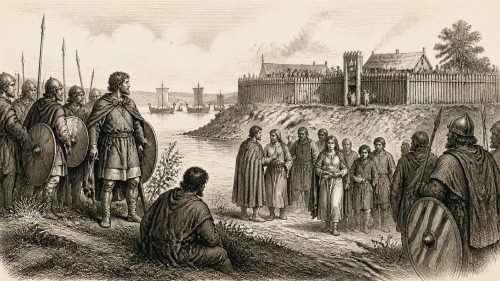
In 970, annalistic evidence records conflict across northern and midland Ireland. Amlaíb Cuarán of Dublin and Domnall mac Congalaig of Brega defeated Domnall ua Néill, king of Tara, at Cell Móna, where several regional kings died. Amlaíb had earlier raided Kells with foreigners and Leinster allies, seizing cattle and defeating Uí Néill forces. Campaigning also brought atrocities: Ardgar of Ulaid sacked Conaire, while Domnall ua Néill retaliated by attacking Louth monasteries, including Lann Léire, where hundreds were burned. The sources reveal shifting alliances, Dublin’s political influence, ecclesiastical wealth’s strategic importance, and warfare’s devastating effects on communities amid uncertain annalistic dating.
Dateline
The surviving record for 970 is unusually concentrated in the northern and midland zones of Ireland, and it must be read with care. The Annals of Ulster introduces its cluster of notices with a dating formula that spans 969–970, while Chronicon Scotorum places closely corresponding events under 970. Modern historical convention therefore treats the sequence as belonging to 970, but the annals are terse retrospective records rather than a day-by-day chronicle. Even so, their convergence reveals an eventful year: Dublin’s ruler Amlaíb Cuarán and a Brega ally challenged the Uí Néill king of Tara; major churches and settlements were raided; and a counterstroke by the king of Tara brought catastrophic violence to monastic communities in Louth.
A Battle of Shifting Allies
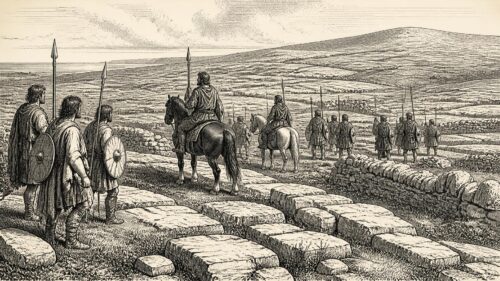
The central political event was the battle of Cell Móna. Its precise site is uncertain, though suggestions have included places in modern counties Meath and Westmeath; the uncertainty is a useful warning against attaching false geographical precision to the campaign. What is clear is the alignment recorded by both principal annals. Domnall mac Congalaig, ruler of Brega, and Amlaíb Cuarán, king of Dublin, defeated Domnall ua Néill, king of Tara. The battle was not a simple contest between ‘Irish’ and ‘Vikings’. Amlaíb’s Dublin force fought with an Irish provincial ruler against another Irish overking, while rulers and fighting men from several Irish peoples were drawn into the opposing side.
The cost was severe among the regional political elite. Ardgar mac Matudáin, king of Ulaid, fell, as did Donnacán mac Máel Muire, king of Airgíalla, and Cinaed mac Cróngall, king of Conaille. Chronicon Scotorum adds Fergus, king of Cualu, and says that other nobles died. The lists mattered. They show that Cell Móna was not an isolated skirmish but a clash which reached across the northern half of the island, involving Ulaid in the north-east, Airgíalla across much of modern Armagh and Monaghan, Conaille around the Louth borderlands, Brega in the Boyne valley, and the king of Tara’s Uí Néill following.
Domnall ua Néill retained the prestigious style ‘king of Tara’ in the annals, but that title did not amount to secure command of Ireland. Tenth-century Ireland consisted of numerous kingdoms linked by kinship, clientship, tribute and military obligation. A ruler’s standing depended upon his ability to protect dependants, exact submissions and lead successful hostings. The defeat at Cell Móna therefore exposed a real weakness in Domnall’s position. At the same time, it demonstrated the strategic value of Dublin: its ruler could supply armed followers, maritime connections and access to wealth, and could alter the balance of power far beyond the settlement on the Liffey.
Kells and the Cattle Tribute
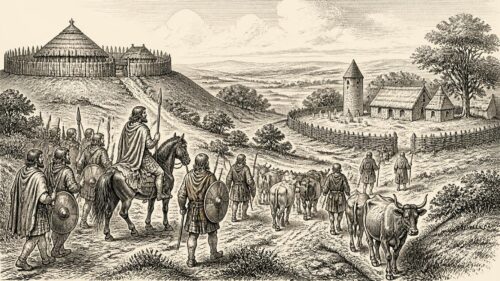
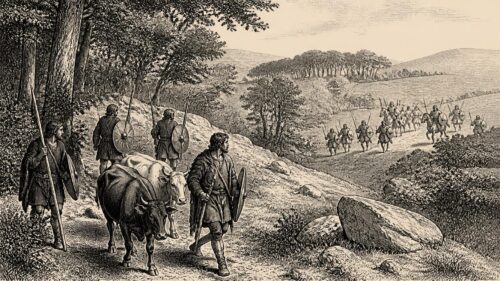
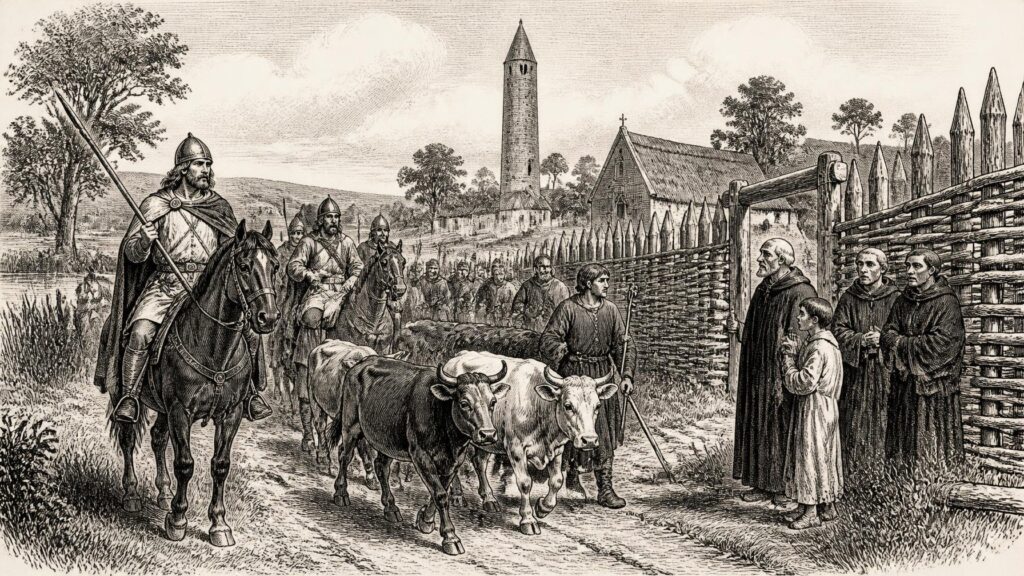
Before the battle, Amlaíb plundered Cenannas, modern Kells. Chronicon Scotorum supplies details omitted by the shorter Ulster notice: Amlaíb acted with ‘the foreigners and the Laigin’, took a great cattle tribute, lost men including Bresal mac Ailelláin, and defeated Uí Néill forces at Áed Maolchon. The participation of Laigin, the peoples of Leinster, again makes plain that alliances crossed cultural and linguistic labels. Dublin’s ruler was not operating as an external raider on a foreign shore. He was a major participant in Irish politics, capable of cooperating with Leinster interests and of striking deep into the midlands.
The emphasis on cattle is equally revealing. Livestock was the central measure of movable wealth in much of early medieval Ireland: cattle sustained households, supplied dairy produce and hides, and served as a recognised medium through which tribute, compensation and political dominance could be expressed. To take a large cattle prey from Kells’s district was to damage farms and dependants as well as to enrich the victors. The annals do not permit a reconstruction of individual households’ losses, but their language makes clear that the raid was economic as well as military.
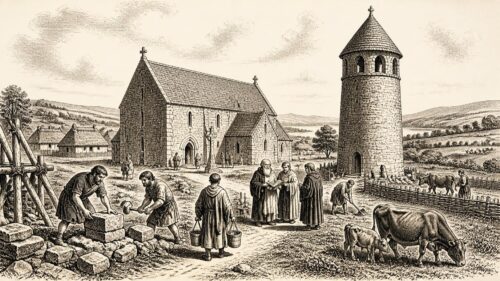
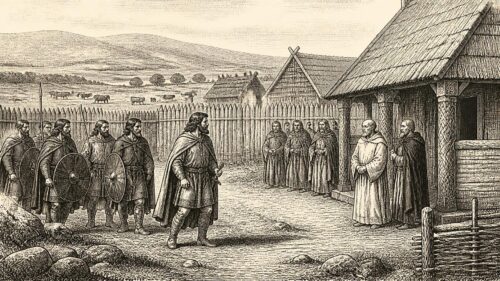
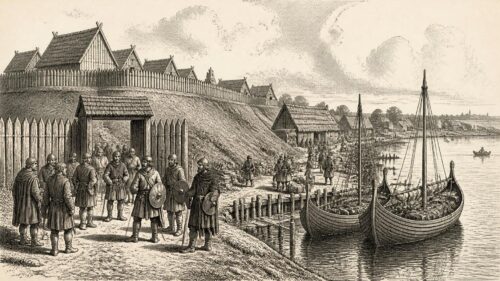
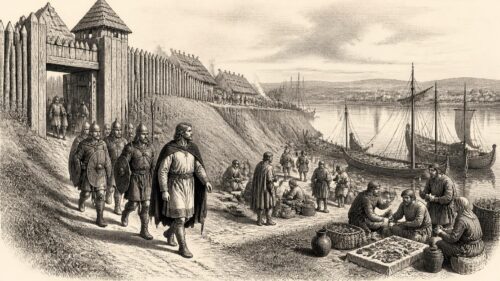
Kells was no ordinary rural target. It was a major Columban ecclesiastical centre, embedded in networks of landholding, learning and patronage. Its community possessed resources worth seizing and symbolic importance worth challenging. Yet it should not be imagined as a silent stone monument surrounded by emptiness. Monastic settlements were places where clerics, tenants, craftspeople, visitors and local elites met. Tenth-century Dublin archaeology provides a complementary view of the world in which Amlaíb acted: excavations have revealed densely occupied plots, timber houses, workshops, leather- and antler-working, tools, weights and scales, agricultural equipment and evidence of trade. Dublin’s power rested not solely on ships and weapons, but also on labour, craft production and exchange supported by its hinterland.
Violence in Louth
Ardgar had already made an expedition ‘with the foreigners’ and sacked Conaire, where the Annals of Ulster says that many people were beheaded. The location of Conaire is not securely identified, and the annal gives neither a motive nor a total of the dead. Its placement beside Cell Móna nevertheless conveys the violent, mobile character of the year’s campaigning. Leaders gathered followers, moved through contested territories and used spectacular destruction to enforce or advertise authority.
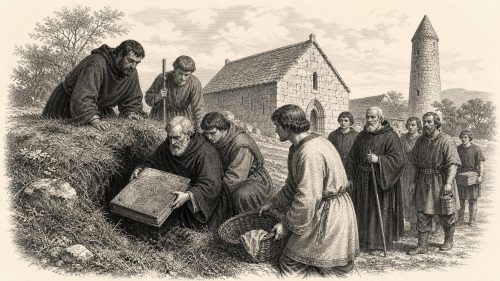
Domnall ua Néill’s response was no less destructive. The annals report his sack of Mainister and Lann Léire. Lann Léire, at modern Dunleer in County Louth, was an established monastic site in a region exposed to both Dublin-based power and northern armies. The Annals of Ulster says that 350 people were burned in one house. Chronicon Scotorum, probably preserving a related tradition, identifies the building as Lann Léire’s refectory and gives a figure of 400 martyrs, men and women. The discrepancy means that neither number should be presented as an audited total. What both accounts firmly establish is an exceptionally lethal burning in a communal building.
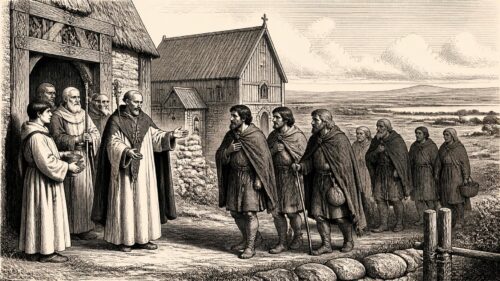
The word ‘martyrs’ is the chronicler’s religious interpretation, not a neutral casualty category. It signals that the deaths were understood as an outrage against a sacred community. The mention of women also cautions against picturing monasteries as exclusively male clerical compounds. Such sites interacted closely with surrounding populations, and their precincts could shelter diverse people in danger. Whether those inside had sought sanctuary, were members of the wider community, or both, cannot be recovered from the surviving entries. The event’s human scale, however, is unmistakable.
In the same campaign, Domnall ua Néill plundered Lugmad, modern Louth, and Druim Inasclainn, modern Dromiskin. The attack linked ecclesiastical centres along routes between the Boyne region, the northern coast and the Dublin sphere. It was probably directed as much at hostile political networks and resources as at religion itself. Monasteries held land, livestock, food stores, skilled personnel and prestige; assaulting them could weaken rivals and compel submission. The year’s record therefore resists an easy opposition between secular war and sacred life. Church communities were deeply entangled in the political landscape, and that made them powerful as well as vulnerable.
What 970 Does—and Does Not—Show
A later compilation, the Annals of the Four Masters, assigns further killings, ecclesiastical deaths and a Munster hosting by Mathgamain mac Cennétig in Ciarraige to its annal for 970. It also records the killing of Murchad mac Finn, king of Leinster, after a shared meal with Domnall Claen. These notices are valuable evidence for remembered political tradition, but they are not independently matched by the contemporary annalistic cluster used above, and the chronology of the Four Masters can differ from earlier texts. They should not be used to turn 970 into an island-wide, precisely sequenced narrative.
That limitation is important. The sources privilege kings, church leaders, raids and deaths; they tell us little directly about weather, harvests, marriages, women’s work or routine local exchange in this particular calendar year. Nonetheless, the evidence securely connected with 970 shows an Ireland of interlocking regions rather than isolated kingdoms. Dublin’s Hiberno-Scandinavian ruler and Irish dynasts made and broke alliances; cattle and ecclesiastical wealth were stakes in warfare; and the destruction of a refectory at Lann Léire exposed the devastating consequences for communities caught between rival powers. Cell Móna did not settle the struggle for Tara or Dublin. It did, however, show how quickly a coalition could unsettle the political order on which both depended.
Primary Sources
- The Annals of Ulster: Year U970
- Chronicon Scotorum: Annal CS970
- Annals of the Four Masters: Annal M970
- The Annals of Ulster
- Chronicon Scotorum
- Annals of the Four Masters
- Annals of Inisfallen
- Exploring the Irish Annals
- Viking Ireland Afterthoughts
- Vikings in Ireland
- Viking
- Ua Néill, Domnall
- Óláf Sihtricson [Óláfr Sigtryggsson, Amlaíb Cúarán]
- Church-Raiding And Subjugated Vikings, 980–1014
- Identity, Exemplarity and the Ideal King in Early Medieval Ireland
- Residence, Ritual and Rulership: A State-of-the-Art for Royal Places in Early Medieval Ireland
- Mobility in the Early Middle Ages, and Beyond
- Dunleer: County Louth Urban Archaeology Survey
- Farming and Archaeology
- Ireland: Kingdoms and Kingship
- Viking Ireland: Key Stage Guide
- 950–1450: Vikings, Normans and Medieval Mints