Glas Liatháin’s Orphaned Land943 CE
Dateline
In 943, a sudden northern catastrophe altered the balance of Irish politics. Muirchertach mac Néill, king of Ailech and one of the foremost members of the Northern Uí Néill, was killed by a force from Viking Dublin. The loss was more than that of a successful war leader. Contemporary annalists styled him rígdamna Érenn, a man eligible for the kingship of Ireland, and the Annals of Ulster mourned him in a short verse as though the land of the Irish had been left bereft.
The year’s evidence is concentrated, violent and uneven. It records clashes around Strangford Lough, the killing of rulers in Leinster and Dál Araidi, and the plundering of Armagh immediately after Muirchertach’s death. These notices reveal an Ireland divided among regional dynasties, but tied together by rival claims to authority, hostage politics, ecclesiastical prestige and the military reach of Dublin’s Scandinavian-Gaelic rulers.
A Date With Difficult Sources
The date of Muirchertach’s death is unusually precise. The Annals of Ulster, whose year-heading is calibrated as “AD 942 alias 943”, places it on 26 February. Such double dating is a warning against treating every annalistic year-number as a modern calendar label without examination. For this article, the event belongs securely to 943 because the annal provides an internally specific Roman-calendar date and modern reference scholarship accepts 26 February 943.
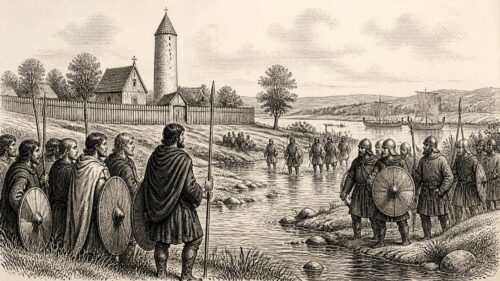
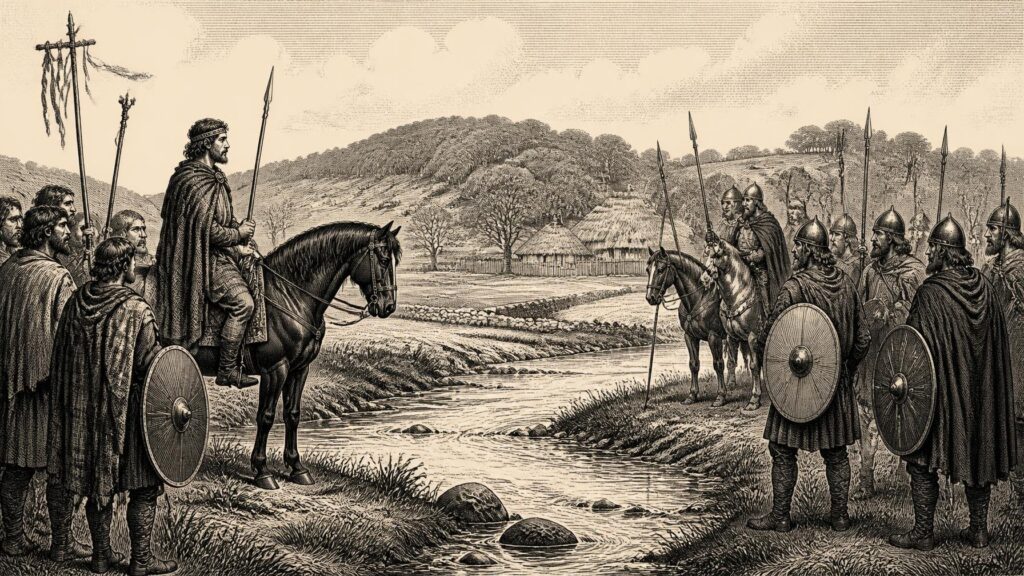
Even so, the surviving chronicles do not give identical geographical descriptions. The Annals of Ulster locate the killing at Glas Liatháin, beside Cluain Cháin, in the territory of Fir Rois; Chronicon Scotorum says that Muirchertach was killed at Áth Firdia, modern Ardee. These places lie in the broad south-Louth borderland and may reflect different ways of locating the same campaign, but the evidence does not permit a more exact reconstruction of the encounter. It is safest to place the death in Fir Rois, in the region between the northern approaches to Dublin and the lands of the Northern Uí Néill.
Muirchertach’s Fall
Muirchertach was the son of Niall Glúndub, the Northern Uí Néill king killed in 919, and had built a formidable reputation in warfare against Dublin and in enforcing Cenél nÉogain power across the north. His later epithet, na Cochall Craicinn, “of the leather cloaks”, evokes the protective mantles supposedly worn by his followers. It is memorable, but should not be mistaken for evidence that the army at Fir Rois was uniformly equipped in some distinctive fashion. The epithet belongs to a political and literary memory of a powerful ruler.
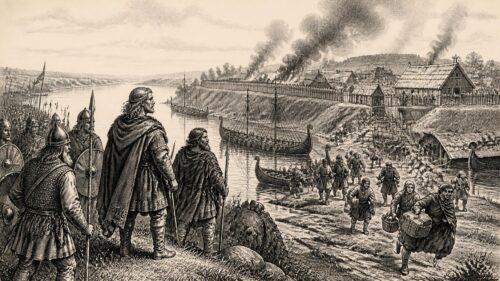
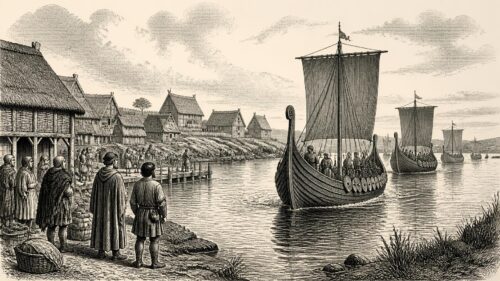
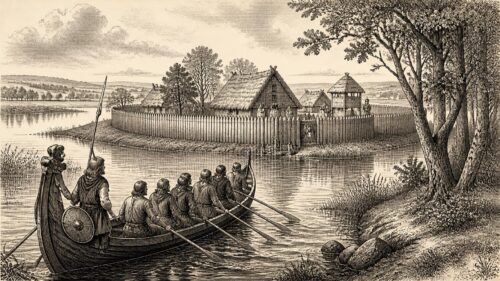
The annal is clearer about the attackers: Muirchertach was killed by the “heathens”, identified as the men of Blacair son of Gothfrith, king of the foreigners. “Heathens” was the chronicler’s hostile Christian vocabulary, not a neutral ethnic description. Blacair’s force came from the Hiberno-Norse polity centred on Dublin, a settlement whose rulers could raid, bargain, make alliances and intervene far beyond its walls. In 943, the Dubliners struck successfully into territory where Muirchertach had long been a dominant opponent.
The annalist’s grand comparison of Muirchertach with Hector, champion of Troy, is therefore revealing rather than literal. It conveys both aristocratic grief and political alarm. He was not king of all Ireland: Donnchad Donn of Clann Cholmáin still held the kingship of Tara. But Muirchertach’s standing as royal heir, his military authority and his dynastic position made him a plausible contender for wider supremacy. His death removed one of the strongest northern figures from an already contested political field.
Armagh Plundered
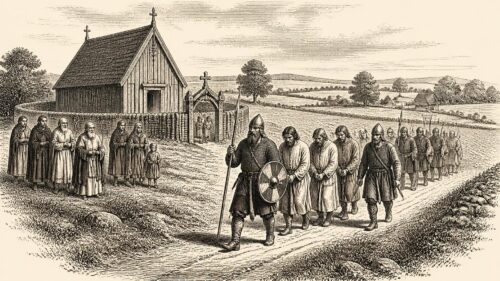
The blow was followed immediately by an attack on Armagh. The Annals of Ulster says that the same foreigners plundered the church centre on the day after Muirchertach’s killing, 27 February. It does not specify the goods seized, the number of captives, or the damage done to buildings; none should be invented. Yet “plundered” was grave language when applied to Armagh. The church was a major religious community, a centre of learning and writing, and the chief Patrician institution through which secular rulers sought prestige and religious legitimacy.
Armagh’s vulnerability underlines the practical consequences of military success in this period. Ecclesiastical sites held movable wealth, food rents, livestock and precious objects, while their people could be exposed to violence, displacement or ransom. An attack on such a place also carried political force: it demonstrated that an enemy could breach a centre associated with the north’s most important saintly inheritance. The sequence of 26 and 27 February made the Dublin raid a direct challenge to Northern Uí Néill authority.
Conflict on Several Fronts
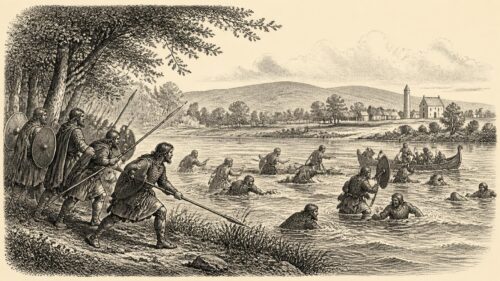
943 was not solely a Dublin–Ailech war. Earlier in the same annalistic year, Leth Cathail, the people of Lecale in eastern Ulster, inflicted a rout on foreigners from Loch Cuan, Strangford Lough, reportedly destroying almost all of them. The notice is undated within the year and gives neither commanders nor a fuller tactical narrative. Nevertheless, it shows that local Irish powers could deal severe defeats to seaborne forces in the same northern world in which Blacair’s expedition succeeded.
The annals also record the killing by foreigners of Lorcán son of Faelán, king of Leinster. No place or date is supplied, but the death brought Dublin’s military pressure into Leinster as well as the north-east. Meanwhile Cellach son of Béc, king of Dál Araidi, was “treacherously killed by his own people”. This was an internal political killing, not a Viking raid, and it demonstrates the danger facing rulers even within their own lordships. The year’s violence was shaped by local feuds as much as by opposition between Irish and Scandinavian-speaking groups.
Chronicon Scotorum additionally enters, under 943, a defeat inflicted by Ruaidrí Ua Canannáin of Cenél Conaill on Cenél nÉogain and foreigners from Loch Foyle, with the death of Máel Ruanaid son of Flann, described as heir of the north. Its annalistic synchronisation is less secure than the dated notice of 26 February, but the entry points to a broader reality: Muirchertach’s death did not create a settled northern succession. Rival Northern Uí Néill kindreds, regional kings and maritime forces all had opportunities to press their advantage.
Dublin’s Reach and Ireland’s Economy
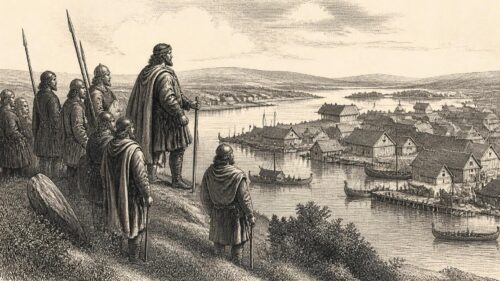
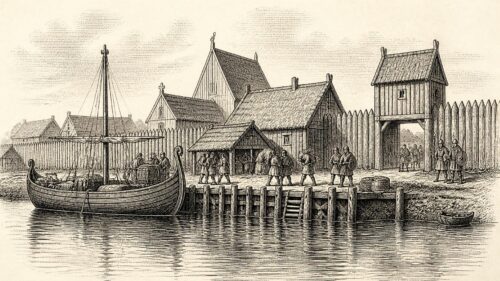
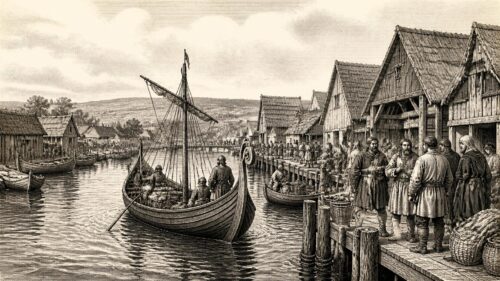
It would be misleading to imagine Blacair’s Dublin as a simple foreign camp set apart from Ireland. By the tenth century Dublin was a durable town and a node in Irish Sea networks linking Ireland with western Britain, the Isles, northern England and Scandinavia. Its inhabitants included people of varied backgrounds; its rulers operated within Irish politics as enemies, allies and employers of local forces. Raiding remained a central instrument of power, but it existed alongside trade, craft production, exchange and settlement.
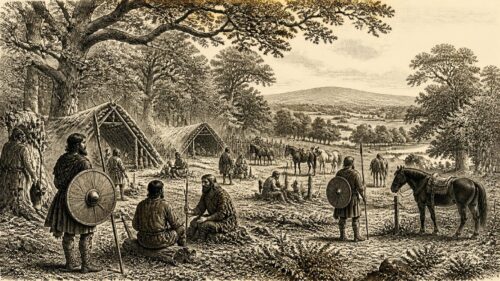
For most people, however, life remained predominantly rural and agricultural. Political power depended heavily on cattle, food renders, control of land and the capacity to assemble armed retainers. Churches were embedded in this economy: they held land, received dues and offered elite families routes to status, literacy and commemoration. A raid on Armagh or the death of a regional king could therefore affect farmers, herders, clerics, dependants and traders as well as the men named in the chronicles. The evidence does not allow a detailed social history of any one community in 943, but it does show how swiftly military disruption could reach both religious centres and productive countryside.
An Unfinished Succession
Later annalistic compilations attach further developments to a year numbered 943, including claims for Congalach Cnogba and reports of hostages. These should not be presented as securely occurring in calendar-year 943. The more closely aligned chronology places Donnchad Donn’s death in 944 and Congalach’s subsequent advance after it. What can responsibly be said is that Muirchertach’s death opened political space. His son Domnall succeeded to Ailech, but the adult network of lordships around the Irish Sea and the Uí Néill was not governed by automatic inheritance.
Thus 943 stands as a year of shock rather than resolution. At Glas Liatháin, or somewhere in the Fir Rois–Áth Firdia landscape recorded differently by the chronicles, Dublin’s forces killed a leading northern claimant. The following day they plundered Armagh. Elsewhere, local rulers fought foreigners or fell to their own rivals. Ireland remained a land of many kings, but the events of this year made clear that the fortunes of its dynasties, churches and growing port towns were inseparably connected.
Primary Sources
- The Annals of Ulster: Year U943
- The Annals of Ulster: Year U943 (Irish text)
- The Annals of Ulster
- Chronicon Scotorum: Annal CS943
- Annals of Inisfallen: Annal AI943
- Annals of the Four Masters: Annal M943
- The Circuit of Ireland by Muircheartach mac Néill
- Muirchertach na Cochall Craicinin
- Blacair (Blakkr)
- Congalach Cnogba
- Donnchad Donn
- Vikings in Early Medieval Ireland
- The Irish Sea and the Atlantic Trade in the Viking Age
- The Vikings in Ninth-Century Ireland: Sources and Settlements
- The Vikings in Ninth-Century Ireland: Sources and Settlements (full text)
- The Winter Camp of the Viking Great Army, AD 872–3, Torksey, Lincolnshire
- Vikings in Ireland and Scotland
- Vikings in Ireland
- Transformation
- The Cambridge History of Ireland: Chronology