Loch Cenn’s Frozen Plunder855 CE
In 855, Ireland experienced an exceptional freeze: from late November to early January, lakes and rivers supported pedestrians and horses, disrupting transport, food supplies and rural life while opening unusual routes. A later annal links the frost to a deadly raid at Loch Cenn. Máel Sechnaill mac Máele Ruanaid took hostages at Cashel, asserting overlordship amid Munster’s divisions. He fought heathen forces with Norse-Irish allies, illustrating intertwined Irish and Scandinavian politics. Norsemen burned Lusca’s oratory, while Áed son of Niall routed Norse-Irish in the north. Death notices for Lismore and Lathrach Briúin clerics underline churches’ intellectual, economic and political roles.
Dateline
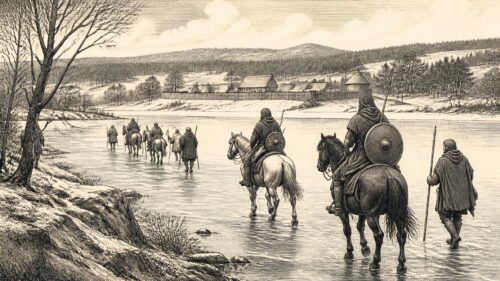
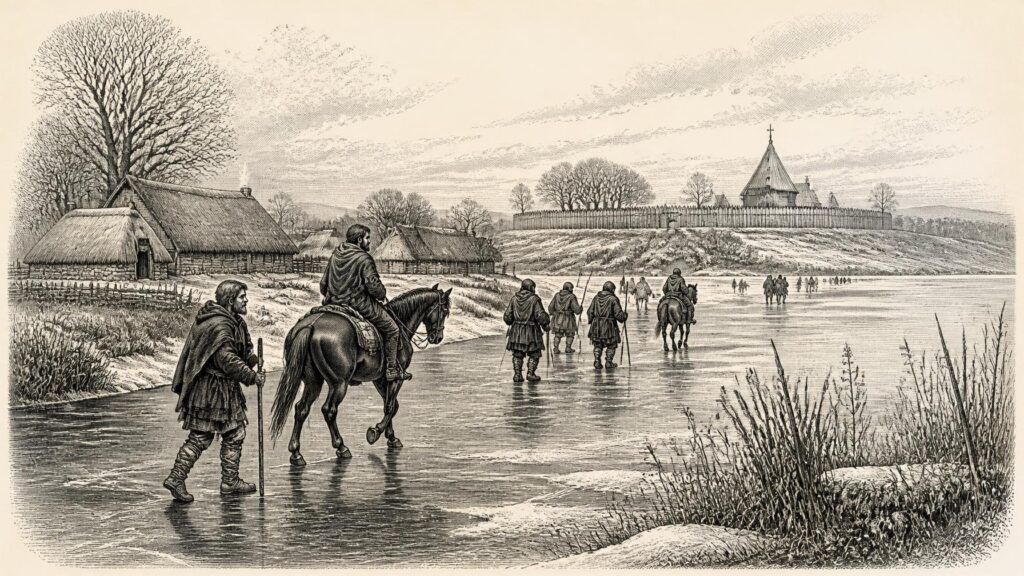
In 855, Ireland’s political contests, Norse activity and religious institutions all continued to shape one another. Yet the year is remembered above all for weather severe enough to alter movement across the country. The Annals of Ulster, in an entry assigned to 855, report that from 23 November until 7 January the principal lakes and rivers could be crossed on foot and horseback. This was not simply picturesque winter scenery. Waterways were normally routes, barriers, sources of food and borders between lordships. Their freezing affected travel, grazing, fishing, communication and the calculations of armed groups. It also gave annalists an unusually precise span of dates, beginning late in 855 but extending into January 856.
A Winter of Passable Waters
The annalist’s phrase “much ice and frost” conveys a remarkable event rather than an ordinary hard winter. Major Irish lakes and rivers do not freeze reliably; for people to cross them on horseback, ice had to be trusted as a practical surface. Frozen water may have shortened journeys and opened routes usually difficult or dangerous, but it also brought hazards. Transport by boat, fishing and access to waterside settlements would have been disrupted. Animals dependent on winter forage faced greater pressure, while a prolonged freeze could damage stores, restrict milling and complicate the movement of food to monasteries, royal centres and households.
A separate, later compilation, the Fragmentary Annals of Ireland, places a raid on Loch Cenn after a “very great frost” in 855 and says that 120 men fell. Loch Cenn is generally associated with Lough Sheelin, on the borderlands of modern counties Cavan, Meath and Westmeath. The entry makes the relationship between frost and conflict explicit, but it gives neither a date within the year nor enough detail to identify the parties or reconstruct the encounter. It should therefore be treated as a connected annalistic notice, not as evidence for a fully understood battle. Still, its survival suggests that the extraordinary cold was remembered not merely as weather but as a condition within which raiding and loss of life occurred.
Máel Sechnaill at Cashel
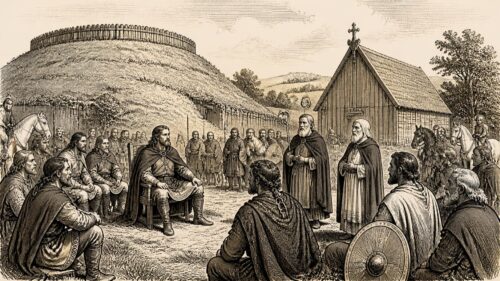
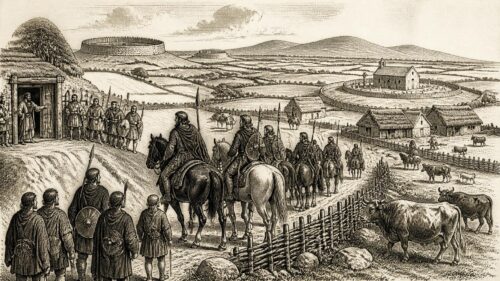
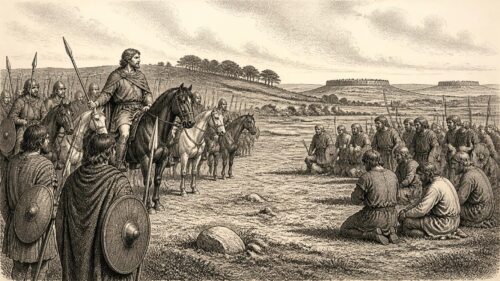
The most consequential political action recorded under 855 was Máel Sechnaill mac Máele Ruanaid’s presence at Caisel, or Cashel, where he took hostages from Mumu, Munster. Máel Sechnaill, king of Tara and leading ruler of the southern Uí Néill, had been extending his authority beyond Mide. His visit to Cashel was a statement that the rulers of Munster’s competing kingdoms were expected to recognise a wider overlordship.
Hostages were neither a decorative ceremonial gift nor necessarily prisoners taken after a single battle. They were guarantees for agreements, submitted by rulers or communities whose future conduct was at stake. Their identity is not supplied in the annal: they may have been members of ruling families, representatives of subordinate dynasties, or a mixture of both. The omission matters. It prevents us from claiming that Máel Sechnaill had permanently subdued all Munster. What can responsibly be said is that he secured a public and politically weighty acknowledgement of power at Cashel, the principal royal centre of the Eóganacht kings of Munster.
This was part of a sustained programme rather than an isolated triumph. Máel Sechnaill had already campaigned in Munster and would return again in later years. The instability of kingship at Cashel made such interventions possible. The Annals of Inisfallen, a source with strong Munster interests, records Máel Gualae son of Donngal taking the kingship of Cashel in 856. Its sparse notice is a reminder that the province was not a unified state awaiting conquest but a landscape of rival dynasties, church communities and regional powers. In 855, Máel Sechnaill’s demand for hostages exploited that political fragmentation.
War with Norse-Irish Allies
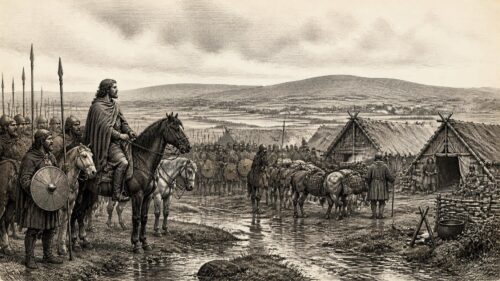
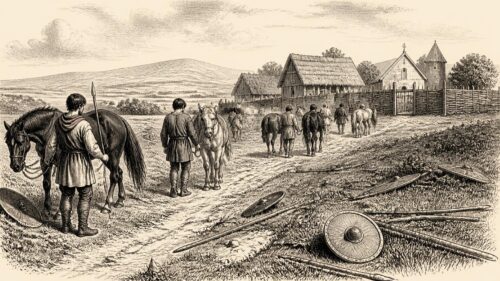
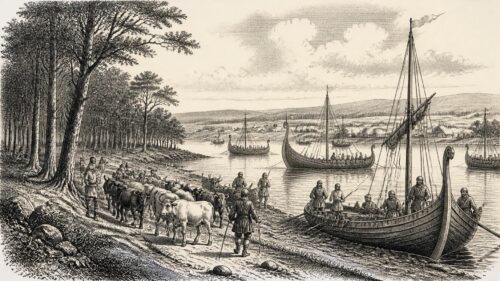
The same Ulster entry reports “great warfare” between the heathens and Máel Sechnaill, who was supported by Gall-Gáedil, rendered by the editors as Norse-Irish. This is among the most revealing notices of the decade. It does not describe a simple opposition between Irish Christians and Scandinavian invaders. The term denotes people understood as connected with both Irish and Norse worlds; the later Fragmentary Annals famously characterises such men as Irish fostered by Norsemen. Whatever the exact composition of the force in 855, Máel Sechnaill was able to employ fighters identified in this mixed way against other heathen forces.
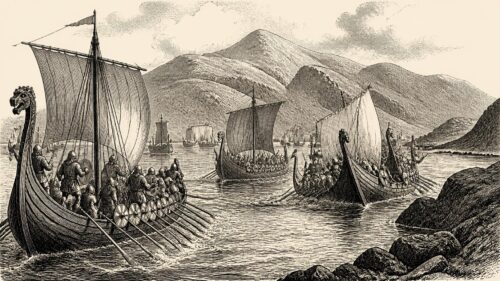
That alliance belongs in the context of the transformation of Viking activity during the mid-ninth century. Scandinavian fleets had long raided Ireland, but they had also established defended bases, acquired Irish allies and become participants in Irish rivalries. Amlaíb, described in 853 as son of the king of Lochlann, had received the submission of the foreigners in Ireland and taken tribute from Irish communities. Dublin’s longphort, first established in 841, was already a strategic centre within the Irish Sea world. Warfare in 855 therefore involved competing networks of power, not a single invading army facing an island united in resistance.
The annal gives no battlefield, commanders or outcome for Máel Sechnaill’s war. Its brevity requires restraint. It cannot prove a continuous campaign throughout the year, nor can it identify every group called “heathen”. But the wording firmly establishes serious conflict and demonstrates that cultural and political affiliations crossed the supposed Irish–Viking divide. Men whom ecclesiastical writers could regard as morally compromised or foreign-connected were useful military allies to a Christian king seeking supremacy.
Lusca’s Burned Oratory
One concrete consequence of Norse activity was the burning of the oratory of Lusca, modern Lusk in north County Dublin. The annal calls the attackers Norsemen. An oratory was a place of worship within a church settlement, and the destruction was significant enough to record, though the source does not state whether people were killed, captives taken or treasures removed. It would be unsafe to supply those details from the wider pattern of raids.
Nonetheless, Lusca’s position helps explain its vulnerability. It lay in the rich and well-connected region north of Dublin, within reach of coastal and riverine routes and close to the developing Scandinavian power based around Áth Cliath. Church settlements were religious centres, but they also concentrated land, livestock, food renders, skilled people, manuscripts and portable valuables. They could be raided for material gain and targeted because attacking them injured the authority of local rulers and ecclesiastical communities. The loss of an oratory was therefore both a devotional blow and a disruption to a settlement’s social and economic life.
Áed and the Northern Borderlands
The annal for 855 also credits Áed son of Niall, later known as Áed Findliath, with a major rout of Norse-Irish at Glenn Foichle, usually identified with Glenelly in County Tyrone. It says that a vast number were slaughtered. Such language confirms a decisive victory in annalistic terms, but no precise casualty total, date, tactical narrative or explanation of the force’s purpose survives. The engagement should not be expanded into a detailed battle story.
There is also a chronological caution. The Ulster entry is assigned to 855 in the modern CELT edition, whereas a modern biographical treatment places Áed’s victory in 856. This reflects the well-known complexities of early Irish annalistic dating, where copied year-headings and later synchronisation can diverge. The safest conclusion is that the victory belongs to the 855–56 sequence and is directly connected with the conflict recorded for 855, rather than assigning it to a particular season without evidence.
Áed’s importance was already evident in the north. A raid against Ulaid, conventionally dated 855 in modern biographical reference works, had cost the Cenél nÉogain leader his brother Flaithbertach and other followers. The episode shows that the northern conflict was not directed only against Norse-linked groups. Áed also faced traditional rivals among the Ulaid. His later kingship would be built in a political world where dynastic warfare, regional loyalties and Scandinavian alliances were inseparable.
Churches, Learning and Ordinary Life
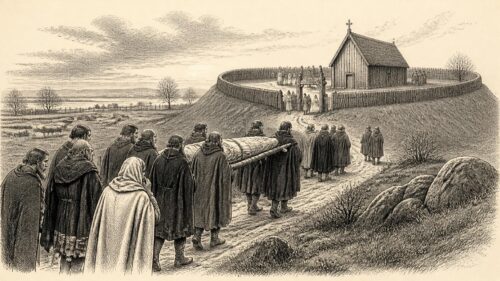
The year’s notices also preserve a quieter but important record of religious life. Suibne grandson of Roichlech, described as scribe, anchorite and abbot of Lismore, died in peace; Cormac of Lathrach Briúin, identified as both scribe and bishop, likewise died. Such titles indicate institutions in which pastoral authority, ascetic prestige and literacy could overlap. Monasteries and churches were not detached refuges from politics. They held land, received renders, educated clerics, preserved texts and mediated agreements between kings. Their personnel were among the people whose knowledge made annal-writing possible.
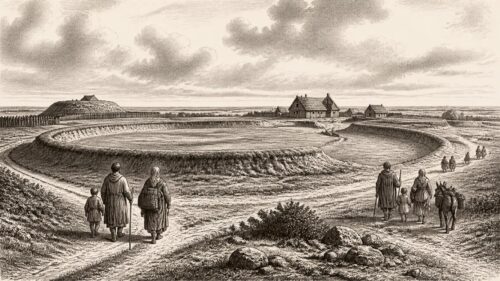
For most inhabitants, however, 855 was experienced through the labour of a rural economy. Ireland remained overwhelmingly a countryside of enclosed farmsteads, cattle enclosures, fields, mills, cereal-drying kilns and ecclesiastical estates. Archaeology indicates a mixed economy in which livestock remained valuable while tillage was becoming increasingly prominent during the ninth century. A severe freeze threatened precisely this interdependence: animals required fodder, grain required storage and processing, and people depended upon reliable routes to exchange produce, render dues and seek protection.
Thus the year’s surviving evidence does not offer a single national narrative. It offers snapshots: a king receiving hostages at Cashel; warfare involving Norse-Irish allies; a church oratory burned at Lusca; a northern victory of uncertain exact date; and waters frozen hard enough to carry people and horses. Together they show an Ireland of local kingdoms and church settlements tied into the Irish Sea world, where authority was negotiated by hostages and military service, and where one exceptional winter could reshape the practical geography of power.
Primary Sources
- The Annals of Ulster: AD 855
- The Annals of Ulster
- Fragmentary Annals of Ireland
- Part 14 of Fragmentary Annals of Ireland
- Annals of the Four Masters
- Part 68 of Annals of the Four Masters
- Annals of Inisfallen
- Chronicon Scotorum
- Annals of Tigernach
- List of Published Texts at CELT
- Áed Findliath
- Máel-Sechnaill
- The Vikings in Ireland
- Vikings in Scotland and Ireland
- Viking Ireland: Afterthoughts
- The Economy of Early Medieval Ireland
- Early Medieval Dwellings and Settlements in Ireland, AD 400–1100, Volume 1: Text
- Dublin City Urban Archaeology Survey: Preliminary Report
- Vikings in Early Medieval Ireland
- High-kings, Vikings and Other Kings
- The Practice of Irish Kingship
- Farming and Archaeology: The Irish Historic Landscape