Loch Riach’s Fallen Crannóg802 CE
In 802, annalistic records reveal interconnected political, military and ecclesiastical pressures across Ireland and the Irish Sea. After Muiredach of Mide died, Áed Oirdnide, king of Tara, led an armed hosting into Mide and divided its rule between Conchobar and Ailill, sons of Donnchad Midi. In Connacht, Muirgius destroyed the crannóg fortress at Loch Riach, demonstrating power near Uí Maine. Heathens burned Iona, a major Columban centre linking Ireland and Scotland. Deaths included Queen Euginis, rulers of Osraige and Mugdorna, and prominent abbots and churchmen. These events show authority dispersed among dynasties, local kingdoms and monasteries, not one unified state.
Dateline
For Ireland in 802, the most secure evidence comes from a compact but unusually revealing cluster of annalistic notices. They record a change of power in Mide, the destruction of a defended lake settlement at Loch Riach, the burning of Iona by heathens, and the deaths of rulers, a queen and leading churchmen. The year is therefore best understood not as a single national drama—early medieval Ireland had no unified state—but as a moment when several overlapping networks were tested: Uí Néill lordship in the midlands, Connacht expansion, monastic authority, and the sea-lanes linking Ireland with western Scotland. There is a chronological caution at the outset. The relevant Annals of Ulster entry is conventionally placed in 802, although the surviving annal headings have dating complications; comparison with other annals and modern chronological work supports treating these events as belonging to 802 CE.
Succession in Mide
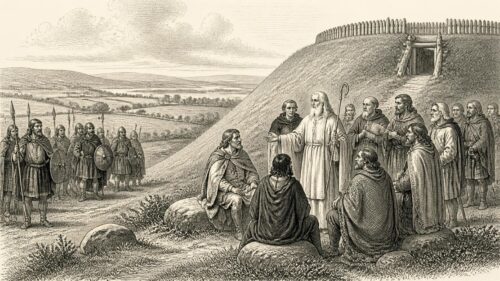
The death of Muiredach son of Domnall, king of Mide, opened the year’s most consequential political crisis. Mide was not merely a tract in the geographical centre of the island: it was the heartland of Clann Cholmáin, a dominant branch of the Southern Uí Néill, and lay close to Tara and the assembly landscape of Brega. Muiredach’s death followed a period of instability in the dynasty. Donnchad Midi, king of Tara and a formidable Clann Cholmáin ruler, had died in 797; his son Domnall was killed in 799. The annals do not narrate the full causes of the new succession dispute, but the rapid intervention of Áed son of Niall, king of Tara and head of the Northern Uí Néill, shows that it mattered far beyond Mide itself.
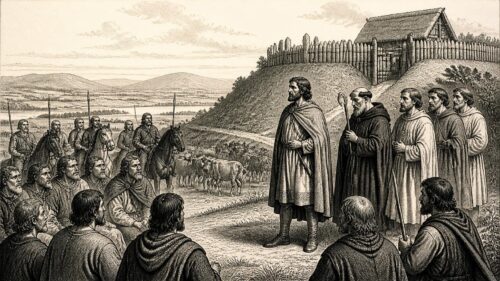
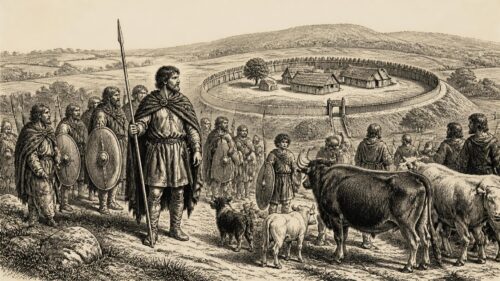
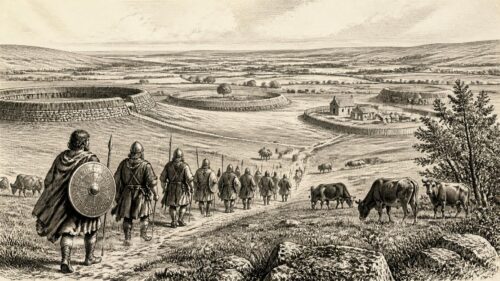
The annal’s wording is precise: Áed led a hosting against Mide and divided the kingdom between two sons of Donnchad, Conchobar and Ailill. A hosting was an armed royal expedition, not a parliamentary meeting. It probably brought together Áed’s own following and subordinate forces, but the source neither supplies numbers nor describes a battle, so neither should be invented. What can responsibly be said is that Áed exercised king-making authority in a rival Uí Néill heartland. He did not annex Mide into a centrally administered kingdom; he installed members of its established ruling family and divided authority between them. This was a forceful settlement, but an inherently fragile one. The annal for the following calendar year records fighting between Conchobar and Ailill in which Ailill died—evidence that 802’s arrangement did not end the competition, though that later death must not be treated as an event of 802 itself.
The death of Euginis, daughter of Donnchad, belongs in the same political frame. The annalist calls her “queen of the king of Temair [Tara]”. As Áed Oirdnide was then king of Tara, historians reasonably identify her as his queen, while recognising that the terse notice does not explicitly name her husband. Her death removed a living connection between Áed’s northern dynasty and the family whose succession he had just reshaped in Mide. Marriage did not erase rivalry, but it was one means by which rulers built claims, alliances and obligations across competing royal kindreds.
Muirgius at Loch Riach
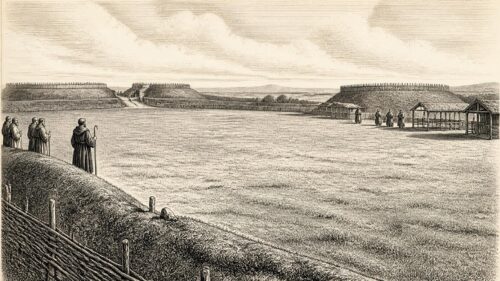
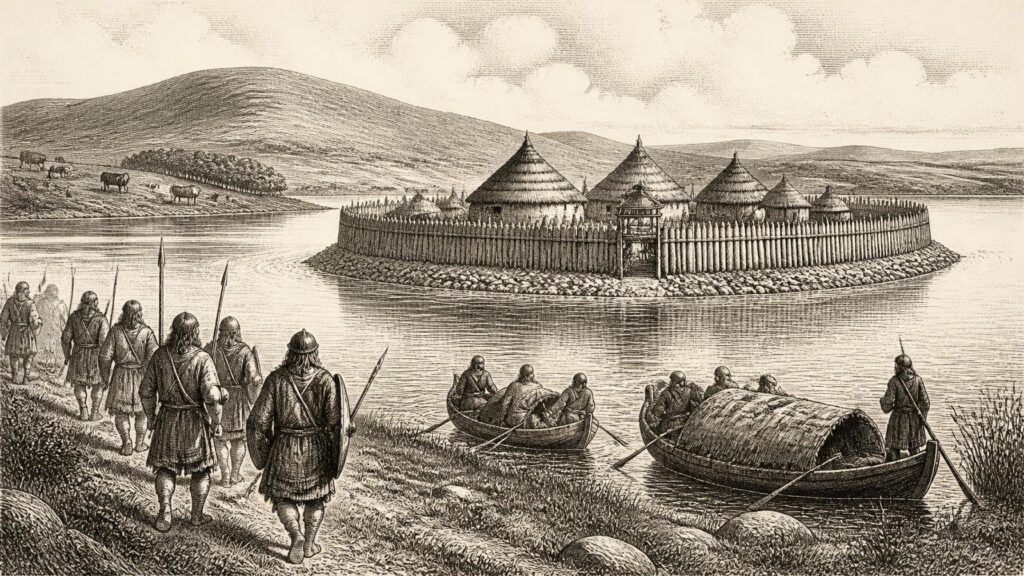
In Connacht, Muirgius son of Tommaltach destroyed the fortress of Loch Riach. This is one of the year’s most concrete acts of violence. Loch Riach is generally identified with Loughrea in modern County Galway, and specialist work identifies the destroyed stronghold as a crannóg: a defended island or artificial lake dwelling. The identification fits both the annal’s language of a fortress and the wider early medieval settlement record around Loughrea, though the annal itself gives no architectural description, no casualty figure and no account of the defenders. The event should therefore be pictured as the taking or ruin of a strategic lake stronghold, not as a siege whose details have somehow survived.
Muirgius was overking of Connacht, of the Uí Briúin Aí, and had strengthened his position amid competition among Connacht dynasties. The Loch Riach attack struck in the orbit of Uí Maine, on a politically sensitive frontier near Sogain. It advertised the capacity of Muirgius’s kingship to project force from its core territory in Mag Aí towards eastern Galway. A crannóg was more than a secluded home: lake settings could protect people, livestock, food stores and valuables, while also marking elite authority over surrounding land and waterways. Its destruction consequently had social as well as military force, disrupting a local centre of lordship and the farming communities dependent on it. Yet the immediate motive remains unrecorded. It may reflect a campaign of Connacht consolidation; it cannot safely be reduced to a named feud or a simple ethnic contest.
Iona Burned
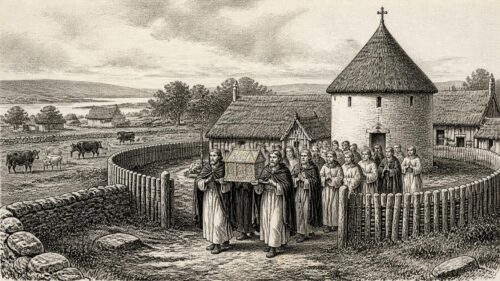
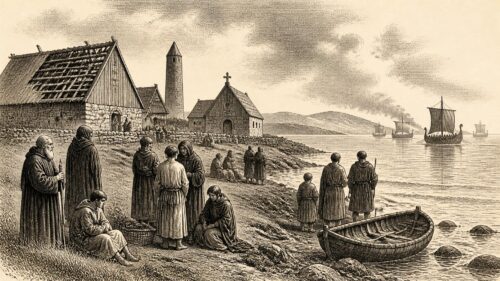
The year’s most resonant notice is also its briefest: “Í Coluim Chille was burned by the heathens.” Í, or Iona, lies off the west coast of present-day Scotland, rather than in Ireland, but its history was inseparable from Irish ecclesiastical life. Founded in the Columban tradition of Colum Cille, it was a principal house in a religious familia whose people, books, relics, land interests and learned culture connected communities on both sides of the North Channel. Its burning is therefore directly relevant to Irish history: an assault on Iona was an assault on one of the foremost institutions of the Irish Sea world.
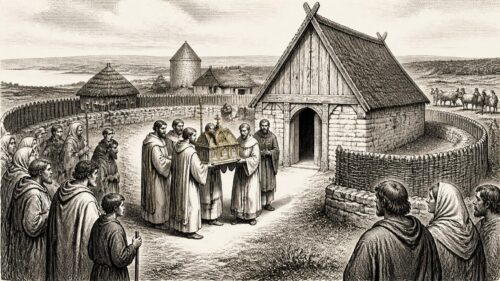
The Annals of Ulster call the attackers gentiles, “heathens”; the later Annals of the Four Masters expressly identifies them as Northmen. In modern terms, this is usually described as a Viking raid, but the evidence for 802 does not identify a leader, fleet, route, number of raiders, treasure taken or people killed. It says that Iona was burned. Earlier and later attacks make clear that this was part of an emerging danger across the Irish Sea, yet it is misleading to turn the entry into a fully documented massacre or to claim that Iona ceased to function. Research on the monastery stresses both the reality of repeated violence and the community’s survival. The immediate human experience in 802 would nevertheless have been grave: fire threatened timber buildings, stored food, manuscripts, metalwork, shelter and the security promised by a sacred island.
Churches, Learning and Local Authority
802 also brought an exceptional series of ecclesiastical obits. Ailill son of Cormac, abbot of Sláine, died and received the rare description “a learned man and an excellent judge”. The pairing is instructive. An abbot could be a guardian of worship and monastic discipline, but also a learned authority in law and arbitration. Sláine stood above the Boyne in the politically charged landscape of Mide and Brega; its leader’s reputation for judgement suggests the practical public work expected from major churches. The record does not tell us which cases Ailill heard, but it does preserve an image of scholarship serving governance.
The annals also name Mac Óige of Bangor, Muiredach son of Óchobor of Clonfert, Coscrach grandson of Fraech of Louth, and Clemens of Terryglass, saying that they ended their lives “happily and in peace”. These were not minor local chapels. Bangor, on Belfast Lough; Clonfert on the Shannon system; Louth in the north-east; and Terryglass near Lough Derg formed part of an island-wide ecclesiastical geography. Their leaders’ deaths mattered because monasteries were centres of prayer, education, manuscript culture, hospitality, landholding and legal protection. The clustering of obits does not prove a shared epidemic or crisis—the formula emphasises peaceful death, and no cause is supplied—but it does remind us how frequently political and intellectual continuity depended on the succession of individual church leaders.
A Country of Small Kingdoms
Other royal deaths underline the granular character of Irish politics. Fergal son of Anmchad, king of Osraige, died in the south-east, while Artrí son of Ailill, king of Mugdorna Maigen in the Airgialla region, also died. Their kingdoms were smaller than Mide or Connacht but were not politically insignificant. Kingship operated through layered relationships: local rulers defended their peoples, extracted food-rents and military service, made alliances and acknowledged more powerful overlords when compelled. The deaths of Fergal and Artrí created local successions whose details are largely lost, just as Muiredach’s death transformed Mide.
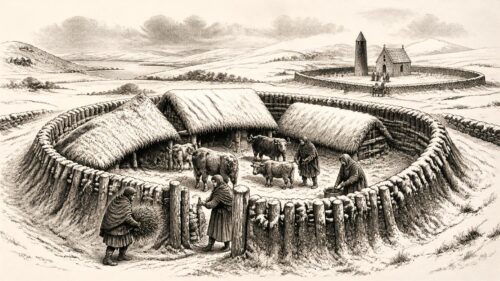
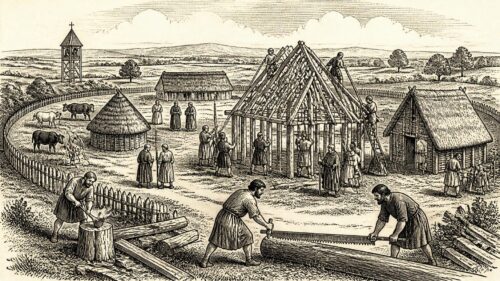
The annals are not a diary of ordinary households, and 802 supplies no firm evidence for a harvest, famine, trade voyage or environmental disaster in Ireland. It would be false to manufacture them. Archaeology and early Irish legal material nonetheless provide the immediate setting for the year’s recorded struggles: a predominantly rural society of dispersed farmsteads and enclosed settlements, in which cattle were central to wealth and status, and where monasteries and royal sites concentrated skilled labour, stored produce and portable valuables. The raid on a lake fortress, the mobilisation into Mide, and the burning of Iona all make particular sense in that landscape of movable wealth, local lordship and vulnerable high-status sites.
Thus 802 was not a year in which Ireland became a single kingdom or in which Scandinavian raiding suddenly remade the island. Its significance lies in sharper, connected developments: Áed Oirdnide asserted power over Mide; Muirgius broke a Connacht stronghold at Loch Riach; Iona’s Columban community suffered fire; and a generation of ecclesiastical and regional leaders passed away. Each event exposes a society whose authority was distributed among kings, kindreds and churches, but whose political and religious horizons already extended across the Irish Sea.
Primary Sources
- The Annals of Ulster, AD 431–1201: English Translation
- The Annals of Ulster, AD 431–1201: Irish and Latin Text
- Annals of Ulster: Year U802
- Annals of Inisfallen: English Translation
- Annals of the Four Masters, Volume 1: English Translation
- Annals of the Four Masters, Volume 1: Irish Text
- Annals of Tigernach
- Vikings in Irish Chronicles, 794–902: Data
- Áed Oirdnide
- Muirgius
- Donnchad Midi
- The Vikings & Ireland
- Iona and the Vikings: A Study in Survival
- Iona in the Viking Age: Laying a ‘Zombie Narrative’ to Rest
- The Social and Ideological Role of Crannogs in Early Medieval Ireland, Volume Two
- Underwater Archaeological Impact Assessment: Long Point, Loughrea, County Galway
- Historical Truth or Literary Embellishment? Uncovering the Voices of Historical Queens in Medieval Irish Sources
- The Chronological Apparatus of the Annals of Ulster AD 82–1019
- Irish Annals Edition Directory
- Changing Human-Cattle Relationships in Ireland: A 6000-Year Isotopic Perspective
- Bewitched by an Elf Dart: Fairy Archaeology, Folk Magic and Traditional Medicine in Ireland
- What Caused the Viking Age?
- Early Viking Church Raiders and the Emergence of Political Purpose
- Religion and Society in Ireland