Sruth Cluana Argait792 CE
In 792, Muirgius son of Tommaltach of Síl Muiredaig defeated and killed Cináed son of Artgal at Sruth Cluana Argait, probably Cloonargid, establishing his effective overkingship of Connacht. A related battle at Ard Maic Rími crushed Uí Ailello forces and killed rulers from Cairpre and Bréifne, strengthening Muirgius without ending Connacht’s political rivalry. Annals also record deaths of kings in Dál nAraidi, Uí Fhiachrach, Dál Riata and elsewhere. Máel Ruain, founder of Tallaght’s influential religious community, died peacefully. These compressed notices reveal an Ireland shaped by contested dynastic authority, ecclesiastical succession, agricultural communities, and interconnected secular and religious power structures.
Dateline
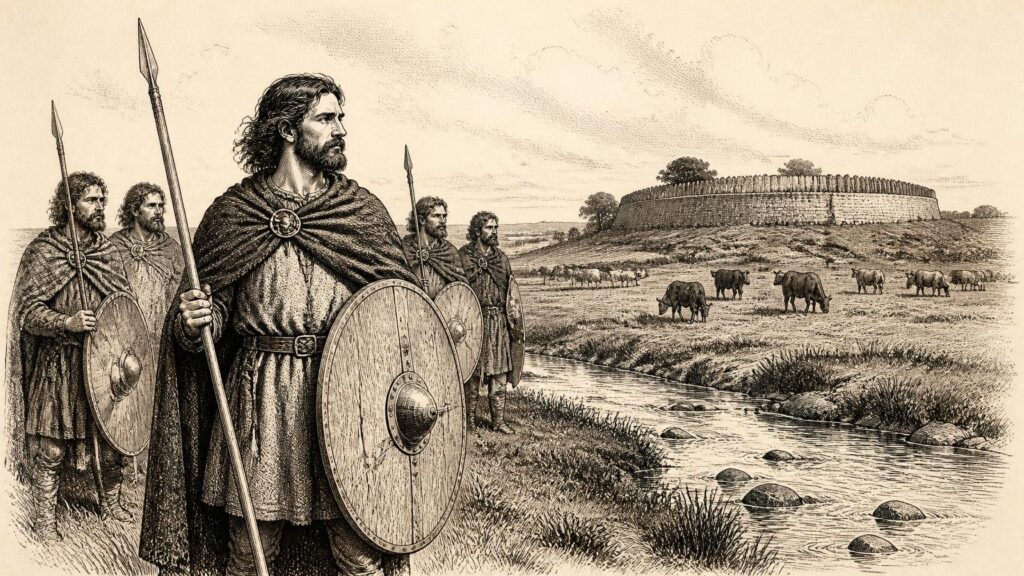
In 792, a struggle within Connacht came sharply into view in the Irish annals. At Sruth Cluana Argait—usually identified with Cloonargid in modern County Roscommon—Muirgius son of Tommaltach defeated and killed Cináed son of Artgal. The Annals of Ulster add a terse but momentous conclusion: this was “the beginning of his reign”. That formula makes the encounter more than a local killing. It marks the emergence of Muirgius as the leading overking of Connacht, while also revealing how precarious such authority could be.
The evidence for the year is unusually concentrated in brief annalistic notices: battles, deaths of kings and churchmen, and little else. These records were copied and arranged long after many of the events they describe, and their year-numbering is not always straightforward. Modern historical works conventionally place Muirgius’s victory, the death of Máel Ruain of Tallaght, and the other associated notices in 792. The annals provide no day or month for the Connacht battles, and neither their scale nor their precise terrain can be recovered. What can be said securely is that 792 was a year of dynastic violence, ecclesiastical succession and regional change.
A Connacht Kingship Won in Battle
Muirgius belonged to Síl Muiredaig, a branch of the Uí Briúin Aí whose power-base lay in Mag Aí, the fertile plain around Rathcroghan and north-east County Galway. His opponent Cináed belonged to Síl Cathail, another Uí Briúin lineage. Their conflict was therefore not a simple contest between unrelated peoples, but a struggle among competing branches of a powerful Connacht dynasty. The death of Cináed removed one claimant to provincial leadership; it did not magically turn Connacht into a unified kingdom under an uncontested monarch.
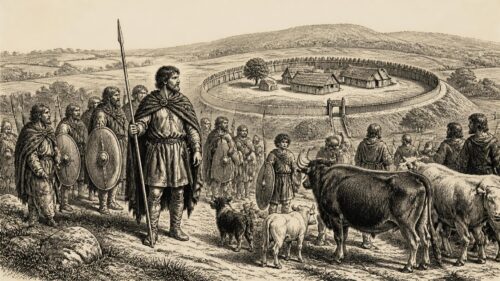
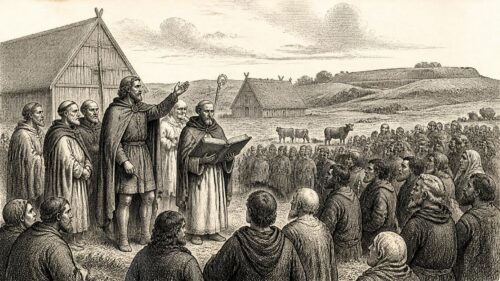
That distinction matters. Early medieval Irish kingship was layered. A local king ruled a túath or petty kingdom, while an overking sought tribute, hostages, military service and public recognition from lesser rulers. Such claims rested on kinship, landholding, alliances and the ability to gather armed followers. A victorious battle could alter the balance of power very quickly, but succession rules allowed several eligible males within a royal kindred to compete. Muirgius’s reign began in the annalists’ reckoning in 792 because victory made his claim effective, not because an impersonal state automatically passed to him.
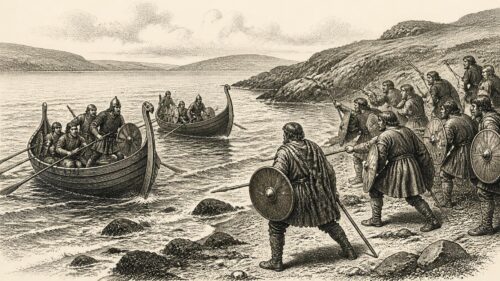
The place-name Sruth Cluana Argait is itself a reminder of the limits of the evidence. Its first element suggests a stream or current, while the location is generally associated with Cloonargid. The name should not encourage elaborate reconstruction. No source describes the manoeuvres, numbers, weapons or weather of the battle. The annal gives only the political result: Cináed fell and Muirgius won. Yet that economy of words reflects the annals’ priorities. The death of a dynastic claimant and the opening of a reign were facts worth preserving because they reshaped obligations across Connacht.
Another Defeat in the North
A second engagement, at Ard Maic Rími, followed closely enough in the record to belong to the same crisis. Here the Uí Ailello were “overthrown”. Among those killed were Conchobor and Airechtach, grandsons of Cathal; Cathmug son of Flaithbertach, king of Cairpre; and Cormac son of Dub dá Crích, king of Bréifne. Modern scholarship places Ard Maic Rími probably in the Tirerrill area of modern County Sligo and understands the outcome as a severe defeat for an alliance opposed to Muirgius.
The named dead show that Connacht politics reached beyond the immediate rival branches of Uí Briúin. Cairpre, Bréifne and the Uí Ailello occupied territories north and north-east of Mag Aí, across zones later associated with Sligo, Leitrim and Cavan. Their rulers were not simply spectators. In a polity built through personal lordship, a provincial succession could draw in neighbouring dynasties whose future security depended upon the victor. Ard Maic Rími therefore indicates both the breadth of the contest and the cost of settling it.
Still, 792 should not be presented as the permanent destruction of every opponent. Connacht remained politically plural. Later annals record further conflict involving Muirgius, while another figure, Colla son of Fergus, could still be styled king of Connacht at his death in 796. The responsible conclusion is narrower: Muirgius made a decisive advance in 792, and the defeats of Cináed and the Uí Ailello greatly strengthened Síl Muiredaig. It was a turning point in a longer contest, not the birth of a stable centralised realm.
Deaths Across the Irish Sea World
The year’s obituary notices suggest a wider reshuffling of authority. The Annals of Ulster record the deaths of Bresal son of Flaithrí, king of Dál nAraidi; Máel Bresail son of Áed son of Críchán, king of Uí Fhiachrach; Domn Corci, king of Dál Riata; and Cathmug, king of Calraige. These entries do not establish that their deaths resulted from a single event, and it would be wrong to join them into an imagined island-wide crisis. They do, however, underline the volatility of political life: several lordships, from north-east Ireland to the Irish Sea zone of Dál Riata, faced succession questions in the same year.
Dál Riata was an Irish Sea polity with interests and populations in north-east Ireland and western Scotland. Its appearance in Irish annals is a useful corrective to modern maps. Political and ecclesiastical relationships crossed the sea readily, while the island itself contained many competing kingdoms rather than a single Irish state. In 792, the strongest securely dated story remains Connacht’s internal war, but the obituaries show that contemporaries tracked leadership changes across a much wider Gaelic world.
Máel Ruain and the Churches
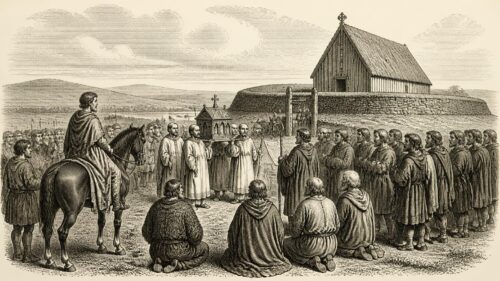
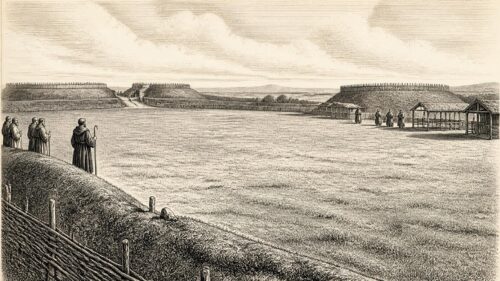
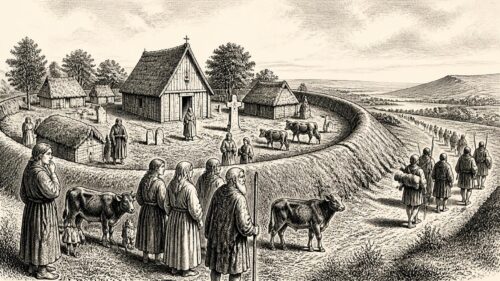
For religious history, the principal event was the peaceful death of Máel Ruain of Tamlacht, or Tallaght, whom the Annals of Ulster calls a bishop and a “soldier of Christ”. Máel Ruain had founded his community in 774 on land granted by Cellach son of Dúnchad, king of Leinster. By his death, Tallaght had become an important centre of disciplined religious life south-west of Dublin. The surviving earthwork curve at the later churchyard preserves a physical hint of the enclosure within which that community developed.
Later texts associated with Tallaght preserve teachings attributed to Máel Ruain and portray an exacting regime of prayer, fasting, celibacy, study and manual work. Historians often connect him with the Céli Dé, or reforming “clients of God”, but the term’s meaning and the extent of any organised movement in his own lifetime remain debated. It is safest to say that his community became central to later reform traditions, rather than to project a fully formed institution back into 792. His death nevertheless mattered immediately: he was succeeded at Tallaght, and subsequent commemoration made his grave a place of local devotion.
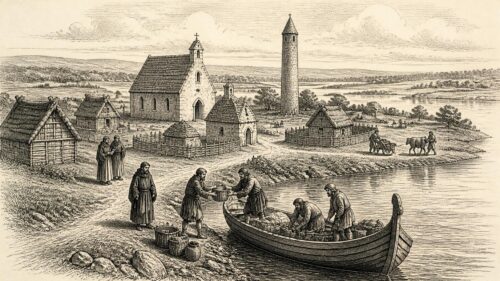
Other ecclesiastical deaths record the density of Ireland’s religious landscape. Aedán of Rahan and another Aedán, grandson of Cú Chumbu, are grouped with Máel Ruain as bishops and milites Christi; Saermug of Enach Dub also died. Téróc, superior of Corcach Mór, is named in the Ulster annals, while the Munster-focused Annals of Inisfallen additionally record the death of Muiredach, abbot of Clonfert. These were not isolated clerics. Churches and monasteries were communities of worship, learning, agriculture, craft and hospitality, tied to lay patrons and to the territories around them.
Work, Land and Authority
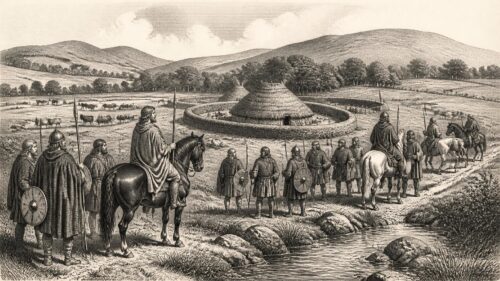
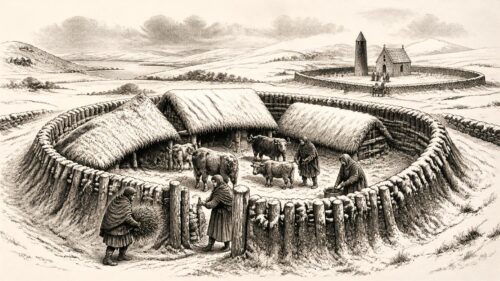
For most people, the year was not defined by annalistic battlefields or abbots’ obituaries. Life centred on small agricultural settlements, commonly enclosed farmsteads now known as ringforts or cashels. Cattle were central to wealth and payment, but households also grew cereals, used querns and drying kilns, fished where waterways permitted, and depended on seasonal labour. Political conflict threatened this world because kings sustained followers through food-renders, livestock, service and gifts. A change of overking could mean new demands on communities without changing the daily round of herding, cultivation, food preparation and household work.
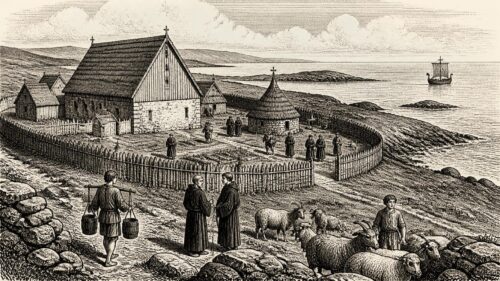
Ecclesiastical settlements formed another layer in that landscape. They could hold land, receive clients and pilgrims, employ craftsmen, preserve books and connect local communities with wider networks of Latin learning. Tallaght, Cork and Clonfert should therefore not be imagined as remote retreats cut off from society. Their leaders were recorded alongside kings because church authority and secular power overlapped, competed and supported one another. Yet the surviving notices tell us nothing specific about harvests, prices, trade voyages or climate in 792. Silence must remain silence.
A Year of Hard-Won Authority
The record of 792 is compressed, but its implications are clear. Muirgius’s victory at Sruth Cluana Argait changed the hierarchy of Connacht; the defeat at Ard Maic Rími damaged rival interests farther north; and the deaths of rulers and senior churchmen opened new successions across Ireland’s interconnected regions. Máel Ruain’s peaceful death offers a striking counterpoint to the warfare: a monastery’s founder passed on just as a provincial king established himself by force. Together, those events show an island in which authority was continually made and remade through kinship, conflict, land, religious prestige and memory.
Primary Sources
- The Annals of Ulster: U792
- The Annals of Ulster
- Annals of Inisfallen: Part 35
- Annals of Inisfallen
- Chronicon Scotorum
- The Annals of Tigernach
- CELT Project: Annals of Tigernach
- Annals of the Four Masters
- Muirgius
- Máel-Ruain
- Céli Dé in Ireland
- Félire Óengusso: Problems of Dating
- Saint Patrick and the Landscape of Early Christian Ireland
- Prehistoric and Early Christian History
- Farming and Archaeology: The Irish Historic Landscape
- Rathbeagh Ringfort, Co Kilkenny
- National Monuments Service: Monument Class and Scope Notes
- Religion and Society in Ireland
- Kingship, Society, and Sacrality: Rank, Power, and Ideology in Early Medieval Ireland
- The Organization of Exchange in Early Christian Ireland
- How Did Early Church Sites Differ from One Another? A Comparative Approach within the Kingdom of Fir Maige, Ireland
- Monasticism and its Limits: Rematerialising Monastic Space in Early Medieval Ireland