Bairche’s Whale-Tooth Offering752 CE
In 752, Irish annals recorded a darkened sun, the deaths of prominent abbots and scholars, and violence between the Uí Ailella and Grecraige. They also report that Domnall Midi, king of Tara, enforced the law of Colum Cille, linking royal authority with the Columban church’s claims to protection and prestige across Ireland and the Irish Sea. Most memorably, a whale stranded at Bairche in Ulaid was said to possess three golden teeth, one placed on Bangor’s altar. Though implausible literally, the tale reflects medieval connections between natural wonders, wealth, sanctity, political power, and ecclesiastical public memory within this fragmented record.
Dateline
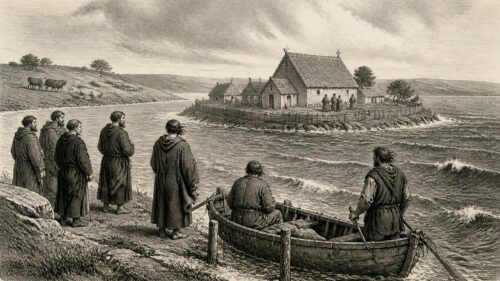
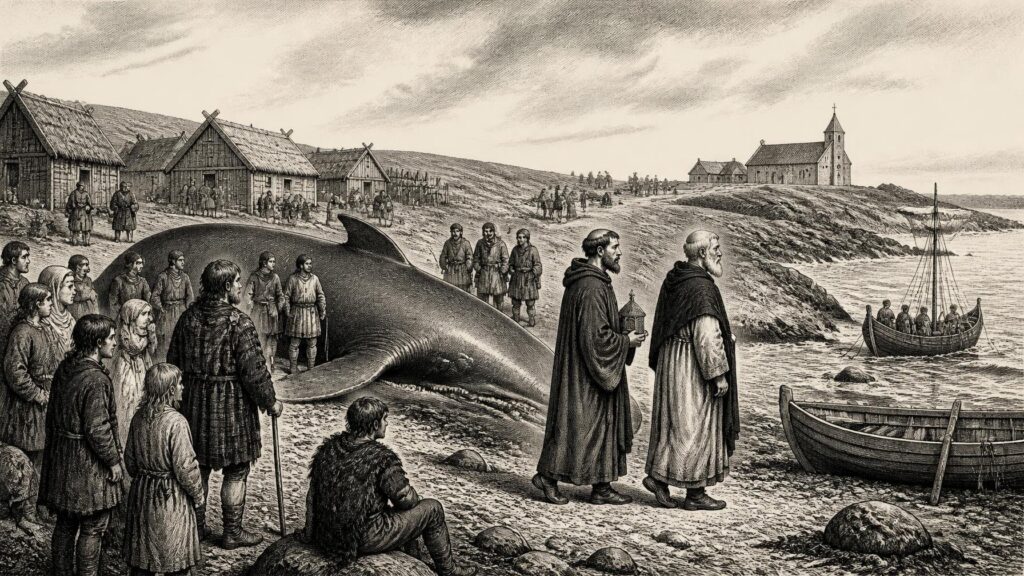
In 752 CE, an Irish annal preserved an extraordinary coastal report: a whale was cast ashore at Bairche, in the kingdom of Ulaid, and was said to have had three teeth of gold. One, the record adds, was placed upon the altar of Bangor. The same annal explicitly identifies this as “AD 752”, an unusually helpful clarification in a body of material whose year-headings can otherwise be offset from modern calendar dating. The account cannot be accepted literally as zoology: a whale with teeth of gold is physically impossible, and the notice may have been shaped by marvel, symbolism or later recollection. Yet it is valuable evidence for what a prestigious church and its patrons wanted remembered in 752: a rare event on the shore, an object of exceptional worth, and its transfer into the sacred custody of Bennchor, modern Bangor.
A Marvel on the Ulaid Coast
The whale notice stands apart because it joins the natural world, royal authority and ecclesiastical display. It is placed “in the time of Fiachna son of Áed Rón, king of Ulaid”, locating the episode within the political sphere of the dominant dynasty in the north-east. Bairche lay in Ulaid’s coastal world, where communities faced the Irish Sea and maintained maritime connections with western Britain and Scotland as well as with other Irish regions. A stranded whale was no small occurrence. Even without accepting the gold-teeth detail, such a carcass could have drawn local attention for its size, meat, blubber, bone and sheer novelty.
The annalist’s real emphasis, however, is not on salvage. It is on the alleged golden tooth and its destination. Bangor was already an important church with a long Columban and monastic reputation. To say that a precious wonder had reached its altar associated the community with divine favour, royal patronage and material magnificence. Altars were places of Eucharistic worship, but they could also be focal points for gifts, relics and objects through which a church’s standing was made visible. Whether the object was truly a tooth, another valuable substance understood or retold as gold, or a literary marvel, the report shows how closely wealth, sanctity and public memory could be intertwined.
A Darkened Sun
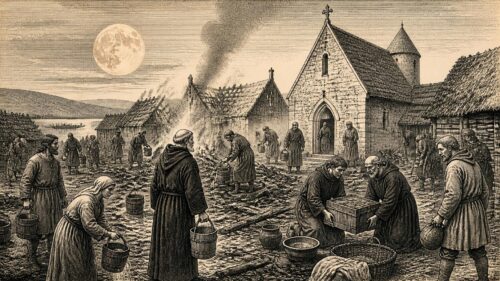
The same annalistic year begins with an even briefer but potentially more arresting observation: “a dark sun”. The words may record an eclipse, as later readers have often supposed, but the surviving entry supplies neither a day nor an explanation. It is therefore safer to retain the annalist’s description than to claim certainty about what observers saw. Early Irish ecclesiastical scholars had strong reasons to watch the heavens. Calculating Easter required sophisticated attention to solar and lunar cycles, while unusual celestial phenomena could be recorded as signs demanding interpretation. A darkened sun would have been meaningful not simply as a spectacle, but as an interruption to the order by which liturgical time itself was reckoned.
The juxtaposition of a dark sun and a miraculous whale is revealing. Medieval annals did not separate natural occurrences, political events and sacred history into modern categories. A strange sky, the death of an abbot, a royal act and an object placed on an altar could all belong in the same annual record. This does not mean that every entry was believed to be a direct omen of another. Rather, it shows an intellectual world in which the created order, Christian worship and the fortunes of peoples and rulers were understood as connected.
Domnall of Mide and Columba’s Law
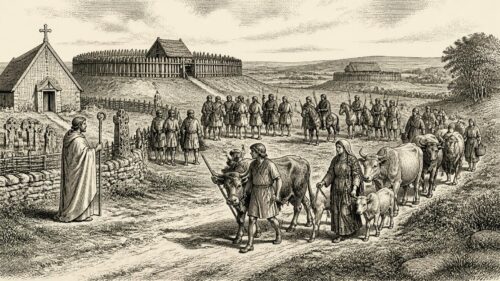
The most consequential political-religious notice assigned to 752 states that “the law of Colum Cille” was enforced by Domnall of Mide. Domnall mac Murchada, generally known as Domnall Midi, was the leading ruler of Clann Cholmáin in Mide and king of Tara. His authority did not make Ireland a unified kingdom in the modern sense. Power was distributed among numerous provincial kings, local dynasties and ecclesiastical communities. Nevertheless, a king of Tara could claim a commanding place within the wider hierarchy of Irish rulership, and Domnall’s participation gave this act a significance beyond his home territory.
The precise provisions of Columba’s law are not known. It would be irresponsible to supply a detailed code of rules that the sources do not preserve. Nor can the entry by itself prove that the law was newly written in 752. What can be said is that it records a formal enforcement or proclamation carried out under Domnall’s authority and invoking Colum Cille, the sixth-century founder-saint of Iona and one of the most potent figures in Irish and Gaelic Christian memory. In early medieval Ireland, the “laws” of saints could create recognised zones of protection, obligation and prestige around churches and their associated networks. Their enforcement joined secular force to ecclesiastical claims.
That connection mattered especially for the Columban familia, the broad network of communities claiming association with Columba and Iona. Iona lay off the coast of present-day Scotland, but its religious, learned and political ties reached deeply into Ireland. The 752 notice is thus directly relevant to Irish history while also reminding us that the Irish Sea was a corridor rather than a frontier. Domnall’s act presented the king not merely as a commander of men but as a guarantor of sacred order. For a church associated with Columba, royal sponsorship could strengthen claims to land, clientship, immunity and honour; for a king, sponsorship of a revered saint’s law enhanced legitimacy.
Churches, Scholars and Succession
The annals also register a striking series of deaths in ecclesiastical centres. Mac Oiged, abbot of Lismore, died; so did Luchraid, abbot of Clonmacnoise, and Cellan, abbot of Clonfert. Scannlán of Dún Lethglaise, later Downpatrick, is also commemorated, as are Mo-Baí, Scannlaige of Cluain Bairenn and Fursa of Es Mac nEirc. Ferblae son of Nárgus is specifically called a learned man. These brief obituaries do not tell us how each succession unfolded, but they show the density of the island’s religious and intellectual landscape. Major churches were dispersed across Munster, the Shannon corridor, the midlands and Ulaid, and their leaders formed part of the social elite whose passing was worthy of a national chronicle.
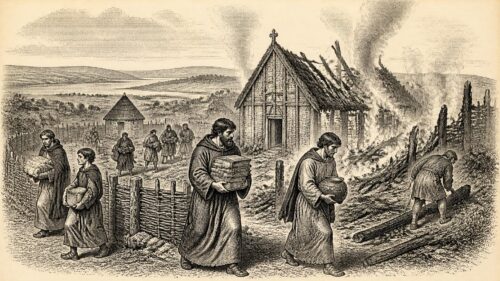
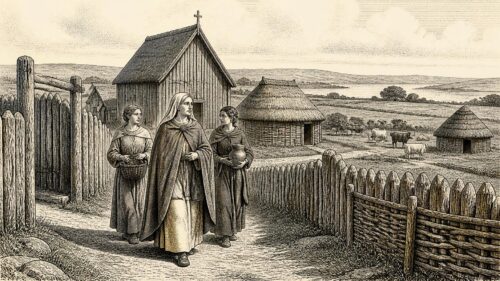
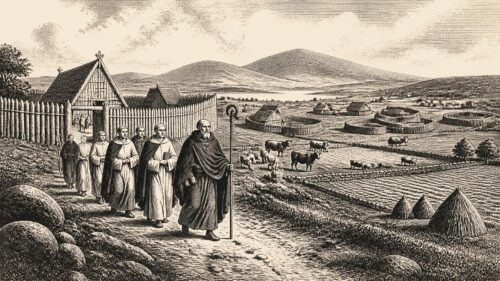
An abbot in this period was rarely only the head of a secluded religious household. Important churches held land, received food-rents and gifts, trained clerics, maintained books and reliquaries, and dealt with kings and local lords. Their communities included clergy and ascetics, but also dependants, tenants, craftworkers and others who cultivated fields, tended animals and sustained hospitality. The number of deaths recorded for 752 should not be mistaken for evidence of a general catastrophe; the annals do not report one. It does, however, underline how leadership changes at renowned churches could matter across regional boundaries.
Conflict Without a Grand Campaign
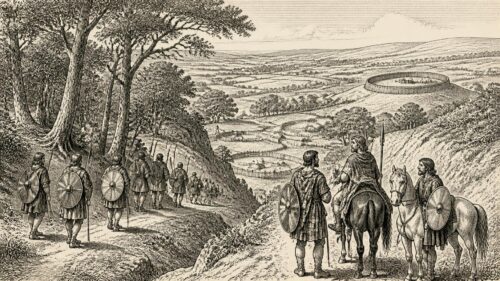
There was also violence. The annal records the slaughter of the Uí Ailella by the Grecraige, but supplies no narrative of causes, numbers or exact location. This restraint is important. The entry confirms conflict between named population groups or political kindreds; it does not permit a reconstruction of a full-scale national war. Elsewhere, Ireland remained a mosaic of small kingdoms and lordships in which raids, cattle-taking, disputes over succession and struggles for territory were recurrent possibilities. Large political claims, such as Domnall’s authority in Mide, depended on negotiation as much as on force.
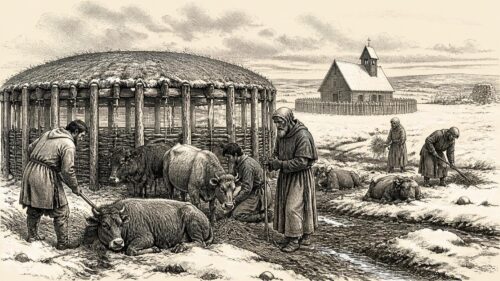
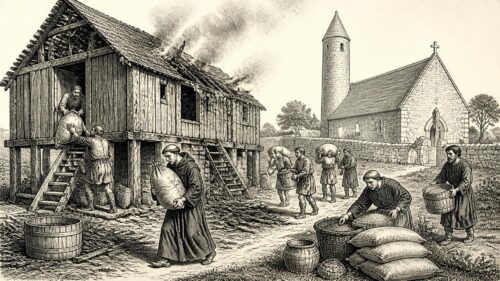
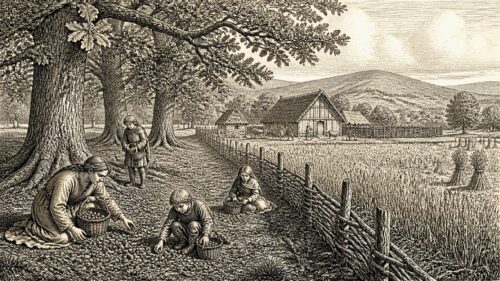
For most people, everyday life was rooted in rural settlements rather than towns. Cattle remained central to wealth, status and food production, while arable cultivation was becoming increasingly important during the eighth century. Archaeological and documentary evidence points to expanding cereal production, grain-drying and water-powered milling in this broad period. Such developments are context rather than events securely dated to 752 itself. They help explain the resources at stake when rulers, churches and communities asserted rights over land, labour and protection. The churches named in the annals depended upon this productive countryside, and in turn helped organise it through patronage, landholding and hospitality.
A Year Preserved in Fragments
Nothing in the evidence permits a continuous narrative of Ireland in 752. The surviving record is selective, retrospective in places and sometimes openly marvellous. Its strength lies precisely in its fragments. A king of Tara enforced Columba’s law; several leading churchmen and a named scholar died; an unelaborated killing marked local rivalry; an observer noted a dark sun; and Bangor was credited with receiving a treasure from the sea. Together these notices illuminate an Ireland in which kingship, monastic institutions, learning, agriculture and coastal experience were inseparable parts of public life. The golden whale-tooth should not be treated as literal fact, but its careful placement in the annal preserves a genuine historical truth: sacred institutions competed to gather meaning, honour and material splendour from the events of their world.
Primary Sources
- The Annals of Ulster, Year U753 (AD 752)
- The Annals of Ulster, Year U753: Original Text
- The Annals of Ulster
- The Annals of Tigernach, Part 14
- The Annals of Tigernach
- The Annals of Tigernach: Original Text
- Chronicon Scotorum
- Domnall mac Murchada: (d. 763), high-king of Ireland
- Agriculture, Settlement and Society in Early Medieval Ireland
- The Economy of Early Medieval Ireland
- Early Medieval Ireland: Investigating Social, Economic and Settlement Change, AD 400–1100
- Early Medieval Archaeology Project: Reconstructing the Early Medieval Irish Economy
- Isle of the Saints: Monastic Settlement and Christian Community in Early Ireland
- Was Glendalough a ‘Monastic Town’
- Ireland in the Middle Ages
- Exploring the Irish Annals
- A Short History of Ireland’s Long Fascination with Eclipses
- Five Millennium Catalog of Solar Eclipses: −1999 to +3000
- Solar Eclipses Visible in Ireland Between A.D. 400 and A.D. 1000
- Cloudy and Clear Stratospheres Before A.D. 1000 Inferred from Written Sources
- The Annals of Tigernach
- The Annals Attributed to Tigernach