Snow, Drought and Suanach748 CE
In 748, Irish annals recorded exceptional snow, widespread cattle mortality and subsequent drought, placing severe pressure on a pastoral economy without proving famine. The death of Indrechtach, king of the Ciannachta, affected politics in Brega, while Congal of Airthir was killed at Ráith Escla. Ua Suanaig’s law was enforced in Leth Cuinn, demonstrating proclaimed legal authority despite uncertain provisions or reach. Annals also noted deaths of abbots, anchorites and learned men, illustrating churches’ economic and social importance. A described battle and an aerial-ship prodigy reveal chronicles combining conflict, environment, leadership and marvels. The evidence depicts interconnected hardship, authority and learning.
Dateline
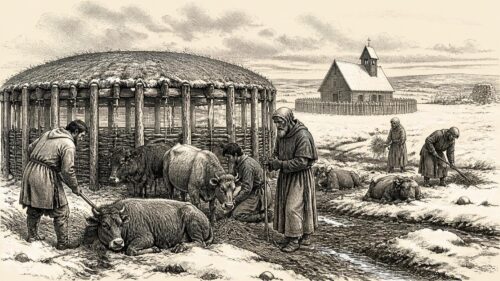
In 748 CE, Ireland’s annalists recorded a year of exceptional environmental strain alongside changes in local rulership, an important legal proclamation and the deaths of religious figures. The fullest contemporary-style notice comes from the Annals of Tigernach, whose entry for 748 reports unusually deep snow, the near-destruction of cattle across Ireland, and a subsequent drought. It is an arresting sequence because it joins winter, livestock loss and summer dryness in a single compressed report. No precise days or months are supplied, and the scale cannot be checked in modern statistical terms; nevertheless, the agreement of the Annals of Tigernach and Annals of Ulster makes it responsible to treat severe snow, cattle mortality and ensuing drought as the defining development connected with this year. The Ulster annals’ internal year-number is offset at this point, a reminder that early Irish annalistic dating requires care rather than a mechanical reading of headings.
A Season of Livestock Loss
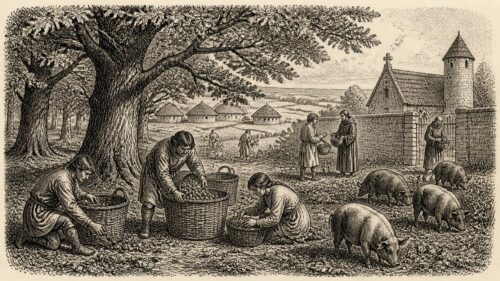
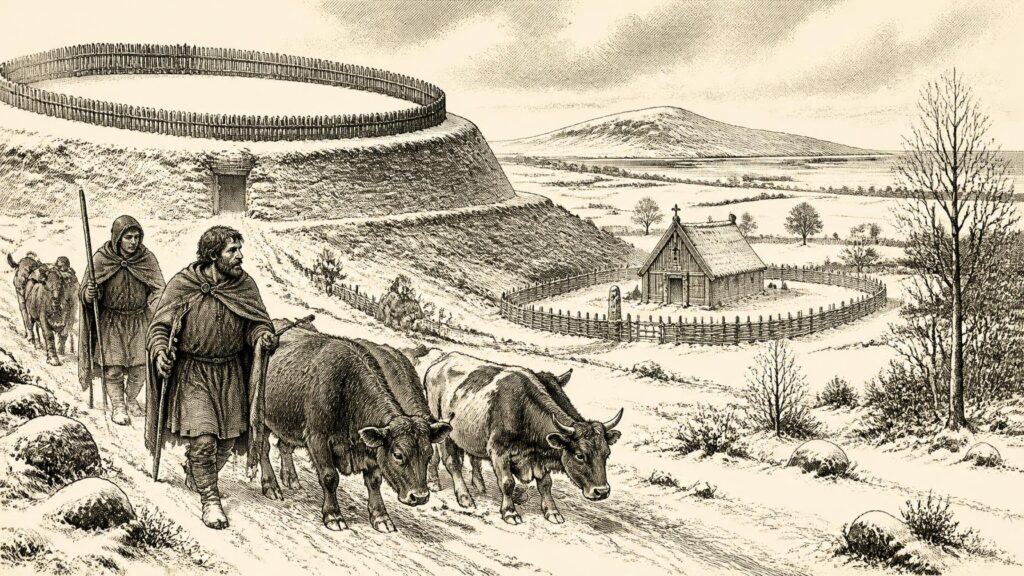
The annal’s language is emphatic: snow lay in extraordinary quantity, “nearly all” the cattle of Ireland perished, and the land was then afflicted by an unfamiliar dryness. Such wording should not be converted into a literal census of every herd. Medieval annalists used sweeping language to convey catastrophe, and their notices are brief. Yet cattle were too central to early medieval life for the report to be dismissed as ornamental rhetoric. They were stores of mobile wealth, sources of milk, butter, meat, hides and traction, and a principal measure of social standing. A hard winter that prevented grazing or made fodder inaccessible would have endangered herds; drought afterwards would have reduced pasture, water and the prospect of rebuilding them.
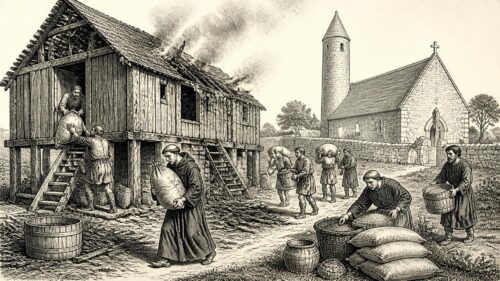
For ordinary households, a loss of cattle could mean more than an immediate shortage of food. It weakened a family’s capacity to give or receive fosterage, pay compensation, make gifts, provide hospitality or maintain dependants. It also narrowed the reserves available for seed-grain, tools and labour. For kings and church communities, herds supported retainers, tenants, guests and religious personnel. The annals do not explicitly record famine in 748, nor should one be invented. What can safely be said is that the reported combination of snow, mortality and drought placed exceptional pressure on a pastoral economy in which cows and their produce had political as well as nutritional value.
The crisis would have been unevenly experienced. Some districts may have retained sheltered pasture, winter fodder or access to alternative resources; others could have been devastated. Ireland was not a single centrally administered state capable of organising a documented island-wide relief programme. It consisted of many small kingdoms, lordships and ecclesiastical territories. The phrase “the whole of Ireland” therefore tells us chiefly how widely the annalist believed the calamity was felt. Its importance lies not merely in weather history but in the vulnerability of social and political relationships built upon cattle.
Death and Authority in Ciannachta
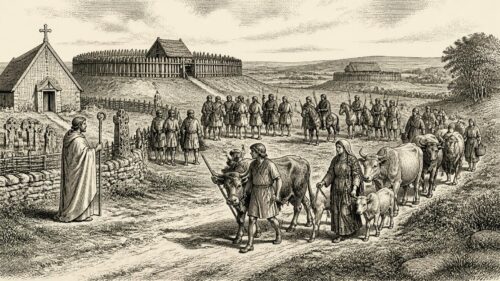
Amid that environmental strain died Indrechtach, grandson of Conaing, styled king of the Ciannachta. His death mattered in the politically crowded region of Brega, north of the River Liffey and associated with the rich Boyne valley. The Ciannachta were a people and territory whose rulers were entangled with larger southern Uí Néill dynastic competition. Indrechtach had appeared in the annals earlier in the decade as a victor in battle. His obit in 748 does not state how he died, name a successor or describe a conflict at his funeral. Still, the removal of a proven regional ruler at a moment of agrarian difficulty was consequential: control of tribute, cattle, land and clients depended on personal and kin-based authority.
The entry does not support an image of an Irish “national” succession. Kingship operated at overlapping levels. Local rulers controlled particular peoples and territories; more powerful dynasties sought recognition, hostages, tribute and military service beyond their immediate lands. The later Annals of the Four Masters, compiled in the seventeenth century from earlier materials, calls 748 the tenth year of Domnall, conventionally identified with Domnall Midi of Clann Cholmáin. That later chronological framework is useful context, but it should not obscure the evidence of 748 itself: the annals chiefly preserve the death of a Ciannachta king, not an island-wide change of ruler.
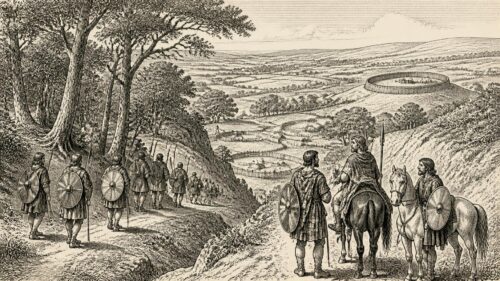
Violence also continued in the north-east. The Annals of Tigernach records the killing of Congal son of Éicnech, king of Airthir, at Ráith Escla, naming Donn Bó son of Cú Bretan as the killer. Airthir lay in the wider Armagh borderlands, and the notice reveals a world in which even a ruler of a comparatively small people might be struck down at a named royal or settlement site. The annals give no motive and do not authorise a reconstruction of a campaign, feud or succession dispute. Their sparseness is itself revealing: political killing was sufficiently intelligible to the original audience that a name, title and place could carry the news.
Suanach’s Law in Leth Cuinn
The same year is associated with the enforcement of “the law of Ua Suanaig” in Leth Cuinn, “Conn’s Half”, the conventional name for Ireland’s northern half. This is among the most significant notices of 748, although also among the least fully explained. The annals do not preserve the law’s clauses, its assembly, its sponsors or the penalties for breaking it. “Ua” can mean grandson or descendant, so certainty about the individual Suanach is not possible. Nor can the surviving sentence prove that every district in Leth Cuinn observed the law equally.
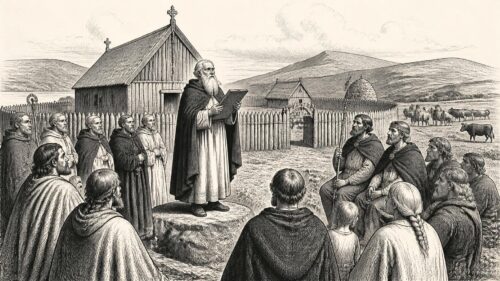
Even so, the notice shows that law could be publicly proclaimed over a wide political and ecclesiastical sphere. Early Irish cáin was not legislation in the modern parliamentary sense. Such laws could be linked to a ruler, a saint, a church federation or a learned lineage, and were commonly upheld through alliances of secular power and ecclesiastical prestige. Their scope might concern peace, protection, dues, status or church privilege. Nothing in the 748 entry tells us which of these applied to Suanach’s law. The responsible conclusion is narrower but important: people in the northern half of Ireland were being told that a named legal authority had force, at precisely the time when climate and political succession could make orderly claims, protection and obligation especially valuable.
Law was therefore not separate from everyday life. In a society where wealth was frequently reckoned in cattle, legal rules shaped compensation for injury, rights over property, obligations between lords and clients, and the standing of churches and learned persons. A proclamation may have been an assertion of authority as much as a remedy for disorder. It could also have required cooperation across boundaries that otherwise divided petty kingdoms. The annal supplies no evidence that Suanach’s law was a direct response to the snow or drought, and that tempting connection must remain unmade. Their juxtaposition instead gives a sharper impression of 748: hardship and institutional order existed side by side.
Churches, Learning and Loss
Several deaths locate the year within Ireland’s dense network of ecclesiastical communities. Arascach, abbot of Muicinis Riaguil, drowned; Cúan Cam is remembered simply as “the learned”; Do-Dímóc, an anchorite and abbot of Clonard, died; and so did Do-Chumae, described as a learned man of Kildare. Flann Foirbthe son of Fogartach and Cúan, an anchorite of Lilcach, are also entered among the dead. These compressed notices do not reveal their writings, the number of monks or clerics under their care, or the circumstances of every death. But the titles themselves matter. An abbot could administer land, labour, food-renders and hospitality as well as religious observance. An anchorite represented an ideal of disciplined withdrawal, while “learned” marked men valued for expertise in scripture, language, law, genealogy or teaching.
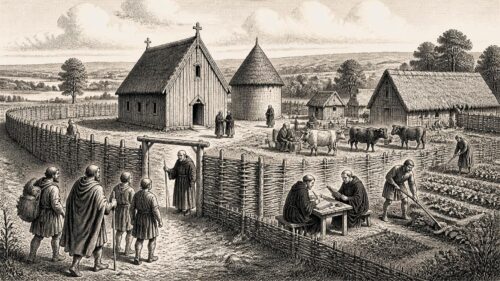
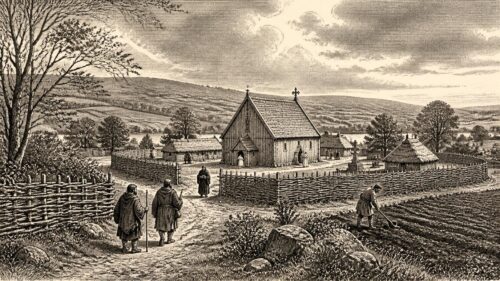
Clonard and Kildare were not isolated retreats. Like other major Irish churches, they were centres of worship, learning, craft, production and exchange, tied to surrounding farming communities. Their resources depended on crops, cattle and obligations from people beyond their enclosures. A broad livestock crisis would therefore have reached church estates as surely as secular ones, although the sources do not quantify the impact. The notices also demonstrate the annals’ priorities: the passing of scholarly and ascetic figures was considered public history, not a private matter.
The Annals of Tigernach adds two striking items which should be handled as evidence of record and belief, not literal modern reportage. It notes a battle at the Ford of the Uí Fiachrach, where there was a slaughter of Leinstermen, but supplies neither commanders nor a secure location. It also says that ships with their crews were seen in the air. The latter was a prodigy: an extraordinary sight entered into a Christian chronicle as meaningful or alarming, not evidence for airborne vessels. Such entries show that the annalists’ historical world included warfare, weather and marvels alike, each capable of signalling disturbance.
A Year of Pressure
748 CE was not a year for which the sources preserve a single decisive battle or a dramatic change in island-wide government. Its significance is cumulative. Severe snow, extensive cattle loss and drought threatened the material foundations of rural society. Indrechtach’s death altered the political landscape in Ciannachta; Congal’s killing demonstrated continued vulnerability among regional rulers; and the law of Ua Suanaig asserted an ordering force across Leth Cuinn. Meanwhile, the deaths of abbots, anchorites and learned men reveal how closely religious institutions belonged to the political and economic fabric of the country. The surviving record is brief, partial and shaped by monastic writers. Read carefully, it nevertheless preserves an Ireland in which climate, cattle, law, kingship and learning were inseparable parts of public life.
Primary Sources
- The Annals of Tigernach, Annal T748
- The Annals of Ulster, Year U748
- Annals of the Four Masters, Annal M748
- The Annals of Tigernach
- The Annals of Ulster
- Annals of the Four Masters
- CELT Project: Annals of Tigernach
- CELT Project: Annals of Ulster
- CELT Project: Annals of the Four Masters
- Nation and Kingship in Medieval Ireland
- CELT Project: Cáin Lánamna
- Narratives in Early Irish Law Tracts
- Regnal Succession in Early Medieval Ireland
- Farming and Archaeology: The Irish Historic Landscape
- Early Christian Monasteries
- Dairy
- Pre-Christian Ireland
- Meat and Dairy Products
- Exploring the Irish Annals
- Irish Script on Screen: Ornamental Reader’s Aids
- Irish Script on Screen: Royal Irish Academy Collection
- Donnchad Midi, Dictionary of Irish Biography