Affrica and Seredmag742 CE
An annalistic dossier assigned to 742 by the Annals of Ulster, but often dated 743, records intense political, ecclesiastical and social change in Ireland. At Seredmag near Kells, Domnall Midi defeated and killed Áed Allán, gaining wider kingship and strengthening Clann Cholmáin against Cenél nÉogain. Other regional battles and killings reveal widespread instability. Deaths of Affrica of Kildare and abbots of Rechru and Mag Bile marked ecclesiastical successions. Suanach’s law was enacted, and relics of Trian of Cell Delge travelled on circuit. The annals also report widespread bolgach, probably a smallpox-like disease, showing warfare, religious authority and illness shaped communities.
Dateline
In 742 CE, Ireland’s annalistic record preserves an exceptionally concentrated picture of warfare, ecclesiastical change, disease and royal succession. It also requires a warning about dates. The Annals of Ulster place this group of notices beneath a heading explicitly calculated as AD 742, whereas the parallel Annals of Tigernach number the same dossier 743, and many modern reference works accordingly date the climactic battle of Seredmag to 743. The events discussed here are therefore securely attached to the annalists’ 742/743 dossier, but Seredmag’s precise modern calendar placement remains disputed. No day or month is supplied for any of them.
A Summer of Battles
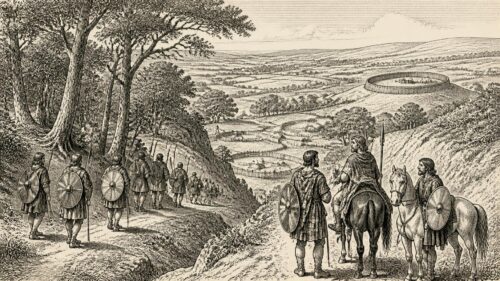
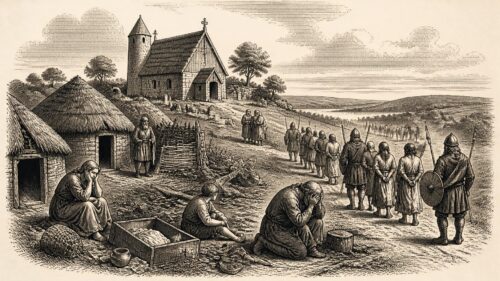
The most consequential recorded event was the battle of Seredmag, placed by the Annals of Ulster at Cenannas, modern Kells in County Meath. Domnall mac Murchada, better known as Domnall Midi of Clann Cholmáin, defeated Áed Allán mac Fergalaig, the leading king of Cenél nÉogain and king of Tara in the annalistic terminology. Áed was killed, as were Cumuscach, king of the Airthir; Máenach, king of Uí Chremthainn; and Muiredach, king of Uí Thuirtri. The list matters. It presents the battle not as a private collision of two rulers but as a struggle involving powerful northern and Airgíalla interests, brought into the southern Uí Néill heartland around Kells.
The sources say Domnall was victor and then that he “begins to reign”. This is the clearest indication that the battle marked a change in the wider kingship, conventionally called the kingship of Tara or, in later historical language, the high-kingship of Ireland. It did not create a unified Irish state. Eighth-century Ireland consisted of numerous kingdoms, overkingdoms and ecclesiastical territories whose rulers negotiated, fought and made alliances at several levels. Yet victory at Seredmag elevated Domnall’s Clann Cholmáin, based in Mide, over a formidable rival from the northern Uí Néill.
Áed Allán’s fall was especially striking because he had been one of the most forceful rulers of his generation. During the 730s he had defeated rivals in the north-west, beaten Ulaid and Leinster forces, and met Cathal mac Finguine of Munster at Terryglass in 737. Those earlier achievements belong to the background, not to 742 itself, but they explain why his defeat registered as a major political reversal. Domnall’s success did not erase Cenél nÉogain: Áed’s brother Niall Frossach and later northern rulers would remain important. It did, however, establish the alternation of influence between the midland Clann Cholmáin and northern Cenél nÉogain that shaped high politics for generations.
The annals attach a small but revealing literary memorial to Áed. They preserve a four-line stanza said to be his last, reflecting on divine mercy, sin and the shore of Loch Sailchedáin. Whether the verse was truly composed by the defeated king cannot be independently demonstrated. Its presence nevertheless shows how a political death could be remembered in a Christian idiom, with defeat and mortality interpreted through repentance rather than simply military loss. Irish annals were terse records, but not emotionally empty ones: they could preserve a king’s name, genealogy, political standing and an attributed final voice.
Seredmag was not the sole violence in the dossier. A battle at Dám Derg in Brega killed Dúngal mac Flainn, king of Fir Chúl, and Fergus mac Oistech; Indrechtach, grandson of Conaing, won. Another confrontation set Uí Maine against Uí Fhiachrach Aidne in Connacht, while a battle at Lorg involved Uí Ailella and Gailenga. The chronicler observed that four wars were fought, or nearly completed, in one summer. That wording is a valuable limit on what can be claimed: it indicates a season of unusually dense conflict, but it does not supply battle plans, troop numbers, civilian casualties or detailed causes. Nor should the entries be forced into a single island-wide war. Some concerned regional rivalries that intersected only indirectly with the contest at Kells.
The killings continued beyond named battlefields. Dub Dothra, king of Uí Briúin and Conmaicne of Bréifne in the fuller Tigernach wording, was slain. Dlúthach mac Fidchellach, king of Uí Maine, is also recorded dead in that annal. These notices underline how precarious kingship could be below the level of Tara. Ruling families competed for local dominance in Connacht, Brega, Bréifne and the north, and a political map drawn only around Domnall and Áed would miss much of the year’s instability.
Changing Authority in Church Communities
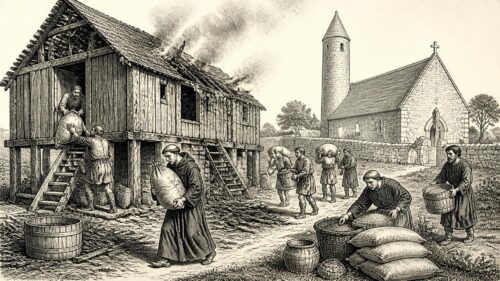
Political upheaval coincided with prominent deaths in religious institutions. Affrica, abbess of Cell Dara, or Kildare, died. The bare entry does not tell us how long she had governed, what buildings she commissioned or what particular reforms she pursued. It does confirm, however, that the headship of Kildare was sufficiently significant to be entered in the annals. Kildare’s association with Brigit made it one of Ireland’s foremost ecclesiastical centres, and an abbess there held an office of considerable religious and social weight. Affrica’s death was therefore a transition in an institution connected to landholding, pastoral care, learning, craft and the prestige of a major saint’s cult.
Cuiméne, grandson of Ciarán, abbot of Rechru, also died. Rechru is generally identified with Lambay, the island off the north Dublin coast. An abbot’s death was not merely an internal matter for a small religious household. Monasteries and churches were communities of clergy, students, dependants and labourers, and their leaders managed landed resources while maintaining relationships with lay dynasties. The death of Affiath, abbot of Mag Bile—identified in the Tigernach translation as Moville—adds a third ecclesiastical succession. Together, these notices show institutional continuity amid political violence: communities required new heads, estates and obligations had to be administered, and the memory of saints remained a source of authority.
The entry that “the law of Suanach’s descendant” came into force is equally important, although its details are frustratingly sparse. An Irish saint’s “law” was not a modern statute book. Such a proclamation could combine the prestige of a holy founder, ritual enforcement, negotiated protections and obligations imposed upon a defined population. The later notice that the law of Suanach’s grandson extended across Leth Cuinn, the northern half of Ireland, suggests that the earlier enactment belonged to a developing ecclesiastical programme rather than an isolated phrase. It is unsafe to reconstruct its provisions; the annals do not say who was protected, what payments were due or where enforcement began. But it demonstrates that law, sanctity and political power could be made visible together.
Relics on the Road
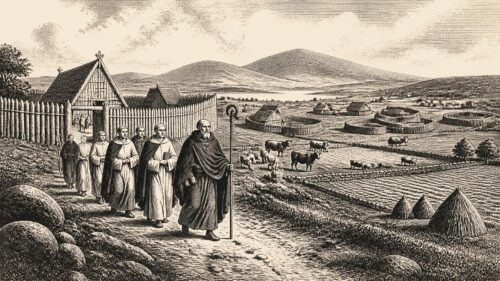
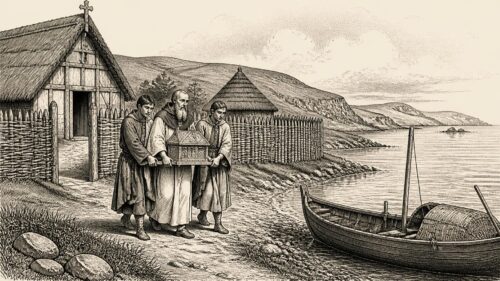
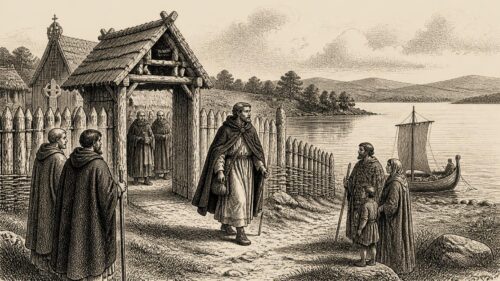
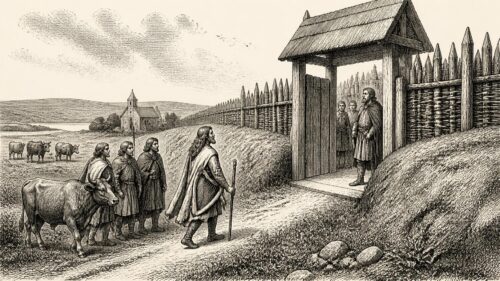
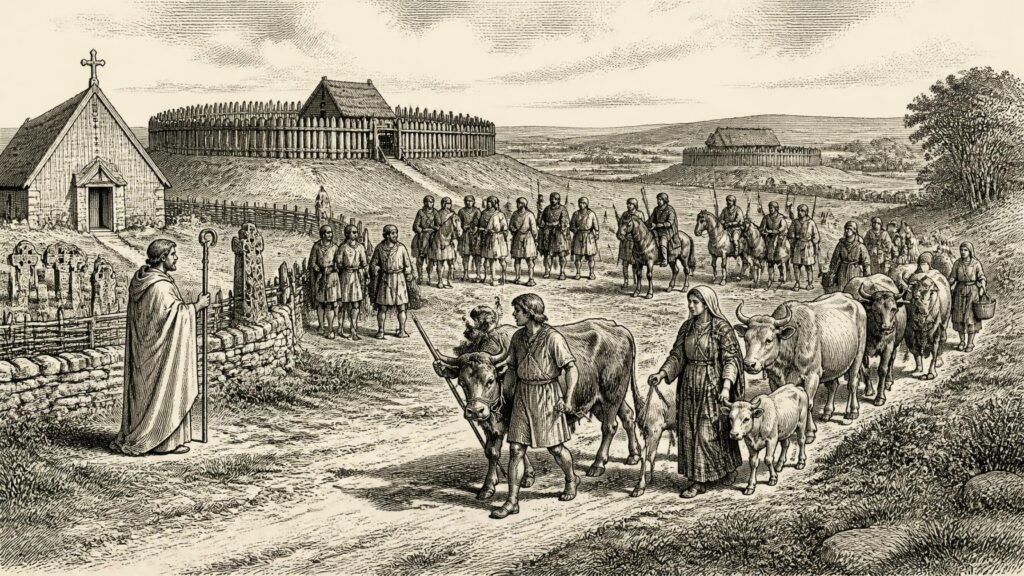
The same dossier records the taking on circuit of the relics of Trian of Cell Delge. A relic procession was a public act. The bodily remains or associated sacred objects of a saint could travel with clerics and attendants through territories connected with a church, gathering reverence, offerings, legal acknowledgements and political support. It was not necessarily a response to the wars of that summer; the annal does not establish such a causal link. But its juxtaposition with conflict, succession and disease is a reminder that movement across early medieval Ireland was not confined to armies. Religious processions linked local communities to wider cults and made holy patronage tangible.
The record is also a window onto communication and learning. Annalists could name scattered places and groups—from Kells and Brega to Uí Maine, Aidne and Bréifne—and preserve terse accounts of matters considered consequential. The attributed verse for Áed Allán, the recording of a saint’s law, and the notice of relics in transit all indicate a literate Christian culture in which Irish and Latin record-keeping, oral political memory and devotional practice interacted. That culture did not stand outside secular power: kings patronised churches, churchmen mediated claims, and sacred authority could travel with relics or be asserted through law.
Bolgach and Ordinary Lives
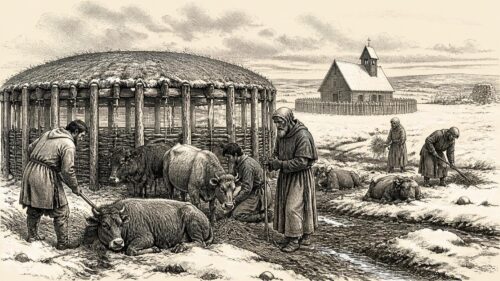
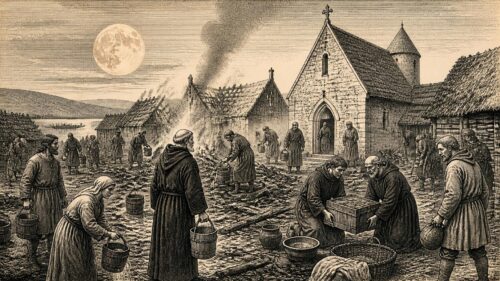
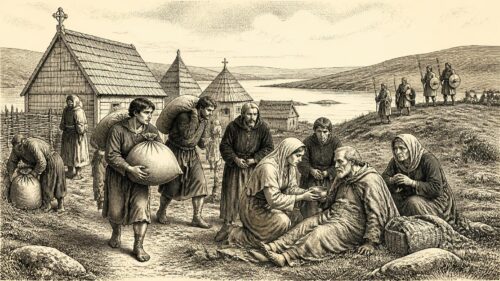
At the end of the dossier comes a grave social notice: bolgach was widespread. The word is often translated as smallpox, and modern medical-historical scholarship regards a smallpox-like pustular disease as a plausible identification. Yet the diagnosis cannot be certain from a single annalistic term without clinical description. What is firm is that contemporaries considered the outbreak extensive enough to record alongside battles and royal deaths. Disease would have been experienced not as an abstract national event but within households, farms, religious settlements and travelling groups, affecting care, labour and the security of food production.
For most people, the year’s history was lived far from Seredmag’s battlefield. Families cultivated crops, tended cattle, prepared food, crossed rivers and maintained kin obligations within local lordships. Warfare could bring raiding, requisitioning and displacement, even though the annals seldom describe these effects. Epidemic illness could interrupt the same routines. We should not invent a universal catastrophe from the word bolgach, nor assume that every district suffered equally. Still, the chronicle’s choice to note an outbreak after a season of fighting makes 742’s dossier unusually vivid: authority changed hands, religious communities lost leaders, relics moved through the landscape, and an unnamed number of ordinary people faced sickness.
Thus the year is best understood neither as the simple accession of Domnall Midi nor as a list of disconnected deaths. Its securely preserved evidence shows several forms of power operating at once: military victory at Kells, contested regional kingship, influential ecclesiastical offices, saintly law, relic-centred public religion and the disruptive presence of disease. The dating of Seredmag must remain explicit and cautious: the Annals of Ulster align the record with AD 742, while many historians use 743. Whichever modern year-number is preferred, the annalistic dossier marks a decisive turning point in the political balance of early medieval Ireland.
Primary Sources
- The Annals of Ulster
- The Annals of Ulster, Part 313: AD 742
- The Annals of Tigernach
- The Annals of Tigernach, Part 14
- Chronicon Scotorum
- CELT Project: Chronicon Scotorum
- Annals of the Four Masters
- Áed Allán
- Domnall Midi
- Donnchad Midi
- Áed Allán mac Fergaile: (d. 743), high-king of Ireland
- Chronological Synchronisation of the Irish Annals: 741–766
- Chronological Synchronisation of the Irish Annals: Introduction
- The Chronology and Sources of the Early Irish Annals
- From blefed to scamach: Pestilence in early medieval Ireland
- The Identification of Some Pestilences Recorded in the Irish Annals
- Facing Infectious Disease in Early Medieval Ireland
- Medieval Irish Chronicles Reveal Persistent Volcanic Forcing of Severe Winter Cold Events, 431–1649 CE
- The Rígdál at Terryglass (737 A.D.)
- The Cult of Relics in Early Medieval Ireland
- The Genealogies, Tribes, and Customs of Hy-Fiachrach, Commonly Called O'Dowda's Country
- Brigit: The Goddess and The Saint
- The Annals of Tigernach: Background Details and Bibliographic Information
- CELT Project: The Annals of Ulster