Forbasach of Osraige740 CE
In 740, Irish annals record the killing of Forbasach son of Ailill, ruler of Osraige, revealing the vulnerability of a strategically placed kingdom between Leinster and Munster. They provide no details of his killer, circumstances or successor, limiting interpretation. Another secular leader, Ua Ailello of Cenél Fiachrach, was also killed. Ecclesiastical deaths included Cellach, abbot of Clonmacnoise, Dub dá Boirenn of Fore, Bran of Lann Ela and Flann Febla of Gort Conaig. These losses illustrate changes in authority across political and religious communities. Rural life continued through farming, craftwork and livestock management, while monastic literacy preserved this selective historical record.
Dateline
In 740 CE, the Irish annals place the killing of Forbasach son of Ailill, ruler of Osraige, beside a notable sequence of deaths among secular and ecclesiastical leaders. It is a sparse record, but not an empty one. Forbasach’s death, recorded in the Annals of Tigernach, offers a sharply focused view of a political order in which local kingship could be abruptly removed, while major churches depended on the continuity of abbots, clerics and learned communities. The surviving evidence does not name Forbasach’s killer, locate the encounter, or describe a battle. It therefore cannot support a dramatic reconstruction. What it does show is that a significant lordship in the south-east lost its ruler in a violent act during a year otherwise marked principally by changes of leadership.
A King Is Slain
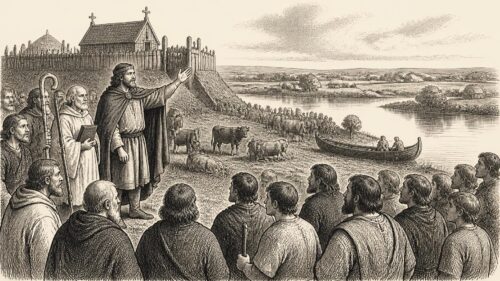
Forbasach is styled king, or lord, of Osraige. This was not a minor geographical label. Osraige occupied a strategically important region around the middle and lower valleys of the Nore and Barrow, broadly centred on modern County Kilkenny and extending into neighbouring districts. Its rulers had to negotiate the competing gravitational pull of Leinster to the east and Munster to the south and west. In the eighth century it was a kingdom with its own dynastic interests, yet one exposed to the ambitions of larger provincial powers.
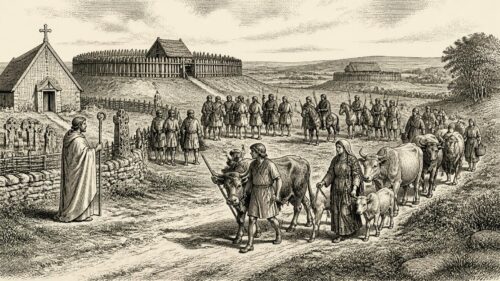
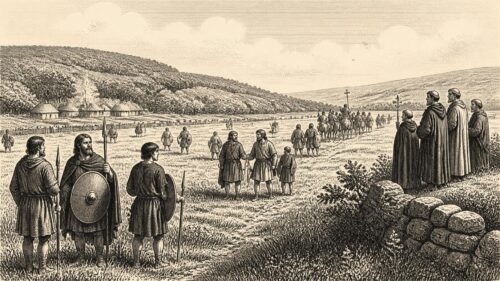
The annal’s wording is brutally compressed: Forbasach was slain. It does not say whether he fell in open fighting, was killed in a raid, or was the victim of a targeted political killing. Nor does it identify a successor. Those omissions matter. Early Irish political language often distinguishes between a battle, a hosting, a burning and a killing; here the notice preserves only the latter. The safest conclusion is also the most important: authority in Osraige was disrupted by the violent removal of its ruler. In a kingship sustained through kinship, clientship, land and control of people, such a death could open a contest whose local consequences were much greater than the few words allotted to it by a chronicle.
The event also belongs to a recent history of pressure on Osraige. Its king Cellach son of Fáelchar had been killed in the conflict between Munster and Leinster recorded a few years earlier. Forbasach’s own death should not automatically be treated as a continuation of that war: the 740 entry supplies no such explanation. Yet the succession of losses illustrates the insecurity of a borderland kingship. Osraige could be influential precisely because it lay between larger political worlds; that same position made its rulers vulnerable when regional relations changed.
Rulers Beyond the Annal
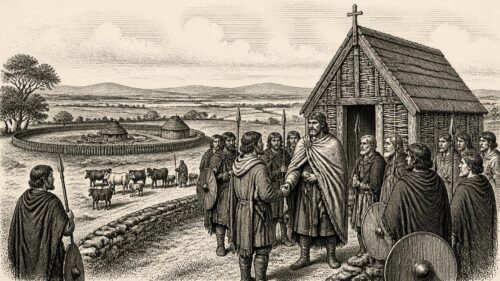
The island was not governed as a single state. Kings ruled over populations and territories of very unequal scale, drawing support from kindreds, clients and allied churches. In 740, Áed Allán of Cenél nÉogain was the dominant Uí Néill ruler in the north, while Cathal mac Finguine remained king of Munster. Their meeting at Tír dá Glas in 737, three years before the year under review, shows that rulers at this level could meet and bargain as well as fight. It has often been interpreted as an attempt to regulate relations between powerful rivals, though its precise terms are unknown.
That meeting is essential context, not an event to be dated to 740. Neither the Irish annals nor surviving narrative sources record a comparable island-wide settlement or major Irish campaign specifically for this calendar year. Cathal would die in 742 and Áed Allán in 743, developments which would soon reorder the balance of power. In 740, however, both remained living figures in a political landscape where the leading dynasties of the north, Mide, Leinster and Munster watched one another closely. Forbasach’s killing must be understood within that unsettled but not uniformly war-torn world of provincial claims and local calculation.
The annals also record the killing of a man described as Ua Ailello, lord of Cenél Fiachrach. The entry does not make clear which branch of that widespread Connacht-associated people is intended, nor does it explain the circumstances. It is nonetheless a useful companion to the notice of Forbasach. Two secular leaders are reported killed, in different parts of the island, without elaborate narrative. This is a reminder that early medieval politics was not confined to famous kings or landmark battles. Rivalries within and between smaller peoples could be decisive for those who lived under them, even when they left only a single line in the historical record.
Clonmacnoise Loses an Abbot
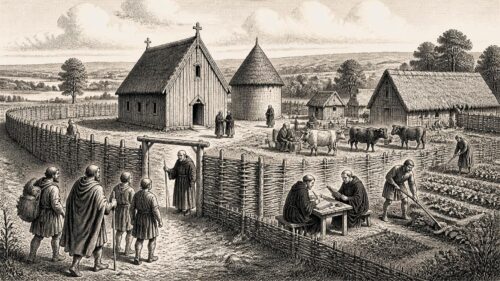
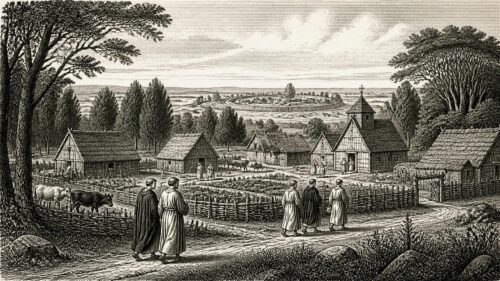
More fully visible than the mechanics of secular succession is the year’s ecclesiastical turnover. Cellach son of Sechné, identified as being of the Conmaicne Buide, died as abbot of Clonmacnoise. The kin designation is revealing: an abbot was not imagined as detached from society, but could be located through family and regional association. His office joined spiritual authority to the management of a substantial religious community. Clonmacnoise stood at a key crossing-place on the Shannon and had already become one of the island’s important ecclesiastical centres. Its enclosure, churches, cemetery, dependent lands and travelling connections made it far more than a secluded place of prayer.
Cellach’s death did not mean that the community ceased its work, but it required an orderly succession if its property, tenants, pastoral obligations and reputation were to be maintained. Monasteries were centres of worship, hospitality, agricultural management, craft activity and learning. They also preserved and shaped memory. The very survival of annual notices such as this one reflects the literate habits cultivated in ecclesiastical settings, though the texts in their present form were copied and edited long after the eighth century. An abbot’s death was therefore political and economic as well as devotional news.
Clonmacnoise’s place in 740 should not be projected backwards from its later stone churches, high crosses and renowned manuscripts. Many familiar monuments are later than the year under discussion. Yet archaeological study shows that the site was producing carved stone memorials in considerable numbers from about 700 onwards. Cellach’s death belongs to that early phase of sustained institutional life, when a community on the Shannon was already accumulating the people, resources and commemorative practices that would underpin its later prominence.
Fore, Lann Ela and Local Churches
Other notices make 740 a year of losses across the church network. Dub dá Boirenn, abbot of Fore, died. Fore, in what is now County Westmeath, had been founded in the seventh century by St Féichín and occupied a productive valley within the midlands. The present ruins are predominantly later than Dub dá Boirenn, but the annal confirms the existence of an established abbacy there in his time. Its leadership mattered to a community whose religious standing rested on the cult of its founder as well as on its lands, dependants and local relationships.
The same annal records the repose, or peaceful death, of Bran of Lann Ela, generally identified with Lynally near Tullamore, and the death of Flann Febla, abbot of Gort Conaig in the territory of Mughdorna. Such language should not be flattened into a modern distinction between public importance and private obscurity. A saint’s repose and an abbot’s death were entries worthy of preservation because local churches were nodes of authority. They linked communities to burial grounds, inherited holy figures, estates and wider federations of churches. Nevertheless, the evidence does not allow us to say that Bran was the acting head of Lann Ela in 740, or to reconstruct ceremonies held after any of these deaths.
This cluster of obituaries does not prove an epidemic, co-ordinated reform or a general crisis. The annals often select deaths because of office and standing, and several recorded deaths in one year may simply reflect that selective interest. The appropriate reading is more modest: 740 brought a notable turnover among named churchmen in the surviving record, with consequences most clearly felt at Clonmacnoise and Fore but also in smaller religious communities.
Work, Food and Security
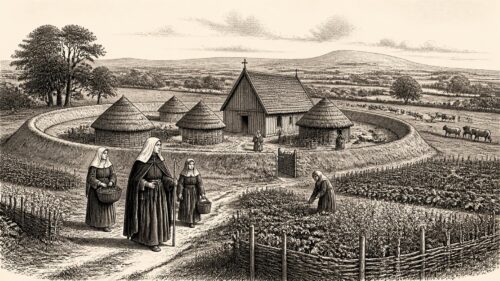
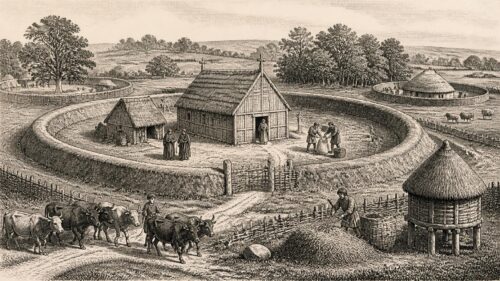
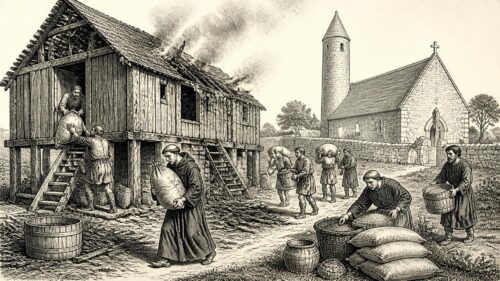
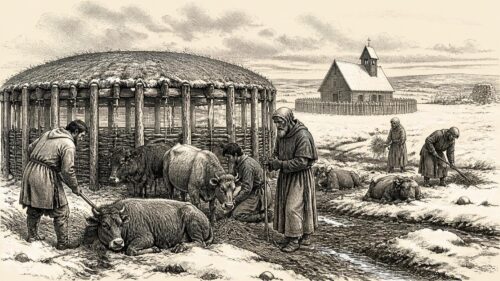
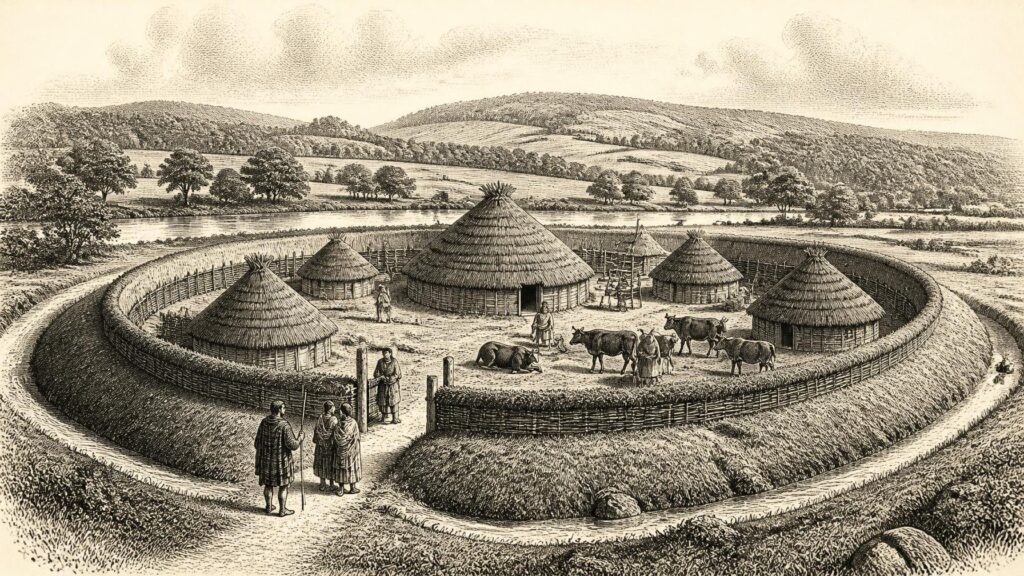
Most people named in neither annal nor genealogy lived in dispersed rural settlements. Archaeology provides the broader setting for their year. Ringforts, or raths, were common enclosed farmsteads: circular banks and ditches protected homes, animal pens, stores and workshops. In stonier districts, comparable cashels used substantial stone walls. Households combined cattle-keeping with cultivation. Cattle were central to food, dairy produce, social standing and the assessment of wealth, while cereals were dried, ground and prepared in and around farmsteads.
None of this can be assigned uniquely to 740. It is the securely attested texture of early medieval life into which the year’s political losses fell. A ruler’s death could affect demands for food-renders, labour and military service; a church leader’s death could alter control over estates and tenants. Raids and local violence made enclosed homesteads and places of refuge valuable, but they did not make daily life an unbroken cycle of warfare. Herding, sowing, harvesting, milling, weaving, leatherwork and ironworking continued because every kingdom and monastery depended upon them.
The documentary record offers no firm evidence for a famine, epidemic, exceptional weather event or environmental disaster in Ireland in 740. It would be irresponsible to invent one in order to give the year a dramatic natural backdrop. Nor is there a securely dated Irish manuscript, sculpture or literary composition that can be credited to this exact year. The cultural significance of 740 lies instead in the machinery of record itself: Irish and Latin literacy, institutional memory and the habits of monastic communities that made deaths, killings and changes of office part of a continuing historical ledger.
A Year of Vulnerable Authority
Forbasach’s killing is the year’s clearest political fact. It exposes the fragility behind a kingly title and the limits of the annalist’s gaze. We know that Osraige lost a ruler; we do not know who profited, what force was mobilised, or how ordinary people experienced the aftermath. Alongside it stand the deaths of Cellach of Clonmacnoise, Dub dá Boirenn of Fore, Bran of Lann Ela and Flann Febla of Gort Conaig. Together they make 740 a year not of one decisive national event but of vulnerable authority at several levels: a local king removed by violence, and religious communities facing the succession of men whose offices joined faith, property, learning and power.
Primary Sources
- Part 13 of The Annals of Tigernach
- CELT Project: Annals of Tigernach
- Part 311 of The Annals of Ulster
- CELT Project: The Annals of Ulster
- Part 56 of Annals of the Four Masters
- CELT Project: Annals of the Four Masters
- CELT Project: Annals of Inisfallen
- CELT Project: Chronicon Scotorum
- Exploring the Irish Annals
- Cathal mac Finguine: (d. 742), king of Munster
- An Eighth-century Royal Conversation: Cathal mac Finnguini and Áed Allán at Tír dá Glás, AD 737
- Irish History Online: An Eighth-century royal conversation
- Cath Almaine Background
- Fore Abbey
- Early Medieval Farmsteads
- Earthen Banks and Broken Walls
- Early Christian Monasteries
- The Cross-Slabs of Clonmacnoise: Reassessing One of the Largest Collections of Early Medieval Carved Stone Monuments in Northwest Europe
- Case Studies: Digital Atlas of Early Irish Carved Stones
- Revealing the Complexity of Early Ecclesiastical Networks: Cross-Slabs Within and Beyond the Hinterland of Clonmacnoise, Ireland
- Land Tenure and Farming in Early Medieval Kerry: A Survey of Field Systems in the Lough Currane Basin
- Farming and Archaeology
- Rathbeagh Ringfort, Co Kilkenny
- The Annals of Inisfallen to Go on Public Display in University College Cork
- Annals of Tigernach