Druim Corcain and Ailenn728 CE
In 728, battles and deaths reshaped Irish political and ecclesiastical leadership. Flaithbertach son of Loingsech defeated and killed Cináed son of Írgalach at Druim Corcain, enabling his claim to the kingship of Ireland, understood as contested supremacy rather than central rule. In Leinster, Fáelán defeated his brother Dúnchad at Ailenn and became overking. Domnall of Connacht and Flann, abbot of Bangor, also died, creating further uncertainty. Annals reliably date core events but cannot reconstruct battlefields or ordinary experience. The year illustrates violent succession, regional autonomy, dynastic rivalry, and the political importance of monastic and learned communities across early medieval Ireland.
Dateline
In 728 CE, two battles and two changes of rulership gave Ireland’s annalists unusually concentrated material for a single year. At Druim Corcain, a place not securely identified today, Flaithbertach son of Loingsech defeated and killed Cináed son of Írgalach. The same annalistic tradition says that Flaithbertach then “took the kingship of Ireland”. In Leinster, meanwhile, Fáelán son of Murchad defeated his elder brother Dúnchad at Ailenn, probably Dún Ailinne at Knockaulin in County Kildare, and succeeded him as overking. The death of Domnall son of Cellach, king of Connacht, and that of Flann, abbot of Bangor, add further reminders that political and ecclesiastical offices alike were held through people whose loss could rapidly alter regional balances.
A Year of Annalistic Certainty—and Caution
The events are firmly assigned to 728 in the Annals of Ulster, the Annals of Tigernach and the Fragmentary Annals. Those texts preserve closely related notices, though they do not always tell the story in the same way or with the same level of detail. This matters. Irish annals were copied, reworked and synchronised over centuries; their year-numbering can differ between compilations. The seventeenth-century Annals of the Four Masters, for example, places other northern fighting and a Dál Riata naval expedition under its entry for 728, but the better-aligned contemporary sequence places those incidents several years later. They should not be presented as happenings of this calendar year.
For 728 itself, the core record is unusually consistent. The annals name the conflict at Druim Corcain, name the leading combatants and list prominent men who died with Cináed: Eódu son of Ailill, Máel Dúin son of Feradach and Dúnchad son of Cormac. They also record the brother-against-brother battle at Ailenn and Dúnchad’s death. Yet even this evidence cannot supply what modern readers may want most: no source describes the terrain of Druim Corcain, the numbers involved, the weapons used, or the precise day on which either battle occurred. The year can be securely stated; a fuller battlefield narrative cannot.
Flaithbertach’s Claim
Druim Corcain was a decisive struggle among the leading kindreds of the Uí Néill, the powerful network of dynasties which dominated much of the northern and midland political world. Flaithbertach belonged to Cenél Conaill, based chiefly in what is now County Donegal. Cináed Cáech, “the one-eyed”, belonged to Síl nÁedo Sláine, a major southern Uí Néill dynasty rooted in Brega, north of the River Liffey. Their confrontation was therefore not a contest between an Irish kingdom and an outside invader, but a violent contest within an elite political order whose leading families competed for tribute, hostages, military followings and precedence.
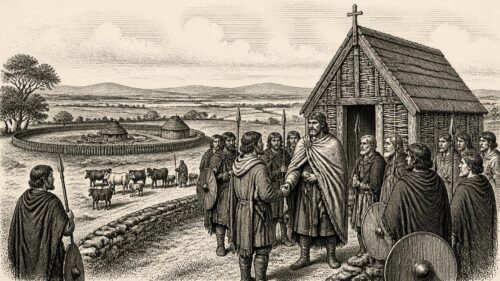
The Annals of Tigernach makes the political consequence explicit: after Cináed’s death, Flaithbertach took the kingship of Ireland. That phrase should not be mistaken for rule over a centrally administered nation-state. Eighth-century Ireland consisted of many kingdoms, lesser lordships and church territories. A claimant described as king of Ireland, or king of Tara, possessed exceptional prestige and could demand recognition beyond his own homeland, but his authority depended on negotiated loyalties and the ability to enforce them. It was always vulnerable to rival overkings.
Flaithbertach’s victory was nevertheless a major transfer of advantage. His father, Loingsech, had earlier held the paramount Uí Néill kingship, and the victory restored the standing of Cenél Conaill after years in which Síl nÁedo Sláine had supplied the claimant at Tara. It also came amid continuing pressure from Cenél nÉogain, the other principal northern Uí Néill dynasty. A battle between Cenél Conaill and Cenél nÉogain had been recorded in 727. Thus 728 did not settle the north permanently; it gave Flaithbertach a stronger title at the very moment when northern competition remained acute.
The language of “kingship of Ireland” also reveals how political memory worked. The annals made Flaithbertach’s victory meaningful not merely because a rival was slain, but because it altered the imagined hierarchy of the island. His status rested on military success, genealogy and the acknowledgement of other rulers. The formula is evidence of an aspiration to island-wide primacy, not proof that every region was directly governed from Tara.
Brothers at Ailenn
The Leinster battle was no less revealing of how kingship operated. Dúnchad and Fáelán were sons of Murchad son of Bran, whose death as king of Leinster had been recorded in the previous year. Both belonged to Uí Dúnlainge, a dynasty that would remain central to Leinster’s political history for generations. Succession was not automatic from father to eldest son. Brothers, half-brothers and cousins could all have credible claims; the decisive test was often whether a man could gather allies and prevail.
At Ailenn, Dúnchad the elder was killed and Fáelán became king. Later narrative material in the Fragmentary Annals adds that Dúnchad lingered for a week after the battle, that Fáelán married Dúnchad’s widow Tualaith, and that Cathal son of Finguine, powerful king of Munster and Tualaith’s father, escaped from the encounter with Cellach son of Fáelchar, king of Osraige. These details create a vivid account, but they survive in a later compilation and should be treated more cautiously than the brief agreement of the major annals on battle, death and succession. Even so, the marriage tradition is historically instructive: elite marriages were political connections, and control of a dead ruler’s household could reinforce a victor’s claim.
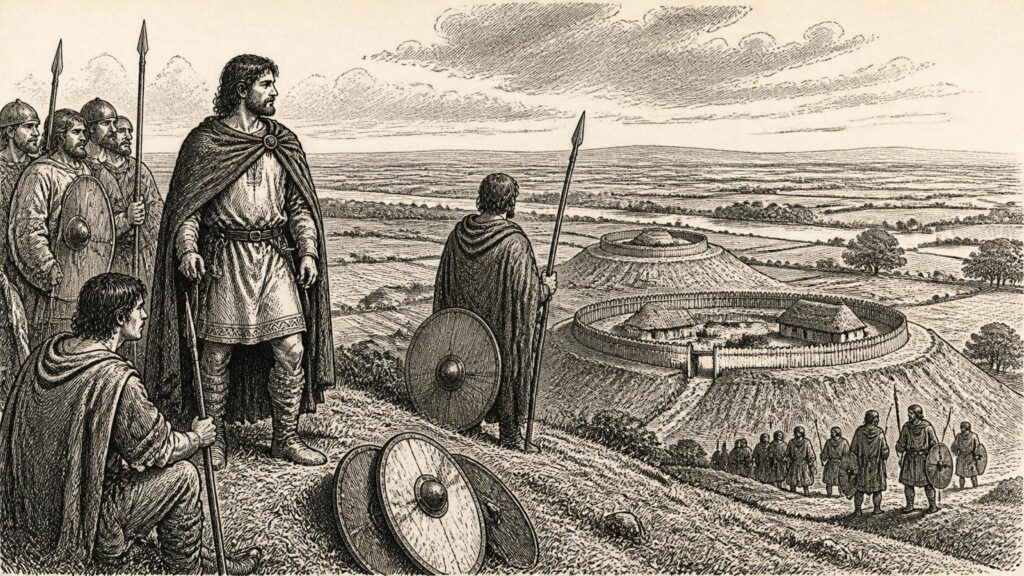
Ailenn was probably Dún Ailinne, the prominent hilltop complex at Knockaulin near Kilcullen. It had been an important royal and ceremonial place long before the eighth century. Its use as the remembered setting for a Leinster succession battle demonstrates the continuing political force of older monumental landscapes. We cannot show that the combat occurred within the surviving earthworks, or reconstruct the scene from archaeology. But the association linked Fáelán’s victory with a place already freighted with royal significance.
Connacht Without Domnall
In the west, the annals simply record that Domnall son of Cellach, king of Connacht, died. No cause of death and no successor are supplied in the 728 notice. That restraint is important: it would be irresponsible to turn the entry into a claimed coup, battle or dynastic settlement. Yet the death was consequential. Connacht was not an incidental province on the edge of the political map; its rulers participated in the shifting relations among the major Irish dynasties and local peoples. A vacancy at its head invited renewed bargaining among competing branches and their clients.
The same year’s political record consequently spans north-west, Brega, Leinster and Connacht. Rather than suggesting a country repeatedly conquered from one centre, it shows several regional systems changing at once. Flaithbertach could claim a higher kingship after Druim Corcain, but Fáelán’s independent seizure of Leinster and the unrecorded succession in Connacht show the practical limits of any single ruler’s reach.
Bangor, Learning and Authority
Religion was inseparable from this political world. The Annals of Ulster and Tigernach record the death of Flann, abbot of Bangor, the major monastery on the shore of Belfast Lough. An abbot headed more than a community of prayer. Major churches controlled land, livestock, labour and dependants; they were centres of hospitality, teaching, manuscript production and commemoration. Their leaders stood within networks of kinship and patronage, and an abbatial vacancy could matter well beyond the enclosure of a monastery.
The entries also preserve the death of a learned man from Munster: the Annals of Ulster names him Mac Bethach, while Tigernach calls him only a sage. The difference is small but useful. It shows both the value attached to learning and the limits of the evidence. We do not know what Mac Bethach taught, wrote or composed, nor can a surviving book safely be assigned to him. Still, the fact that annalists marked such a death beside those of kings and abbots indicates that scholarship possessed recognised social status.
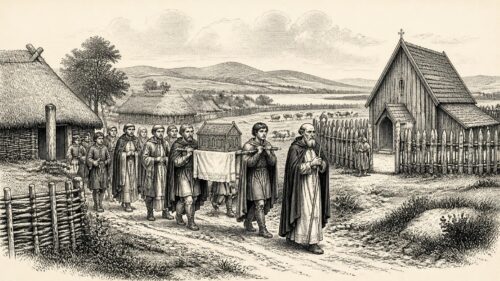
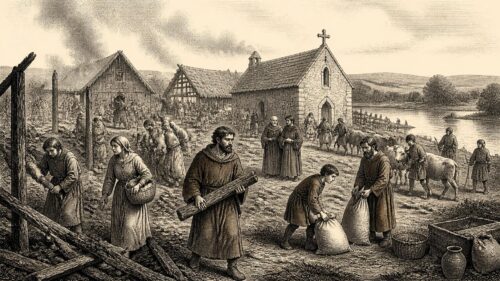
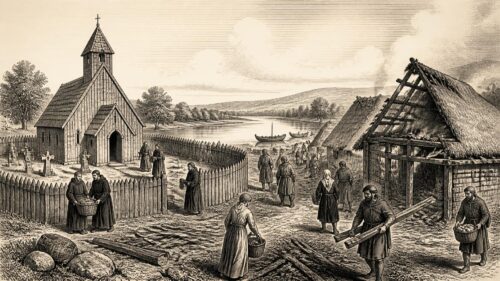
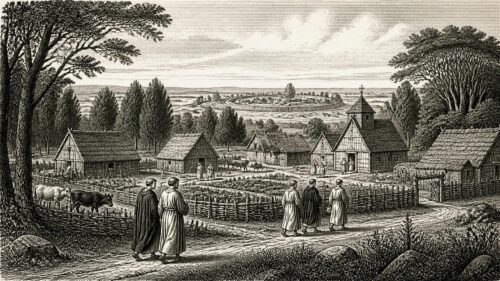
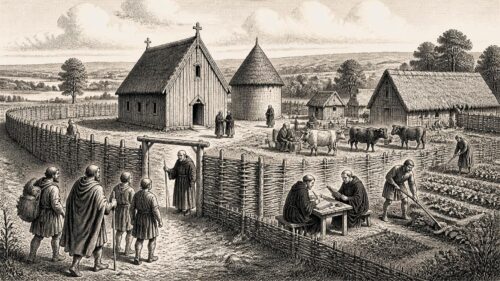
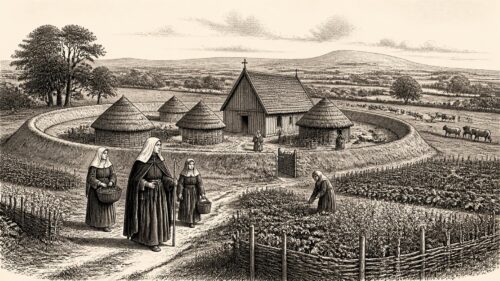
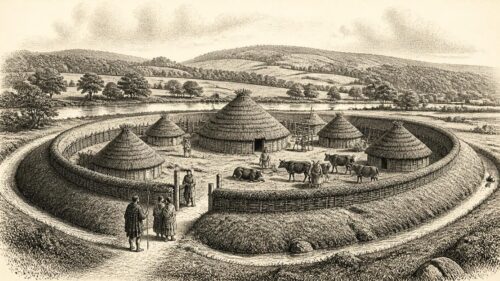
For most people, 728 was experienced far from Druim Corcain, Ailenn or Bangor. Ireland remained predominantly rural, with dispersed farmsteads—many enclosed by earthen ringforts—and a mixed economy in which cattle were especially important, alongside sheep, pigs, crops and local craft production. Churches and monasteries were embedded in this landscape rather than detached from it: ecclesiastical estates required food, labour and transport, while providing religious services, burial places and opportunities for literacy. No annal gives a harvest report, famine, epidemic or exceptional weather for Ireland in 728, so none should be invented for the year.
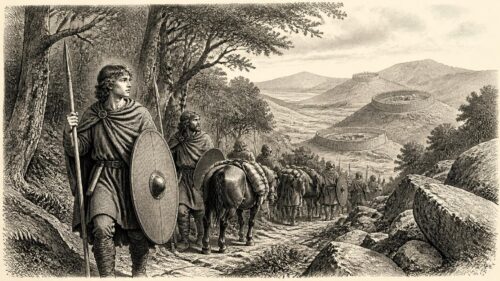
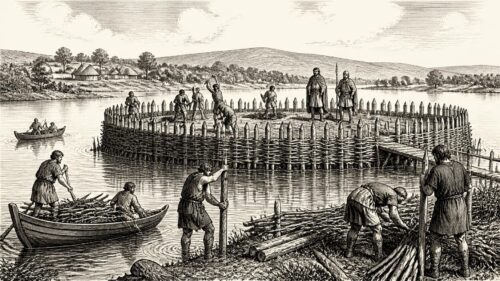
Travel and exchange nevertheless tied regions together. Kings and their retinues moved along land routes and waterways; coastal travel connected Ireland to western Britain and Dál Riata; monasteries sustained intellectual links across the Irish Sea. Bangor’s abbot and Munster’s sage belong to this connected Christian culture, while the political events show how readily its patrons and neighbours could be drawn into armed rivalry.
What 728 Changed
The year did not create a lasting peace. Its importance lies instead in the abrupt remaking of rank. Cináed’s death enabled Flaithbertach of Cenél Conaill to assert the highest available political title. Dúnchad’s death made Fáelán ruler in Leinster. Domnall’s death opened a new phase in Connacht. Flann’s death left Bangor without its abbot. These were personal losses, but in early medieval Ireland offices, households, church communities and client networks were so closely bound to leading individuals that a death could redirect wider history.
728 CE is therefore best seen not as a year when one power mastered Ireland, but as a year in which succession was violently and visibly renegotiated. The annals preserve the winners’ new positions with striking economy. Their silences—the unnamed ground at Druim Corcain, the unrecorded experience of ordinary households, and the uncertain course of Connacht’s succession—are equally part of the historical record.
Primary Sources
- The Annals of Ulster
- The Annals of Tigernach, Part 13
- Fragmentary Annals of Ireland, Part 10
- Fragmentary Annals of Ireland, Part 11
- Annals of the Four Masters, Part 56
- Chronicon Scotorum
- The Annals of Tigernach
- Navigator for T100002A
- List of Published Texts at CELT
- Flaithbertach
- Dúnchad
- Flaithbertach mac Loingsig: (d. 765), high-king of Ireland
- CELT Project: Book of Leinster, Formerly Lebar na Núachongbála
- Dun Ailinne: Excavations at an Irish Royal Site, 1968–1975
- Cemetery Settlements and Local Churches in Pre-Viking Ireland in Light of Comparisons with England and Wales
- The Archaeology of Ecclesiastical Estates in Early Medieval Ireland: A Case Study of the Kingdom of Fir Maige
- Theme and Variations: Christianity and Regional Landscapes in Early Medieval Ireland
- Land Tenure and Farming in Early Medieval Kerry: A Survey of Field Systems in the Lough Currane Basin
- Animals and the Economy of Medieval Ireland: A Zooarchaeological Analysis of the Faunal Remains from Caherconnell Cashel, Co. Clare
- Early Christian Monasteries
- Edward Riordan: Perceptions of Ringforts in Early Modern Ireland
- How Did Early Church Sites Differ from One Another? A Comparative Approach Within the Kingdom of Fir Maige, Ireland