Maíne and Carn Feradaig712 CE
In 712, Irish annals record regional conflicts, dynastic deaths and ecclesiastical losses rather than a unified national crisis. Maíne, a descendant of Áed Sláine, was killed by Flann in Brega, while violence also affected the Ulaid, Cenél Laegaire and southern Leinster. Cú Cerca of Osraige died, and Cormac son of Máenach, king of Munster, fell to the Northern Déisi at Carn Feradaig. Ceode of Iona and Dub Guaile of Glendalough died. An annal noted Bede’s scholarly work. Rural society, farming, maritime connections and monastic networks continued, although sources provide little detail on causes, places or outcomes in the surviving record.
Dateline
In 712 CE, Ireland’s surviving annalistic record presents a year of lethal contests among ruling kindreds, the deaths of kings and churchmen, and one striking notice of learning beyond the island. The dating needs care. The events conventionally assembled under the 712 annal of the Annals of Tigernach and Chronicon Scotorum correspond to the calendar year 712 in modern synchronisations, while the similarly numbered entry in the Annals of Ulster carries an internal year-date one year earlier. What can responsibly be said is therefore precise but limited: several Irish conflicts and deaths were recorded for 712, yet the annals rarely tell us their causes, locations or wider settlement terms.
A Feud in Brega
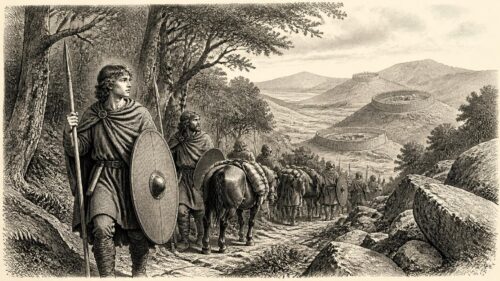
The clearest political entry records a battle between two descendants of Áed Sláine, a major branch of the southern Uí Néill. Maíne, son of Niall son of Cernach Sotal, was killed; Flann, son of Áed son of Dlúthach, was named victor. The wording is important. It does not describe a war between modern-style states, but violence within an extended dynasty whose branches competed for lordship, land, clients and rank in Brega and the wider midlands. Genealogy was political language: to call both men descendants of Áed Sláine identified both their claim to authority and the family fracture behind the encounter.
No battlefield is supplied, nor does the notice say whether Maíne’s death ended the dispute. It would be wrong to invent a royal campaign, a formal succession or a fixed number of casualties from its few words. Nevertheless, the killing mattered beyond one household. In early medieval Ireland, kingship was exercised through overlapping local lordships and personal alliances. A victory by one branch could alter access to tribute, military followers, fosterage connections and ecclesiastical patronage. The entry offers a compressed glimpse of that precarious political order: kinship created entitlement, but it also created rivals close enough to contest it violently.
Deaths Across the Provinces
The year’s notices range widely. In the north, “the Ulaid were overthrown”, and Dubthach, son of Becc Bairche, fell. The annal does not identify the opposing force or the place. A separate entry records the death of two sons of Feradach son of Máel Dúin in a slaughter involving Cenél Laegaire, another group of the southern Uí Néill. Such terse reports should not be joined into one imagined island-wide war. They instead show several regional power struggles proceeding at once, with the annalist preserving the names of men important enough to their political communities to be remembered.
Leinster also suffered a dynastic loss. A battle among the southern Leinstermen killed Bran, grandson of Máel Dúin, together with his sons. Later genealogical and king-list material associates Bran with the Uí Cheinnselaig of south Leinster, but the annal itself does not identify his enemies or explain the conflict. The death of a leader and sons in the same fighting could leave a lineage suddenly weakened, while survivors, collateral branches and allied groups competed to fill the resulting space. That is an inference from the structure of early Irish politics, not a recorded outcome for 712.
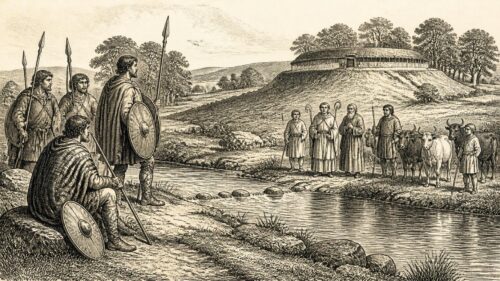
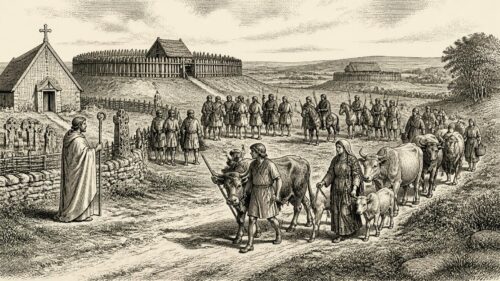
Two further notices mark changes in smaller kingships. Cú Cerca, king of Osraige, died, but no cause is supplied. In Munster, the annals record the battle of Carn Feradaig, in which Cormac son of Máenach, described as king of Munster, fell at the hands of the Northern Déisi. Carn Feradaig is often associated with the Cahernarry area of County Limerick, though early place-name identification must remain cautious. The report does establish that a Munster king died in conflict with a regional people of north Munster; it does not provide a battle narrative, numbers, tactics or an immediate successor.
There is an additional difficulty at this point in the record. The following annal contains a separate notice that “Cormac son of Ailill”, likewise called king of Munster, was killed in war. The variation in patronymic and placement means that the evidence should not be silently compressed into a single fully explained death. It may preserve confused, duplicated or distinct traditions; the extant entries alone do not settle the question. For 712, the secure statement is the one the contemporary annal sequence makes: Carn Feradaig was remembered as a Northern Déisi victory in which a king named Cormac son of Máenach was slain.
Churches and Learned Networks
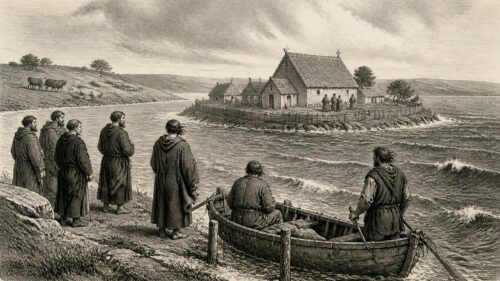
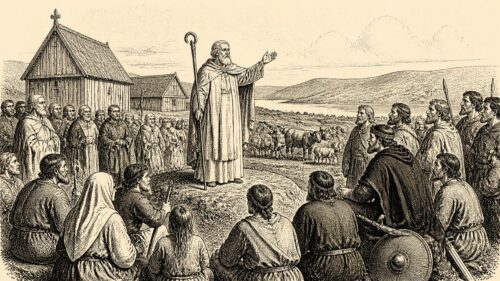
Amid the killings, ecclesiastical institutions continued to connect distant regions. Ceode, bishop of Iona, died in 712. Iona lay off the west coast of present-day Scotland, but was central to Irish history through the Columban federation founded from Ireland and through sea routes linking Irish, Gaelic Scottish, British and Northumbrian communities. Calling Ceode a bishop should not be taken to mean that Iona functioned like a later territorial diocese. Early Irish and Columban ecclesiastical offices overlapped in ways unfamiliar to modern church structures, while monasteries and their associated communities were powerful religious, cultural and economic centres.
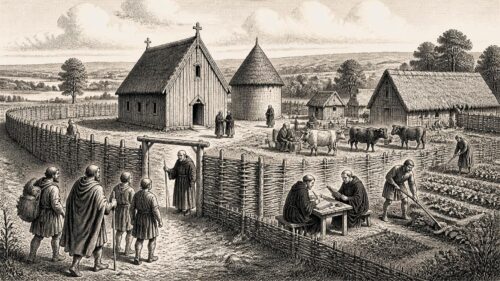
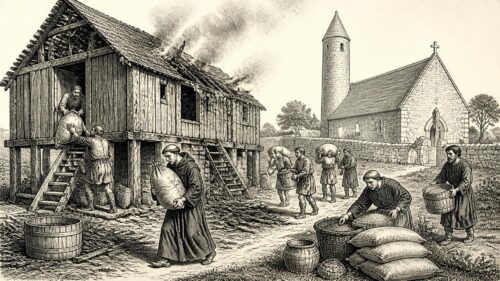
Dub Guaile, abbot of Glendalough, also died. Glendalough’s mountain valley in Leinster was already an important ecclesiastical site, its community rooted in prayer, burial, hospitality, pastoral work, landholding and learning as well as worship. The deaths of an Iona bishop and a Glendalough abbot do not demonstrate a coordinated religious event, but their juxtaposition reveals what the annals considered worth recording: officeholders at prominent churches were figures of island-wide significance. Their communities depended on labour from tenants and dependants, on livestock and crops, and on the protection or favour of secular patrons.
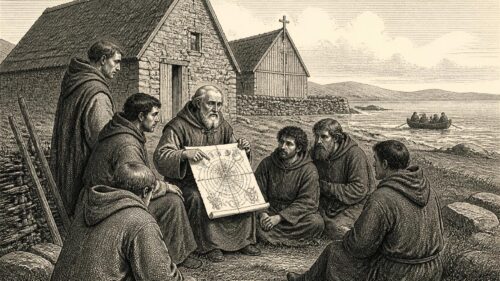
The notice that “Bede made a great book” is equally revealing, though it must be handled with restraint. The annalist labels the work Berba Béid, “Bede’s work”, without enough detail to identify it securely with a surviving text. It cannot safely be used to date one of Bede’s known major writings to 712. What it does show is that the Irish chronicle tradition regarded the Northumbrian scholar Bede as relevant to its intellectual horizon. His scholarship in scriptural interpretation, chronology and the calculation of Easter belonged to a shared Latin Christian culture in which Irish ecclesiastics participated actively.
Life Beyond the Annal Entries
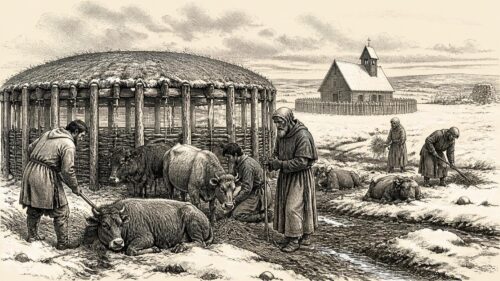
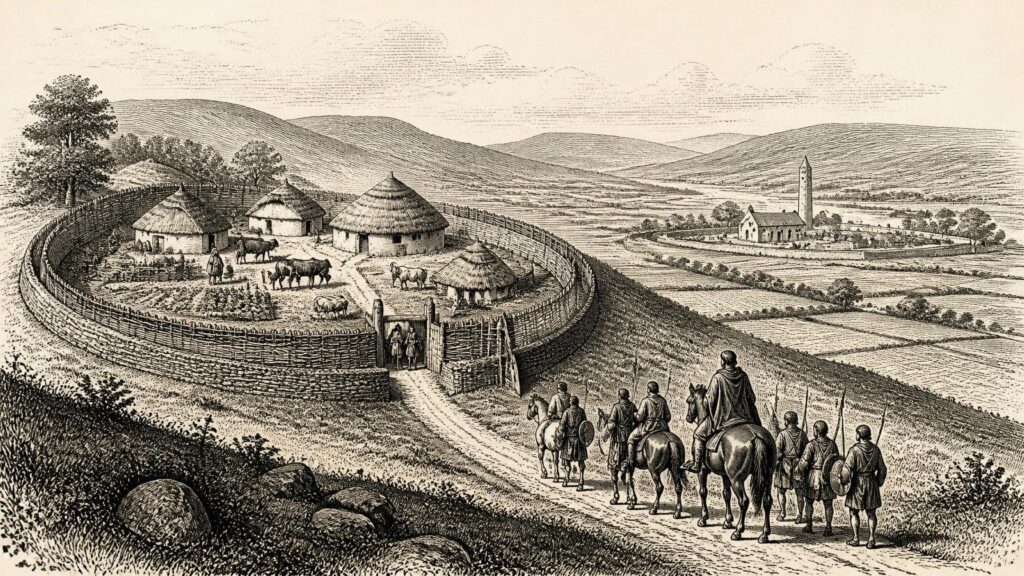
The annals name kings, clerics and violent deaths, not the majority whose work sustained society. For most people in 712, life was organised around rural households, kin groups and farming settlements. Archaeology shows that many early medieval farmsteads occupied ringforts: enclosed spaces containing timber or stone dwellings, storage and working areas. Cattle were fundamental to wealth, food and social exchange, but mixed agriculture also mattered: crops, dairying, grazing, woodland resources and practical crafts underpinned households and elite power alike.
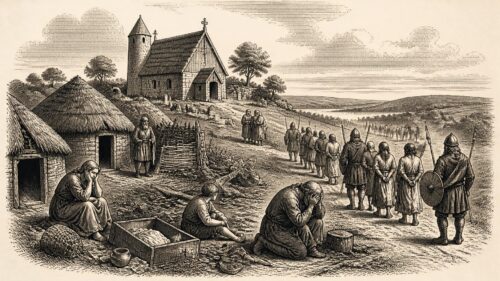
Conflict could bear directly on this ordinary world even where no burned farm or failed harvest is recorded. Lords required food-renders, livestock, labour and armed service; displaced leadership could redirect these demands. Armed encounters also endangered roads, grazing and seasonal work. Yet the sources do not permit a claim that Ireland suffered a general famine, epidemic, climatic disaster or economic collapse in 712. No reliable annalistic entry for this calendar year records one. The responsible picture is therefore one of regional insecurity within a resilient, predominantly rural society, rather than a national catastrophe.
Trade and travel likewise existed without producing evidence for a single dramatic commercial development in 712. Monastic communities, royal households and local settlements needed iron tools, quernstones, textiles, foodstuffs and prestige goods. Coastal and riverine routes linked Ireland with western Britain and Gaelic Scotland, while Latin books and religious expertise circulated through clerical networks. Iona’s place in the year’s record is a reminder that the sea was a route of communication rather than an outer boundary. Still, no surviving source authorises a claim of a named Irish trading voyage or market foundation in this particular year.
Fire, Memory and Limits
One final entry states that Dlúthach son of Fidchellach was burned by fire. The report gives no location, motive or explanation. It may record an accident, an attack, punishment or another circumstance now lost; to choose among them would turn silence into story. The same restraint is needed throughout 712. Annals are invaluable precisely because they preserve names and events otherwise lost, but they are selective records, copied and arranged long after many of the events they note.
Even so, the pattern is meaningful. In 712, competition within ruling families brought death in Brega and Leinster; the Ulaid and Cenél Laegaire also appear in violent notices; Munster’s political order was shaken by Carn Feradaig; and major churches at Iona and Glendalough marked the passing of senior officeholders. The year does not reveal a unified Ireland acting as one realm. It reveals a densely connected island of local kingdoms, ecclesiastical communities and maritime ties, in which authority was continually made, defended and sometimes extinguished in a single battle.
Primary Sources
- The Annals of Tigernach, Annal T712
- Annals of Tigernach, Irish and Latin text, Annal T712
- The Annals of Ulster, Year U712
- The Annals of Ulster, full text
- Chronicon Scotorum, Annal CS712
- Annals of the Four Masters, Annals M707–M715
- Annals of the Four Masters, Irish text, Annals M707–M715
- Chronological Synchronisation of the Irish Annals, 488–722
- The Dating of the Irish Annals
- The Practice of Irish Kingship
- Carn Feradaig, The Metrical Dindshenchas
- Irish Script on Screen: Book of Lecan, MS 23 P 2
- The Economy of Early Medieval Ireland
- Early Medieval Dwellings and Settlements in Ireland, AD 400–1100
- Early Medieval Farmsteads
- Ringforts, National Monuments Service
- Early Christian Monasteries
- Religion and Society in Ireland
- Kingship, Society, and Sacrality: Rank, Power, and Ideology in Early Medieval Ireland
- Ireland in the Seventh Century: A Tour
- De Temporum Ratione, Beda Venerabilis
- Bedae Opera de Temporibus, National Library of Ireland catalogue