Kildare’s Lector Banbán685 CE
In 685, Irish annals record the deaths of Banbán, learned lector of Kildare, and Forcrann, abbot of Clonmacnoise, though differing chronologies prevent precise dating. Their notices demonstrate the importance of major churches as centres of learning, landholding, authority and record-keeping. Ireland remained politically fragmented under competing dynasties, with Fínnechta Fledach holding the overkingship of Tara rather than ruling a unified state. Irish writers also carefully recorded Ecgfrith of Northumbria’s defeat and death at Dún Nechtain on 20 May, reflecting ecclesiastical and political links across the Irish Sea.
Dateline
In 685 CE, Ireland’s surviving record is unusually sparse, but it is not empty. The year is best approached through a small, difficult cluster of annalistic notices: the death of Banbán ‘Os Cach’, described as a learned man and, in the fuller notice of the Annals of Tigernach, lector of Kildare; the repose of Forcrann, abbot of Clonmacnoise; and events in northern Britain recorded by Irish writers, above all the defeat and death of the Northumbrian king Ecgfrith at Dún Nechtain on 20 May. These sources do not preserve a single narrative of Ireland in 685. Their differing chronological systems also require caution. Yet together they show an island whose political life was divided among many dynasties, while its great churches sustained scholarship, record-keeping and links across the Irish Sea.
A Year of Careful Dating
Early Irish annals are indispensable, but their year headings are not modern archival dates. Entries were copied, rearranged and synchronised over centuries; the Annals of Ulster, Annals of Tigernach, Chronicon Scotorum and later compilations sometimes place closely related notices under adjacent years. This matters especially in 685. The Annals of Ulster explicitly date the battle of Dún Nechtain to Saturday, 20 May, in a heading equated with AD 685. The Annals of Tigernach places the killing of Rothachtach and Dargart son of Finnguine, the death of Banbán, and the death of Forcrann under its next annal, labelled 686. Its fuller wording calls Banbán fer légind Cilli Dara, the lector, or teacher and learned reader, of Kildare.
It would therefore be unsafe to pretend that a charter or contemporary diary proves Banbán died on a particular day in 685. What can responsibly be said is that his obit belongs to the annalistic sequence centred on that year and is preserved beside securely dated events of 685. The same qualification applies to Forcrann of Clonmacnoise. The notices are very short, but their choice of titles is revealing. A lector was not simply a man who could read prayers: he held a recognised intellectual office within a major ecclesiastical community. An abbot was likewise more than a secluded religious superior, exercising authority over people, land, patronage and the institutional memory of a church.
Banbán and the School of Kildare
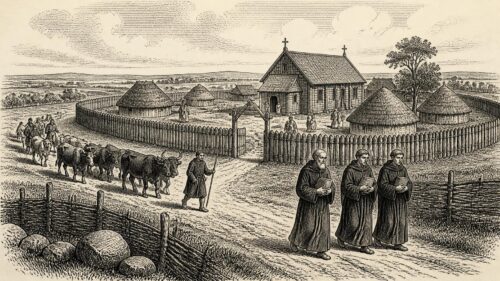
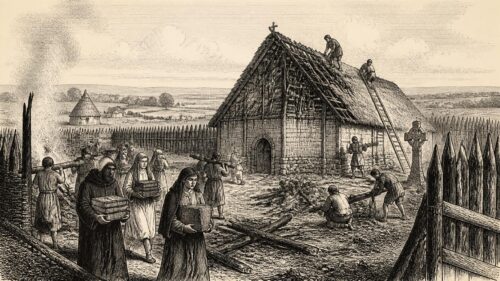
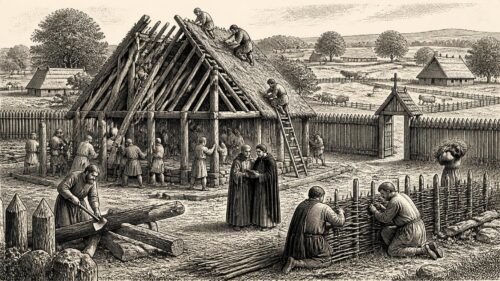
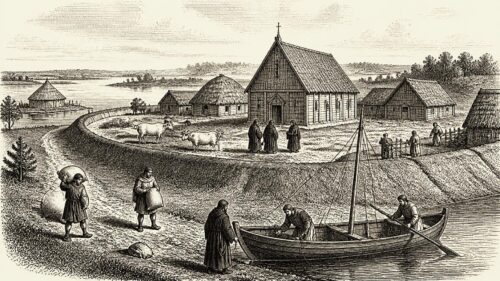
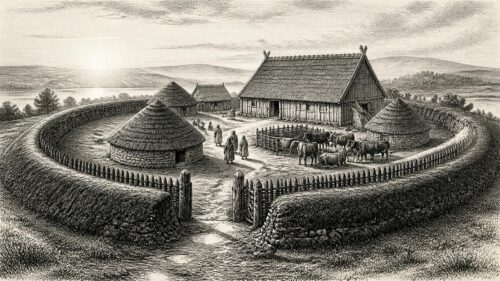
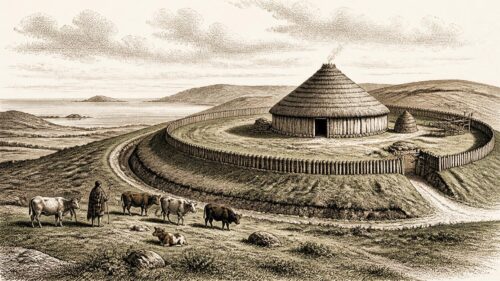
Banbán’s association with Kildare is the clearest Irish point of focus. Cell Dara, ‘the church of the oak’, stood in Leinster and was already one of Ireland’s principal foundations, claiming the patronage of Brigit. Its prestige rested on devotional reputation, aristocratic support and learning. By the seventh century, important Irish churches were communities rather than isolated stone chapels: their enclosures contained places for worship and burial, but also dwellings, workshops, agricultural spaces, guest accommodation and stores. Buildings were often of timber, wattle and thatch; books, metal vessels and textiles were precious movable goods; livestock and grain underwrote daily survival.
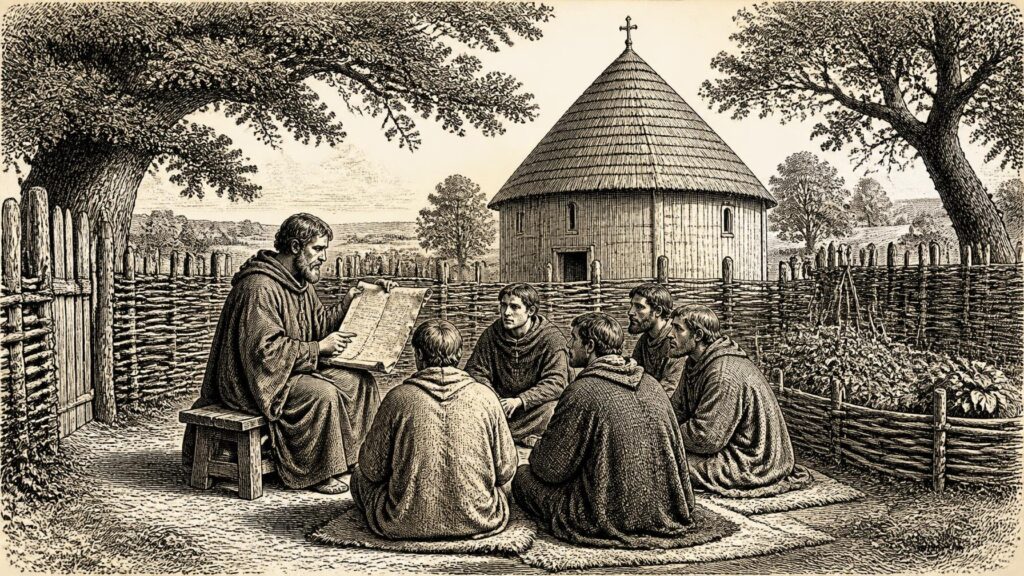
To call Banbán a lector is to glimpse the educational labour behind ecclesiastical influence. He would have belonged to a culture in which Latin scripture, liturgy, computus—the calculation of the ecclesiastical calendar—and inherited Irish learning were cultivated together. Instruction depended on listening, memorisation and repeated reading as much as on individual silent study. Manuscripts were copied by hand on expensive parchment, while the Latin alphabet also served the Irish language in glosses, names and legal formulae. The annals’ praise of Banbán as learned indicates that intellectual accomplishment was publicly valued and sufficiently institutionalised for a specialist office at Kildare to be remembered.
Nothing surviving permits a reconstruction of Banbán’s classroom, his writings or his personal opinions. Nor should later fame be projected backwards: the elaborate stone churches and much of the visible sculpture associated with Ireland’s major monastic sites belong to subsequent centuries. Still, his notice makes a modest but firm point. In 685, Kildare was not merely revered through stories of its founder. It supported a learned ecclesiastic whose death was judged worth entering into the historical record.
Forcrann and the Shannon Crossing
The corresponding notice for Forcrann, abbot of Clonmacnoise, points to a second kind of ecclesiastical power. Clonmacnoise lay on the eastern bank of the Shannon, where river traffic and major east–west routes met. Its situation made it unusually well placed to connect Mide and the midlands with Connacht and the western seaways. This was not an urban town in the modern sense, and it would be misleading to imagine streets of stone houses or a population detached from farming. Nevertheless, a large ecclesiastical settlement could draw in clerics, tenants, dependants, craftsmen, travellers and royal visitors. It was a religious centre embedded in a working landscape.
Forcrann’s death cannot tell us the size of the community he governed, but the recording of an abbatial succession suggests that continuity mattered. The abbot’s office joined spiritual authority to practical responsibilities: supervising estates, receiving gifts, maintaining relationships with neighbouring rulers and safeguarding the community’s rights. Churches such as Clonmacnoise also offered burial, hospitality and places of assembly. Their influence was not opposed to secular politics; it operated through it. Kings sought the prestige of saintly foundations, while churches needed protection, labour and land from powerful families.
For ordinary people, the rhythm of life around such a centre remained agricultural. Cattle were wealth, dairy produce was important, and grain cultivation required seasonal co-operation. Boat travel on the Shannon could move people and goods far more readily than many overland journeys, but weather, river conditions and local tolls or obligations shaped movement. The Irish annals record no harvest catastrophe specifically for 685. It is better, therefore, to recognise the normal vulnerability of a mixed farming society without inventing a famine, epidemic or climatic disaster for this particular year.
Kingship Without a Single State
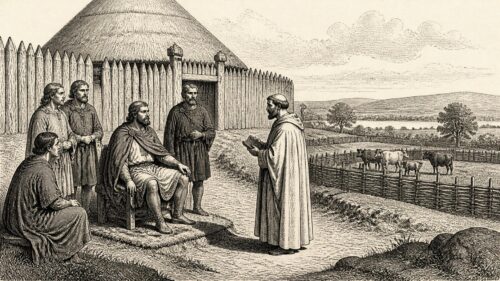
Politically, Ireland in 685 was a mosaic. Fínnechta Fledach of the Síl nÁedo Sláine held the overkingship of Tara in this period, but that did not make him the ruler of a unified Irish kingdom in a modern sense. His position depended upon the shifting allegiance of branches of the Uí Néill and on dealings with the kings of Leinster, Munster, Connacht, Ulaid and smaller peoples. Local rulers controlled the immediate resources that mattered most: cattle, food renders, fighting men, client communities and access to churches.
That fragmentation was not political failure. It was the structure through which authority worked. A ruler’s standing was performed in assemblies, gift-giving, fostering ties, raids, settlement of disputes and the taking of hostages. Ecclesiastical communities were valuable partners because they conferred legitimacy and possessed literate expertise; they could also be vulnerable targets during conflict. The silence of the annals about a major battle in Ireland in 685 should not be mistaken for a peaceful, centralised realm. Rather, it means that no domestic event on the scale or in the form favoured by the surviving chronicle reached us securely for this year.
Dún Nechtain and the Irish Sea World
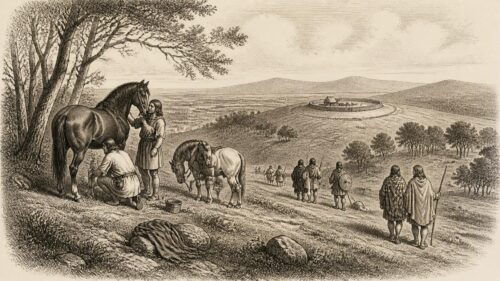
The best-dated event connected to Ireland in 685 occurred beyond the island. On 20 May, the Pictish king Bridei son of Beli defeated Ecgfrith of Northumbria at Dún Nechtain; Ecgfrith and a large part of his army were killed. Bede’s near-contemporary account portrays the Northumbrian king as advancing rashly into hostile country, while the Irish annals preserve the precise Saturday date. The battle checked Northumbrian power north of the Forth and transformed the balance between Northumbria and the Picts.
Why did Irish annalists care? The Irish Sea was a connective zone, not an empty barrier. Iona, founded from the Irish kingdom of Dál Riata, had long linked communities in Ireland, western Scotland and Northumbria. Clerics, books, travellers, exiles and political news moved along these routes. Irish ecclesiastical writers also followed the affairs of neighbouring kings because Northumbria was a major Christian kingdom with close connections to Columban and Irish-trained churchmen. Recording Dún Nechtain was therefore not foreign gossip: it described a consequential change within a maritime neighbourhood in which Irish institutions had interests and contacts.
The same annalistic cluster records the violent deaths of Rothachtach and Dargart son of Finnguine. Dargart belonged to Cenél Comgaill, a Gaelic kindred of western Scotland with close cultural and dynastic connections to Ireland. Modern historians link him with the family of later Pictish kings through his marriage to Der-Ilei, though the surviving evidence does not allow every relationship to be stated with certainty. His killing, recorded beside the Pictish victory, is a reminder that the political world around Ireland’s north-eastern sea routes was interwoven and unstable.
What 685 Leaves Behind
For Ireland itself, 685 is not a year of one spectacular recorded battle or royal revolution. Its importance lies in the texture of its evidence. Banbán’s obit preserves Kildare as a place where learned office mattered. Forcrann’s preserves Clonmacnoise as an institution whose abbot belonged in a national historical record. The careful notice of Dún Nechtain shows Irish annalists watching events across the sea with enough precision to retain a day of the week. Together, these fragments reveal a society in which learning, religion, landholding and kingship were tightly entangled.
They also impose a discipline on the historian. The annals are not blank windows onto the past; they are selective records shaped by ecclesiastical priorities and complicated chronologies. Yet their brevity is meaningful. In the Ireland of 685, a lector at Kildare, an abbot on the Shannon, and a battle in Pictish territory could all belong to the same remembered world.
Primary Sources
- The Annals of Ulster, U686 (AD 685)
- The Annals of Tigernach, T686
- Chronicon Scotorum, CS684–CS688
- Annals of the Four Masters, M683–M684
- Annals of Inisfallen, AI677–AI686
- The Annals of Ulster: Document Details
- The Annals of Tigernach: Document Details
- Chronicon Scotorum: Document Details
- Exploring the Irish Annals
- The Dating of the Irish Annals
- The Chronicle of Ireland: Then and Now
- The Ecclesiastical History of the English People, Book IV, Chapter 26
- Scotland’s Inventory of Historic Battlefields
- The Life of Columba, Written by Adamnan
- Picti: From Roman Name to Internal Identity
- Ministry, Mission and Myth
- Clonmacnoise, County Offaly
- Early Christian Irish Monasteries Survey
- S. Ciarán’s Church and His Lands: A Study of the History and Development of Clonmacnoise
- Early Medieval Ireland: Archaeological Excavations, 1930–2009
- The Cross-Slabs of Clonmacnoise: Reassessing One of the Largest Collections of Early Medieval Carved Stone Monuments in Northwest Europe
- Reassessing the Irish ‘Monastic Town’