Loch Gabair677 CE
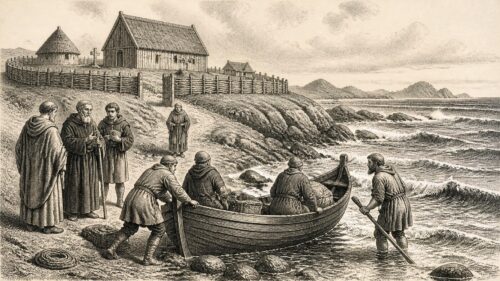
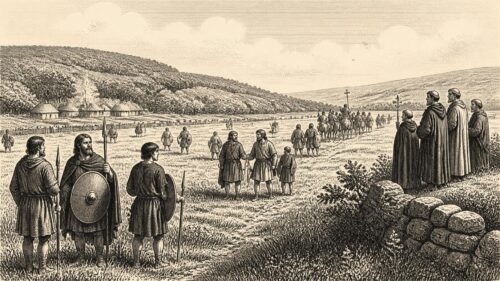
In 677, Fínshnechtae Fledach, king of Tara, defeated the Laigin near Loch Gabair in southern Brega, close to the royal landscape of Tara. The battle, apparently costly to both sides, defended his heartland but did not lead to the conquest of Leinster. The Leinster force was probably led by Fiannamail mac Máele Tuile, whose position survived the defeat. Other annalistic notices record the killing of Dúnchad of Airgíalla and an obscure violent encounter at Cúil Maine, reflecting widespread political instability. The death of Becán of Rùm also points to Ireland’s ecclesiastical links across the Irish Sea. Chronological uncertainty affects several notices.
Dateline
In 677 CE, the most consequential Irish event securely associated with the conventional year was a battle near Loch Gabair, modern Lagore in County Meath, where Fínshnechtae Fledach, king of Tara, defeated the Laigin. It was a victory on the frontier of his own Brega heartland, not a conquest of Leinster, and that distinction matters. The surviving annals are terse, while their chronological headings are not wholly straightforward: the Annals of Ulster place the relevant dossier under an annal numbered 677 but give an equivalent of AD 676, whereas the Fragmentary Annals and modern biographical reference works conventionally date the battle to 677. This article therefore treats the conflict at Loch Gabair as the year’s principal event, while avoiding invented dates, troop numbers and motives.
A Battle at the Brega Heartland
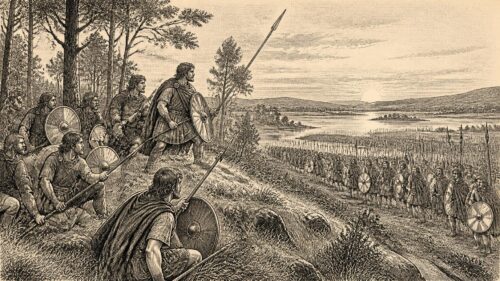
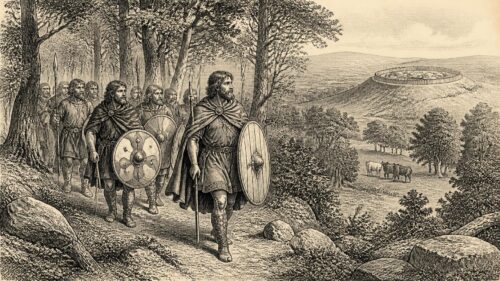
The annalistic formula is stark: there was a battle between Fínshnechtae and the Laigin near Loch Gabair, and Fínshnechtae was victorious. A later narrative annal adds an important qualification: there was slaughter on both sides. That does not permit a reconstruction of manoeuvres, but it establishes that this was not a bloodless display of superiority. Men from Leinster had crossed into, or pressed hard upon, the territory dominated by the southern Uí Néill dynasty of Síl nÁedo Sláine. Fínshnechtae met them close to a royal centre and prevailed.
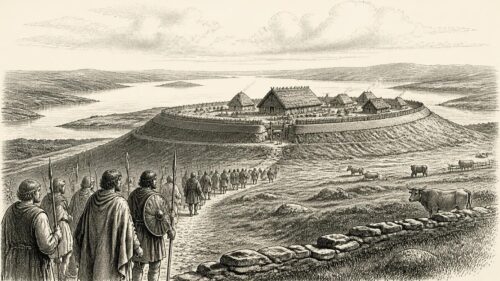
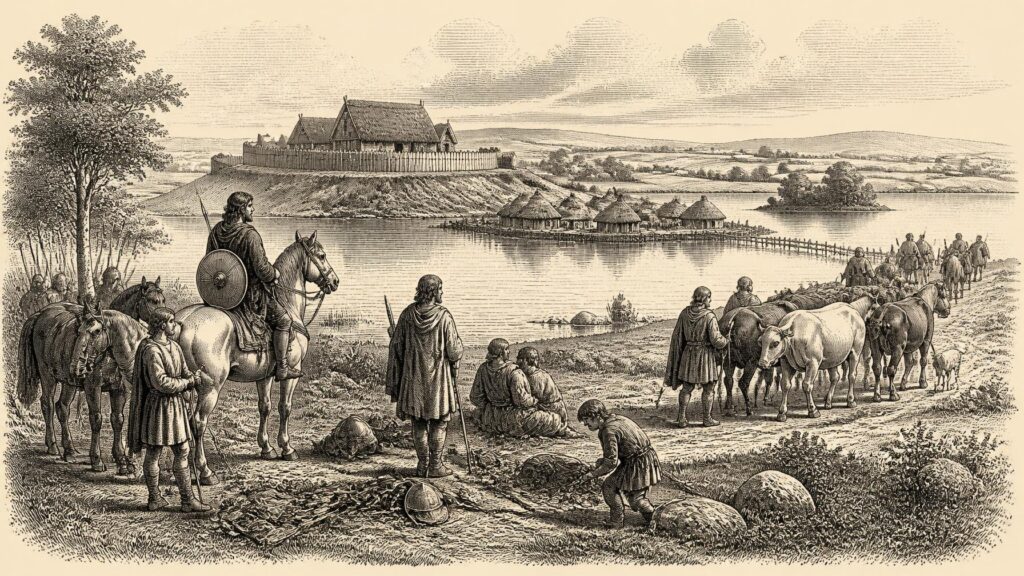
Loch Gabair was far more than a convenient landmark. The lake and its surrounding district lay in southern Brega, north-west of the Hill of Tara and within the political landscape from which Fínshnechtae’s kindred exercised power. Lagore is also known archaeologically for its crannóg, an artificial or adapted island settlement whose waterlogged setting preserved evidence of elite occupation over a long period. The battle was recorded as occurring near the lake rather than necessarily at the crannóg itself. Still, the location made the message unmistakable: Leinster’s advance had reached a zone dense with royal associations, productive land and routes linking the midlands to the east.
Fínshnechtae, whose byname Fledach is usually understood as “of the feasts” or “the bountiful”, had gained the kingship of Tara only shortly beforehand, after killing his cousin and predecessor Cenn Fáelad in 675. His position rested on the fluctuating strength of the Uí Néill confederation, above all the Síl nÁedo Sláine branch that ruled Brega. “High king of Ireland” is often used for rulers such as Fínshnechtae, but it should not suggest a unitary kingdom with permanent borders or an administrative capital. His authority was exercised through kinship, military following, tribute, hostage-taking, clientage, assemblies and the capacity to defend strategically important districts. A Leinster army near Loch Gabair was therefore a direct challenge to the credibility of his rule.
Fínshnechtae and Fiannamail
The Leinster leader was probably Fiannamail mac Máele Tuile, overking of Leinster and a member of Uí Máil. The annals simply say “the Laigin”, but the identification fits the political setting and is accepted in modern reference scholarship. Fiannamail’s career demonstrates how provincial kingship worked in seventh-century Ireland. Leinster was not a single, politically uniform people; its overking had to negotiate rival dynasties and local lordships, including powerful groups such as Uí Dúnlainge and Uí Chennselaig. Nor did victory or defeat automatically extinguish a rival’s position. Fiannamail remained significant until his killing in 680.
The clash should consequently be seen neither as an invasion of “Ireland” by “Leinster” nor as an ethnic war. It was a contest between overlapping networks of kingship. Brega’s rulers had reason to protect the approaches to Tara and their own rich plain. A Leinster overking had reason to test, resist or renegotiate Uí Néill claims pressing southward. The frontier was not a line on a map. It was made and remade through cattle-raiding, payments, marriages, fosterage, hostage agreements, church patronage and armed expeditions. The recorded victory established that, in 677, Fínshnechtae could defend the northern side of that contested zone.
Yet restraint is as revealing as triumph. There is no contemporary evidence that Fínshnechtae converted the victory into the annexation of Leinster, installed a client king there, or imposed a named settlement at Loch Gabair. The battle affirmed leverage rather than creating a new territorial state. Later tradition attached to Fínshnechtae includes stories of generosity, feasting and ecclesiastical counsel, but those tales were written down much later and should not be used as a day-by-day record of 677. What the contemporary annal supports is narrower and more valuable: the king of Tara won a costly encounter when Leinster’s forces came close to a Brega royal site.
Violence Beyond the Midlands
The same annalistic year-group reports the killing of Dúnchad son of Ultán, called king of Airgíalla or Oriel in one version, by Máel Dúin son of Máel Fithrich. The Annals of Ulster name Dún Forgo as the place of his death; the Annals of Tigernach preserve the victor’s name and title for the victim. This was important northern politics, but its exact placement in the modern calendar is less secure than the traditional annal number implies. It is safest to describe it as belonging to the 677 annalistic dossier, rather than claim a precise date within 677 CE.
Airgíalla was itself a federation of peoples and dynasties in the north, positioned between Ulaid, Cenél nÉogain and other powerful interests. Its rulers operated amid constant pressures from larger neighbouring kindreds and internal competitors. Dúnchad’s killing shows that the instability visible at Loch Gabair was not confined to the midlands. A royal title did not guarantee security; succession and power could be decided at a fortified place, on a route, or in a sudden encounter that an annalist compressed into a single line.
Another notice records an encounter at Cúil Maine in which two sons of Máel Aichdin fell. Neither the site nor the wider political alignments can be securely recovered from that brief statement. Its proper historical use is modest. It confirms another episode of lethal, kin-centred conflict, but it cannot responsibly be transformed into a major battle or assigned to a named kingdom. Such laconic entries are a reminder that the annals preserve only a selection of what contemporaries thought worth recording, overwhelmingly deaths, battles, accessions, church leaders and unusual phenomena.
What Conflict Meant on the Ground
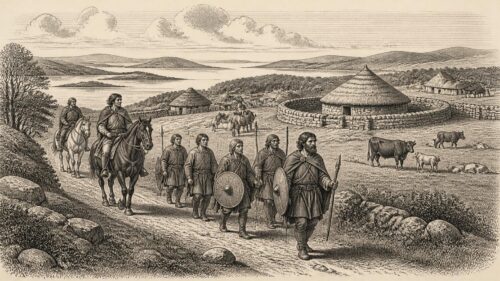
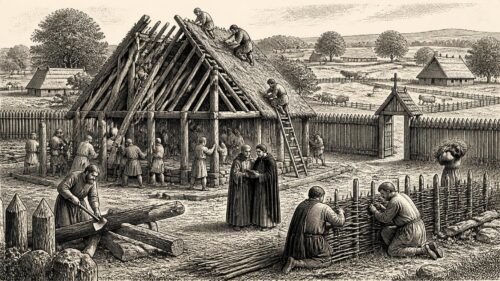
For most people, the political importance of 677 would have been felt through disruption rather than through a grand national narrative. Ireland’s population was overwhelmingly rural. Families lived in dispersed farmsteads, many of them enclosed by earth-and-timber ringforts or, in stonier districts, by stone cashels. Houses were generally timber, wattle-and-daub or dry-stone structures with thatched roofs; farm buildings stored grain and sheltered animals. Cattle were central to wealth, food, dairying, status and compensation. Fields supplied cereals, while woodland, pasture, rivers, lakes and coasts provided further resources.
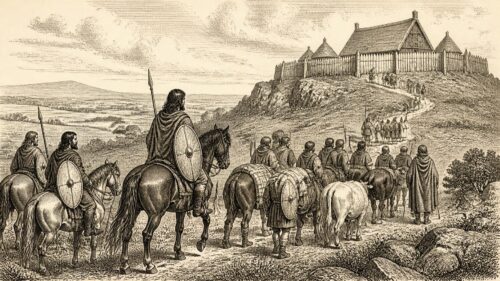
An armed hosting placed such households at risk. Warriors needed food, animals, guides and transport; a passing force could seize cattle, strip stores or compel local allegiance even without burning a settlement. Ringfort banks and ditches helped define a household’s resources and offered some protection for people and livestock, but they were not castles capable of stopping an organised royal army. The political geography of Loch Gabair was thus also an economic geography. Control of Brega meant access to agrarian surplus and to the social obligations that surplus sustained.
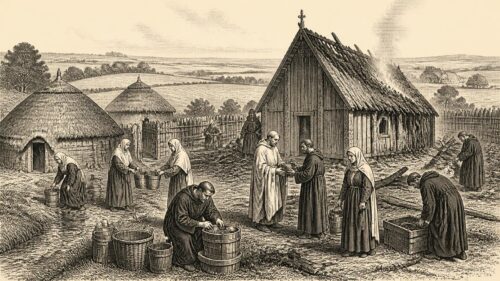
It would be wrong, however, to imagine uninterrupted chaos. The very possibility of mobilising forces and maintaining royal sites depended on working farms, negotiated obligations and seasonal routines. After the fighting, sowing, harvesting, milling, dairying, textile work and stock management continued. The annals do not tell us which communities furnished men for either side or what losses individual households endured. Archaeology and early Irish legal material supply the wider framework, but they cannot turn the battle into a documentary window on one particular village in 677.
Churches, Islands and the Irish Sea
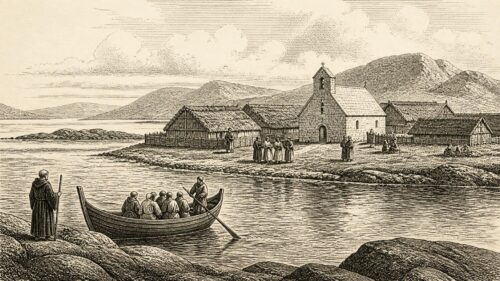
The year-group also notes the death of Becán of Rùm, an ecclesiastic associated by later scholarship with the Columban world of Iona and the Small Isles. As with Dúnchad’s death, the absolute calendrical placement is complicated by the annals’ offset, so it should not be presented as a firmly dated event within 677 itself. Nevertheless, the notice is directly relevant to Ireland’s world in this period. Iona, founded by Columba from Irish origins, stood in a sea-linked ecclesiastical network joining Ireland, western Scotland, Northumbria and islands such as Rùm.
Becán’s significance lies less in a recoverable biography than in the connections his name evokes. A seventh-century letter by the Irish scholar Cummian addressed a hermit named Béccán alongside Ségéne, abbot of Iona, during the controversy over the calculation of Easter. Whether every reference belongs to precisely the same man cannot be proved beyond doubt, but the evidence shows a learned religious milieu in which Irish and insular churchmen debated scriptural authority, calendars and the proper ordering of Christian life. Religious communities were centres of prayer and burial, but also of literacy, teaching, landholding, food production and travel.
That wider monastic culture formed an important counterpoint to the wars of kings. It did not stand outside politics: rulers endowed churches, sought clerical support and used ecclesiastical links to enhance prestige. Yet it also carried ideas, books, personnel and devotional practices across sea routes that ignored later national boundaries. In 677, as Fínshnechtae defended Brega against Leinster, Irish influence and Irish participation extended through the islands and coasts of the western seaways.
A Year of Tested Authority
The central fact of 677 is therefore not an imagined all-Ireland campaign but a successful, apparently costly defence at Loch Gabair. Fínshnechtae’s victory kept a Leinster challenge from achieving its immediate aim in Brega and reinforced the standing of a relatively new king of Tara. The associated notices of a northern royal killing and another obscure encounter reveal a political order in which power remained contested at every level.
A bright comet is also entered in the same annalistic dossier as having been visible during September and October. Astronomical and chronological study associates that observation with 676 rather than 677, so it should not be counted as an event of the requested calendar year. Its presence is useful chiefly as a warning: early medieval annal numbers are indispensable evidence, but not always identical to modern calendar dating. For 677 itself, Loch Gabair remains the clearest landmark—a battle fought close to a royal lake, where victory strengthened authority without ending the rivalries that made such authority necessary.
Primary Sources
- The Annals of Ulster AD 431–1201
- The Annals of Tigernach
- Part 10 of The Annals of Tigernach
- Fragmentary Annals of Ireland
- Chronological Synchronisation of the Irish Annals, 488–722
- Fínshnechtae Fledach
- Fiannamail
- Ireland in the Seventh Century: A Tour
- Irish Society c. 700: I. Communities
- The Dating of the Irish Annals
- De controversia Paschali
- TEI Header for De controversia Paschali
- A Bright Crowd of Chancels: Whither Early Church Archaeology in Scotland?
- An Evaluation of Astronomical Observations in the Irish Annals
- Annales Cambriae, from Saint Patrick to AD 682: Texts A, B and C in Parallel
- Early Medieval Farmsteads
- Earthen Banks and Broken Walls
- Ringforts / Ráthanna
- Monument Class and Scope Notes
- County Meath Urban Archaeology Survey, Part II
- Early Christian Ireland: Sample Chapter
- Of Bede’s ‘Five Languages and Four Nations’: The Earliest Writing from Ireland, Scotland and Wales