Ailech Frigrenn676 CE
In 676, Fínsnechtae Fledach, southern Uí Néill king of Tara, destroyed Ailech Frigrenn, a royal centre of the northern Cenél nÉogain. The attack demonstrated his recently secured authority but did not end northern autonomy. Annalistic dating is imperfect, though several sources associate the event with this year. The records also note killings among elite kindreds, whose circumstances remain unknown. Deaths of Colmán, bishop of Inis Bó Finne, and Fínán son of Airennán, together with Failbe’s return from Ireland, reveal active ecclesiastical and Irish Sea connections. The year illustrates the links between dynastic warfare, rural resources and religious institutions.
Dateline
In 676 CE, the most consequential Irish event assigned by the annals to the year was the destruction of Ailech Frigrenn by Fínsnechtae Fledach, king of Tara. The record is brief, but its implications were not. Ailech stood at the heart of the Cenél nÉogain’s northern power, while Fínsnechtae belonged to the southern Uí Néill dynasty of Síl nÁedo Sláine. His attack was therefore not a local raid but a forceful declaration that his newly won supremacy extended beyond Brega and the midlands. Medieval Irish annal chronology is not mechanically exact: the same cluster is placed under 676 in the Annals of Tigernach, Chronicon Scotorum and the Fragmentary Annals, while the surviving Annals of Ulster manuscript sequence has a known chronological displacement. The destruction can responsibly be connected to 676, but no month, day or campaign route is recorded.
A Northern Royal Seat Attacked
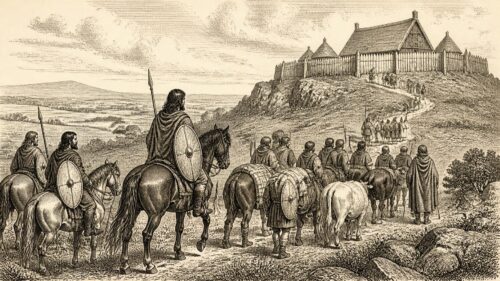
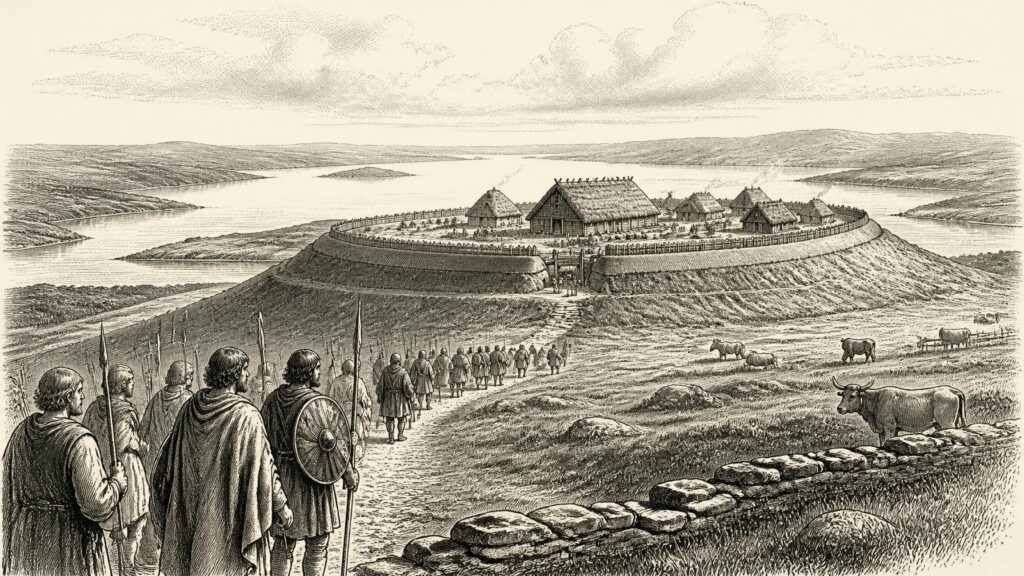
Ailech was more than a defensible hilltop. It was a royal landscape in Inishowen, overlooking the approaches to Lough Foyle and Lough Swilly, associated with the Cenél nÉogain, the dominant northern branch of the Uí Néill. From such a place, rulers could supervise routes between peninsula, coast and inland Ulster; they could also make authority visible through assembly, hospitality and control of dependants. The prominent stone enclosure now called Grianán of Aileach is a powerful modern landmark, but it should not simply be treated as an untouched seventh-century structure. It was substantially restored in the nineteenth century, and the annal’s Ailech Frigrenn may denote a particular enclosure, building or fortified element within the wider royal complex. What is secure is that the annalists regarded its destruction as important enough to preserve.
The name Ailech Frigrenn carried an antiquarian resonance even in medieval Ireland. Later place-lore described it as a specially built stronghold within “Ailech of the kings”, and a related poem imagined a fort marked by successive ramparts and horse-trodden approaches. These literary accounts cannot be read as eyewitness descriptions of 676. They do, however, show why an assault on Ailech could be remembered as an assault on a dynasty’s seat, its ancestral prestige and its claim to rule. “Destruction” need not mean that every rampart was levelled or that the site ceased to function. In early medieval warfare it could mean the burning or demolition of buildings, the breaking of defences, the seizure of goods and livestock, or the ritual humiliation of a rival’s centre. The annals do not specify which occurred.
Fínsnechtae’s Demonstration
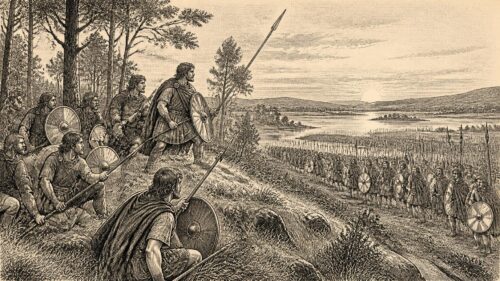
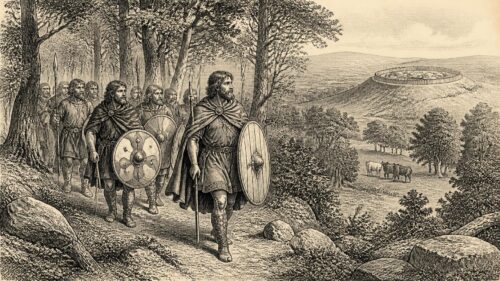
Fínsnechtae had come to power only shortly beforehand. In 675 he defeated and killed his cousin and predecessor, Cenn Fáelad, in a struggle within the southern Uí Néill. The campaign against Ailech in the following year should be seen against that immediate background: a new ruler, whose position had been won violently, needed recognition from competing kin-groups as well as obedience from lesser kings. His byname Fledach, usually understood as “of the feasts” or “the bountiful”, evokes the expected generosity of a king, but royal generosity depended upon extracting food-renders, labour, military service and hostages. A successful northern expedition advertised that Fínsnechtae could protect his own followers and punish resistance far from his home territory.
It would nevertheless be misleading to imagine an Irish state directed from a permanent national capital. “King of Tara” was a pre-eminent claim within a network of kingdoms, rather than the office of a ruler administering a united island through officials and fixed borders. Cenél nÉogain retained its own leadership, military following and regional ambitions. The attack on Ailech shows both the reach and the limits of Fínsnechtae’s power: he could bring sufficient force to strike a northern royal centre, yet the northern Uí Néill were not extinguished. His authority was negotiated continually through kinship, alliances, ecclesiastical connections, tribute and displays of military capacity. The very need to destroy Ailech indicates that northern autonomy remained politically significant.
Lives Recorded in Short Form
The same annalistic cluster preserves other events, each compressed to a line. Congal son of Máel Dúin and men described as the sons of Scannal and Aurthulae were killed or murdered. The sources provide neither a location nor an explanation, and the identities of all involved cannot securely be reconstructed. Such notices are a reminder that political violence did not consist only of famous battles. It also involved targeted killings among elite kindreds, men whose names mattered to local communities but whose fuller stories are now lost. The responsible conclusion is not that Ireland was uniquely violent, but that status, land, cattle, clientship and succession could all be defended by armed force in a society without a central monopoly of coercion.
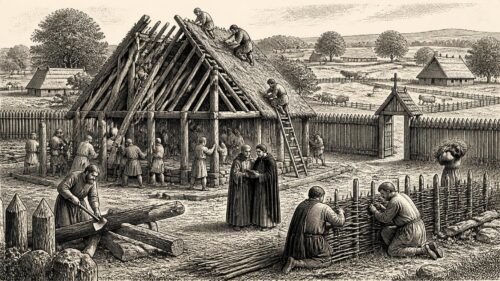
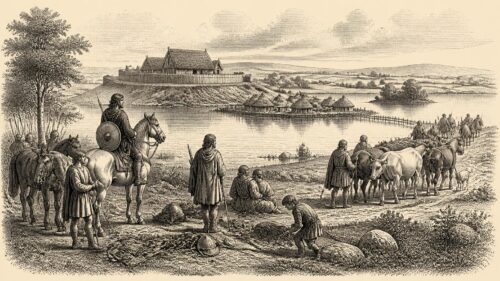
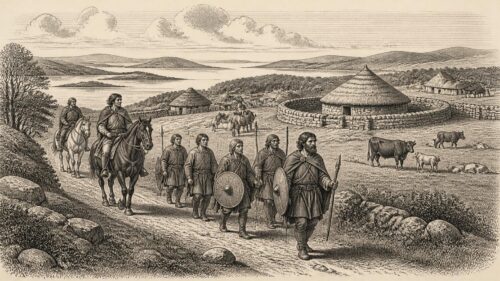
For ordinary households, the consequences of high politics were practical. A royal hosting required provisions: cattle, pigs, grain, dairy produce, ale and the service of men and horses. A raid on a royal site could disrupt dependants as well as dynasts, taking stored food and animals or compelling people to supply a passing force. Yet the annals give no harvest report, famine notice or weather event for 676, and none should be invented. The broader archaeological and historical picture suggests a rural Ireland of dispersed farmsteads and enclosed settlements, with cattle central to wealth and mixed farming increasingly important. Most people encountered the contest for kingship through obligations, seasonal work, food supply and local security rather than through the annalists’ grand political vocabulary.
Churches, Islands and Sea Roads
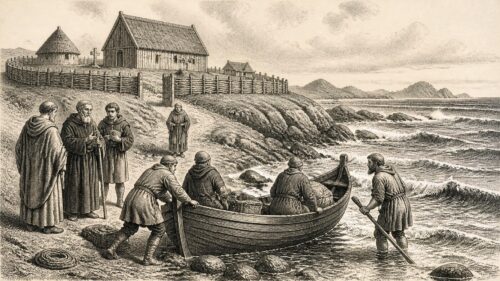
Religion was also present in the year’s sparse record. Colmán, bishop of Inis Bó Finne, and Fínán son of Airennán are said to have “rested”, the conventional annalistic language for death. Colmán is generally identified with the former bishop of Lindisfarne, who had left Northumbria after the Synod of Whitby and became associated with the monastery on Inis Bó Finne off the west coast of Connacht, as well as with Mayo. The identification is widely accepted but not wholly beyond scholarly qualification, so the annal itself remains the firmer evidence: a bishop of that island community died in the year. A later annalistic compilation gives Colmán’s death as 8 August; because that precision comes from a much later compilation, it is safer to treat 676 rather than the exact day as secure.
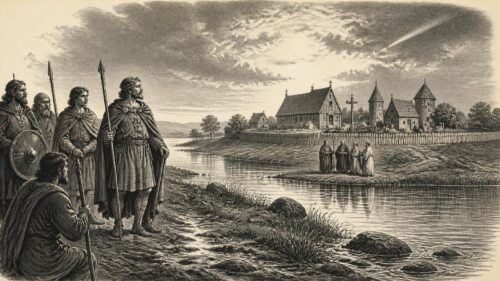
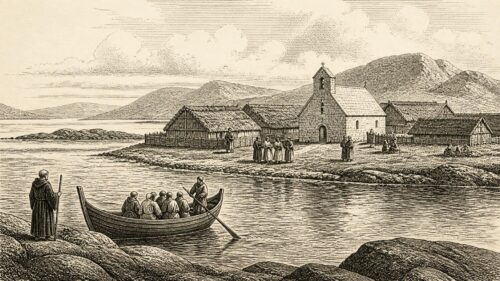
Colmán’s career illuminates the Irish Sea world behind the obituary. Irish monasteries and churches were not isolated institutions. Clerics, students, books, relics and ideas travelled between Ireland, Iona, Northumbria and western Britain. Colmán’s own experience linked Iona, Lindisfarne and Connacht, while the annals also note that Failbe returned from Ireland in 676. Failbe is normally understood as the abbot of Iona, whose movements show that the sea was a route of connection rather than a hard frontier. The record does not tell us why he travelled, whom he met or what he carried. It does demonstrate that the monastic networks of the western seaways remained active during a year of major Irish dynastic conflict.
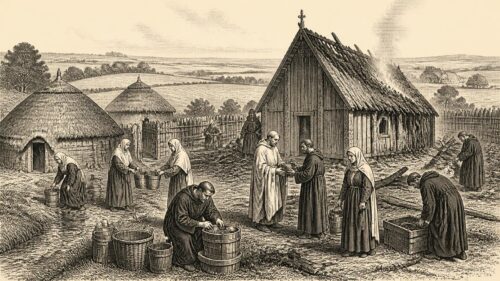
Church communities were centres of worship, burial and pastoral care, but they also possessed land, livestock, food stores and educated personnel. Their leaders could be counsellors to kings and custodians of memory; their scriptoria and schools supported the learned culture from which annalistic record-keeping emerged. That does not mean every monastery was a quiet refuge from politics. Religious houses depended on patrons, lay protectors and agricultural resources, and their prominence could draw them into disputes over territory and status. The deaths recorded in 676 therefore belonged to the island’s institutional history as well as its devotional life: they marked the passing of people embedded in networks of travel, learning and landholding.
What the Year Reveals
676 is not a year that permits a densely narrated national history. Its evidence does not support claims about a nationwide assembly, a diplomatic settlement, an epidemic, a major environmental crisis or changes in trade. What it does preserve is unusually revealing: a southern Uí Néill king deliberately destroyed a northern royal centre; several elite killings were remembered; and the deaths and journeys of churchmen connected Ireland to the wider Irish Sea. These are not separate worlds. Kingship required resources and reputation; ecclesiastical institutions required patrons and communications; sea travel sustained relations across islands; and rural producers underpinned both royal warfare and religious communities.
Above all, the destruction of Ailech Frigrenn makes 676 a year of political theatre as well as conflict. Fínsnechtae’s action was meant to be seen, remembered and understood by rivals. It proclaimed that the king who had recently secured power in the south could carry war into the northern Uí Néill homeland. The survival of the entry, stripped of speeches and battlefield detail, is itself testimony to the enduring symbolic weight of the place. Ailech was not merely attacked: in the annalists’ memory, it was destroyed.
Primary Sources
- The Annals of Ulster
- The Annals of Tigernach, Part 10
- Chronicon Scotorum, Part 66
- Fragmentary Annals of Ireland, Part 4
- Annals of the Four Masters
- Fínshnechtae Fledach
- Chronological Synchronisation of the Irish Annals
- Chronicon Scotorum: Editorial Introduction
- The Metrical Dindshenchas, Part 22
- The Metrical Dindshenchas, Part 24
- Excavations at Elagh Castle: Data Structure Report
- Grianán of Aileach
- Iron Age Ireland: Grianán of Aileach
- Archaeological Survey
- Protection and Designation of Monuments
- Early Christian Ireland: The Powers of Kings
- Early Christian Ireland
- Early Medieval Ireland 431–1169
- Colmán of Inis Bó Finne
- Exploring the Irish Annals
- Irish Texts at CELT
- The Annals of Tigernach
- The Annals of Ulster, U677 (AD 676)
- Fragmentary Annals of Ireland: Manuscript History