Guaire Aidne663 CE
In 663, Irish annals chiefly record deaths and killings rather than major campaigns. Guaire Aidne, king of Connacht, died and was buried at Clonmacnoise, linking his dynasty with an influential monastery. The killing of Conall and Colcu, sons of the former northern Uí Néill king Domnall mac Áedo, reflected continuing dynastic danger. Ecclesiastical losses included Ségíne, abbot of Bangor, and Tu-Enóc, abbot of Ferns, alongside several bishops. Annalistic dating varies slightly between sources, but 663 is generally accepted. These sparse notices reveal a politically fragmented Ireland in which kingship, kinship and churches shaped authority and remembrance, shortly before the mortality recorded for 664.
Dateline
In 663 CE, Ireland’s annalistic record is dominated not by a famous battle or a royal inauguration, but by deaths: above all that of Guaire Aidne, remembered as king of Connacht, and by the loss of senior churchmen at Bangor and Ferns. The year is a useful reminder that early Irish history is often preserved in short, retrospective notices rather than continuous narrative. Those notices nonetheless reveal a society in which royal standing, kinship, monasteries and burial places were tightly interwoven. They also require care over dating. The Annals of Ulster preserve these notices under U663, while their internal year-equivalent is one year earlier; Chronicon Scotorum and the Annals of Tigernach place the sequence at 663, whereas the much later Annals of the Four Masters place related entries at 662. Modern synchronisation generally treats 663 as the appropriate calendar year, but the evidence does not permit a more exact day or season for most events.
A Connacht King Remembered
The principal political death was Guaire of Aidne, or Guaire Aidne mac Colmáin. Chronicon Scotorum expressly calls him rí Connacht, king of Connacht, while the Annals of Ulster tersely record his death. His byname connects him with Aidhne, the south Galway territory of the Uí Fiachrach Aidhne. This dynasty was one among several powerful Connacht kindreds, and the title “king of Connacht” should not be mistaken for control exercised in a modern territorial or bureaucratic sense. Seventh-century Irish kingship was personal and layered: a ruler’s authority rested on lineage, clientship, armed followers, alliances and the ability to command tribute or hospitality. The annals’ designation nevertheless shows that Guaire’s death mattered beyond one small kingdom.
Guaire had long been a conspicuous figure. In 649 he had fought Diarmait mac Áedo Sláine, a leading Southern Uí Néill ruler, at Carn Conaill, in or near his own Aidhne territory. The annalistic notice says Guaire fled after defeat. Later saga material greatly enlarged that episode, depicting an intense contest of kingship, honour and saintly intervention. Such literature cannot simply be read as a factual report of the battle, yet it indicates why Guaire remained memorable. By 663, his name could prompt the Fragmentary Annals to attach a short verse lament invoking Carn Conaill. The poem does not establish the details of his final years, but it shows that his death was linked in historical memory to the older catastrophe of defeat.
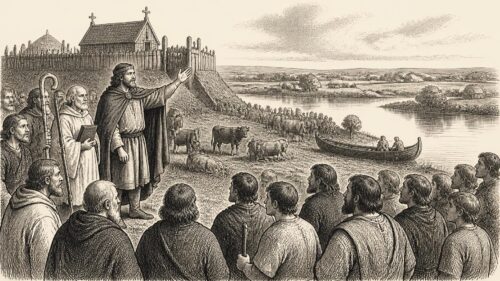
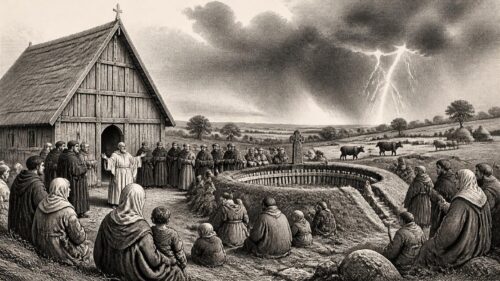
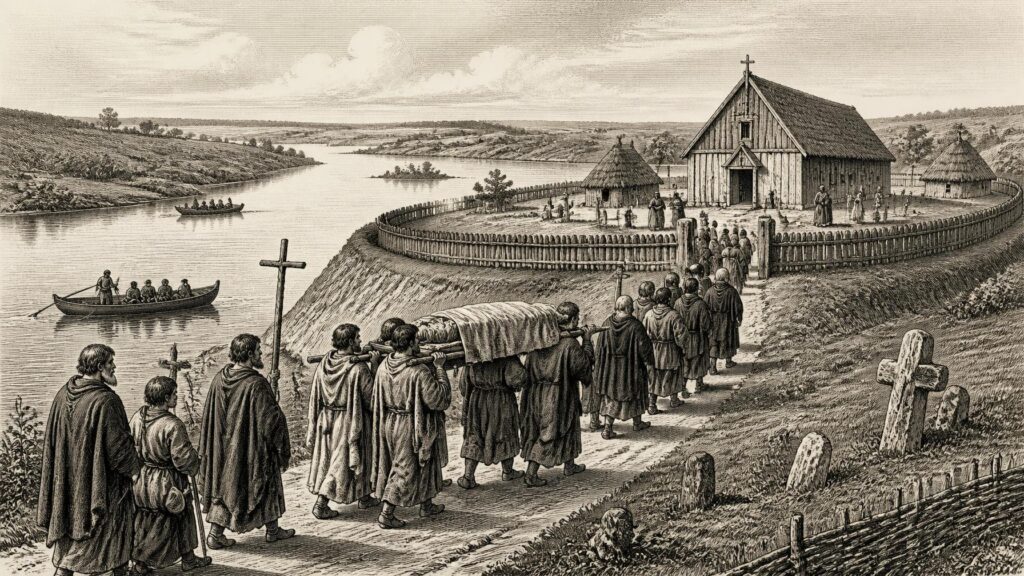
One detail is especially significant: Chronicon Scotorum records Guaire’s burial at Clonmacnoise. The monastery stood on the Shannon, at a meeting-point between Connacht and the midlands, and its position made it both a religious centre and a place of communication across regional boundaries. Burial there connected an Aidhne ruler to the cult of Ciarán and to a community whose influence extended well beyond its immediate lands. This was not merely a private funeral choice. Elite burial at a major church could express patronage, secure prayer and commemoration, and advertise relationships between a dynasty and an ecclesiastical institution. The record does not describe the ceremony, grave or gifts, so these must not be imagined in detail; yet the decision to preserve the location of burial suggests that it was meaningful.
Succession Without a Recorded Settlement
Guaire’s death inevitably raised questions of succession in Connacht and Aidhne, but the annals do not describe an election, dispute or settlement in 663. Later king-lists and genealogical traditions offer differing impressions of succession, and it would be unsafe to turn them into a confidently dated transfer of power. What can be said is that the death removed a ruler with a substantial political reputation at a time when provincial authority in Ireland was never uncontested. Connacht contained competing dynasties, while the Uí Néill power-centres of the north and Brega could exert pressure through warfare, alliance and claims to wider supremacy. A king’s death therefore mattered not only to his close kindred but also to clients, rival branches and churches that depended on royal protection.
The broader political setting was still shaped by Diarmait and Blathmac, sons of Áed Sláine, who appear in later annalistic regnal reckonings as joint rulers over Ireland. Their authority was strongest in the Southern Uí Néill sphere of Brega, rather than representing a uniform administration of the whole island. Indeed, the previous year’s battle of Ogoman exposed conflict among forces connected with them. Nothing in the surviving entries for 663 records a new campaign by either man in Connacht, and Guaire’s death should not be presented as the result of an invasion or royal punishment. The year’s evidence is about the changing personnel of power, not an attested military realignment.
Violence in the Northern Kindred
Another sharply worded notice records the killing of Conall and Colcu, sons of Domnall son of Áed. Their father was Domnall mac Áedo of Cenél Conaill, a major northern Uí Néill king who had died in 642. Chronicon Scotorum and the Annals of the Four Masters identify their killer as Ceirceann. The sources do not explain the motive, location or political aftermath. It is tempting to supply a feud narrative, but none survives in the contemporary annalistic form. Still, the killing of two sons of such a prominent father demonstrates the risks built into aristocratic life: descent offered claims to leadership, but also made men targets in the rivalries of kin groups and neighbouring powers.
The same annalistic sequence notes the death of Gartnait son of Domnall, styled king of the Picts, alongside the deaths of Domnall son of Tóthalán and Tuathal son of Morggán. Gartnait’s death occurred outside Ireland, but it belongs in an Irish historical frame because Irish churchmen, learned communities and maritime travellers were closely engaged with western Scotland and Pictland. The notice is evidence for the broad horizons of the chronicle tradition, not for a specific Irish intervention in Pictish affairs. No treaty, fleet movement or Irish campaign is recorded for 663. Its value lies in showing that Irish writers situated their island within a northern British and Irish Sea world.
Bangor, Ferns and Ecclesiastical Continuity
Church affairs provide the most substantial Irish evidence after Guaire. The Fragmentary Annals record the death of Ségíne moccu Cuinn, abbot of Bennchor, modern Bangor in County Down. Bangor was already an important ecclesiastical community, associated with the sixth-century founder Comgall and remembered for its disciplined religious life and wide connections. The annals do not tell us how long Ségíne had governed, who succeeded him, or how the community marked his death. Yet naming him as abbot confirms that Bangor’s leadership was important enough to enter the historical record, and that abbots could be figures of island-wide significance.
The sources also register the death of Tu-Enóc, son of Fintan, abbot of Ferna Mór, identified with Ferns in Leinster. Bishops named Indercach and Dímma are included in the same cluster of obits, while the Annals of Ulster add Ultán moccu Conchobair “according to another book”. These entries expose both the density of ecclesiastical networks and the limits of the evidence. “Abbot” and “bishop” were recognised ranks, but early Irish church organisation did not map neatly onto later diocesan arrangements. Major communities combined worship, burial, learning, hospitality, landholding and, often, craft and agricultural work. Their leaders dealt with lay patrons and local populations as well as religious households.
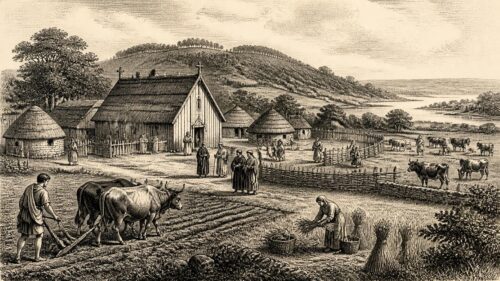
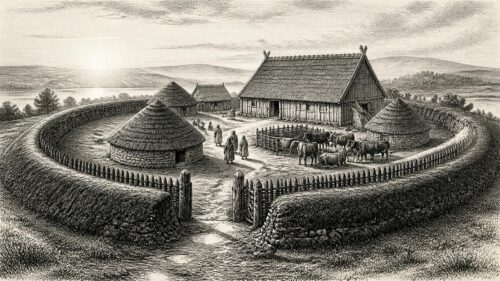
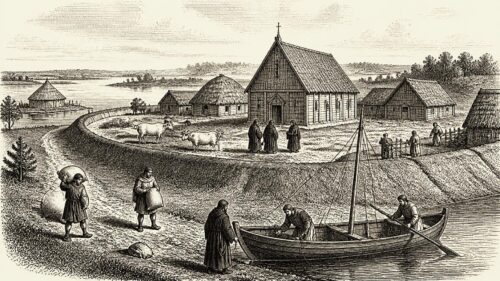
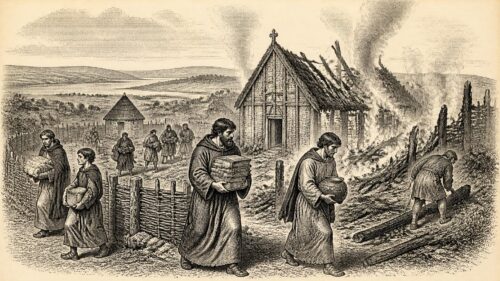
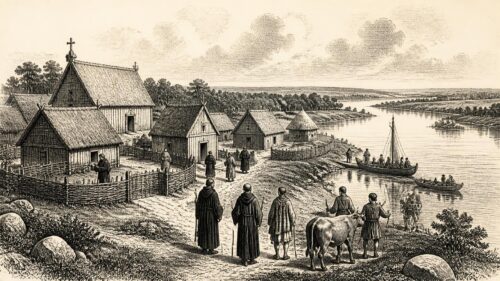
Archaeology helps establish the material background without pretending to describe a particular monastery in 663. Early medieval ecclesiastical sites ranged from substantial landed monasteries to smaller churches and outlying settlements. Most churches of this period were probably built largely in timber or other perishable materials, so modern stone ruins should not be projected back uncritically onto the seventh century. At places such as Clonmacnoise, Bangor and Ferns, the communities recorded in the annals were thus living institutions rather than simply sacred buildings: places where food, labour, livestock, books, liturgy and political patronage met.
Learning, Memory and the Limits of the Record
The notices of 663 do not name a surviving book copied that year, a school founded, or a poem composed. Even so, their survival is itself evidence of learned culture. Irish annals were compiled and continued in ecclesiastical milieux, drawing on earlier notes and memorial traditions. The variation between chronicles is important. One source preserves Guaire’s burial, another Ségíne’s obit, and another attributes the killing of Conall and Colcu to Ceirceann. Rather than treating these differences as a failure, historians compare them to recover the fullest responsible account while recognising that the extant manuscripts were written centuries after the events they record.
Later literary tradition transformed Guaire into an exemplary generous king, associated with stories of hospitality and with a dialogue between the king and his brother Marbán, an ascetic. Those tales illuminate values cherished by later Irish audiences: lavish giving, tension between worldly lordship and religious renunciation, and the prestige of poetic speech. They do not prove that Guaire behaved exactly as their narratives say in 663. His securely dated death and reported burial are historical anchors; the elaborated portrait belongs to the longer afterlife of his reputation.
On the Eve of Mortality
No plague is securely recorded in Ireland during 663 itself. That distinction matters because the following annalistic year records the arrival of a devastating mortality on 1 August 664, with later sources calling it the buide Chonaill. It would be wrong to let that disaster eclipse the evidence for 663 or to assume that every death listed in this year resulted from disease. In 663, the annals report ordinary but consequential losses among kings, aristocrats, abbots and bishops. They offer no reliable account of harvests, weather, prices, trade or conditions among most farming households. The rural majority remained largely unnamed, even though their cultivation and livestock sustained both royal households and churches.
For Ireland, 663 was therefore a year of transition registered through obituaries and killing rather than through a single decisive event. Guaire’s burial at Clonmacnoise bound a Connacht ruler’s memory to one of the island’s most important religious centres. The deaths of Ségíne of Bangor and Tu-Enóc of Ferns marked changes in two established ecclesiastical communities. The killing of Domnall mac Áedo’s sons revealed the continuing danger of dynastic politics. Taken together, these sparse entries show a politically plural Ireland whose churches were central to remembrance, authority and connection across regions—and which stood, unknowingly, just before a far more widely recorded crisis.
Primary Sources
- The Annals of Ulster, Year U663
- Chronicon Scotorum, Annal CS663
- Fragmentary Annals of Ireland, Annals FA 21–28
- The Annals of Tigernach
- Annals of the Four Masters
- Chronological Synchronisation of the Irish Annals
- Scéla Guairi meic Colmáin ocus Óenu moccu Loígse: Background Information
- Cath Cairnn Chonaill: Background Information
- A Marbán, a Díthrubaig
- It É Saigte Gona Súain
- The Characteristics of the ‘Annals of Tigernach’ and Chronicum Scotorum
- Irish Hagiography and Its Dating: A Study of the O’Donohue Group of Irish Saints’ Lives
- The Life of Molaga: A Critical Edition
- More Scottorum: Buildings of Worship in Ireland, c.400–950
- The Architectural Setting of the Mass in Early-Medieval Ireland
- How Did Early Church Sites Differ from One Another? A Comparative Approach Within the Kingdom of Fir Maige, Ireland
- The Archaeology of Ecclesiastical Estates in Early Medieval Ireland: A Case Study of the Kingdom of Fir Maige
- The Earliest Church Sites in Ireland AD 400–550: Landscape Archaeology and the Process of Conversion
- Conversion and Consolidation in Leinster’s Royal Heartland
- The Corpus of Early Medieval Architecture of Ireland
- The Cross-Slabs of Clonmacnoise: Reassessing One of the Largest Collections of Early Medieval Carved Stone Monuments in Northwest Europe
- The Architectural Setting of the Cult of Relics in Early Medieval Ireland