Annalistic Uncertainty655 CE
Ireland’s record for 655 is sparse and chronologically uncertain, but annalistic notices illuminate regional politics and church life. The battle of Flescach, dated variously to 655 or 656, saw Crunnmáel of Cenél nEógain defeat and kill Cumascach of Uí Cremthainn, reflecting rivalry among northern kingdoms. Notices also record the deaths of rulers in Leinster and Connacht and churchmen at Terryglass and Lorrha. The contested date of Nem of Aran’s death highlights Aran’s monastic links with wider Irish society. Irish annals also noted British events, demonstrating learned ecclesiastical networks, Latin literacy and connections across the Irish Sea.
Dateline
In 655 CE, Ireland’s historical record is unusually thin, and its dating is unusually difficult. No contemporary Irish chronicle survives in an original seventh-century manuscript, while later annals sometimes assign the same occurrence to different years. The most defensible approach is therefore to treat 655 as a cautiously reconstructed point in a sequence rather than as a year illuminated by a full narrative. A cluster of annalistic notices connected with this date nevertheless reveals a political landscape of small but ambitious kingdoms, a church embedded in regional society, and an island whose learned communities kept Ireland’s affairs in view alongside events in Britain.
A Battle in the North
The principal conflict conventionally associated with 655 is the battle of Flescach. The Annals of Tigernach, under its entry for 655, state that Cumascach son of Ailill, king of Uí Cremthainn, fell there, and that Crunnmáel son of Suibne, king of Cenél nEógain, was victorious. The closely related tradition of the Annals of Ulster places the same notice under a heading conventionally numbered 656, a discrepancy that is itself a warning against pretending to know the precise day, season or even calendar year of the encounter. Modern chronological work connects this annalistic cluster to the middle of the 650s; it is reasonable to discuss it with 655, but not to attach a more exact date.
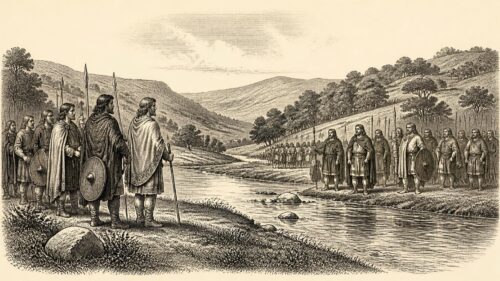
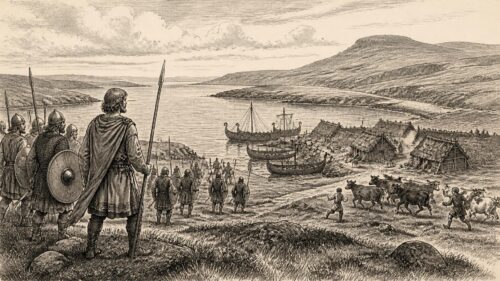
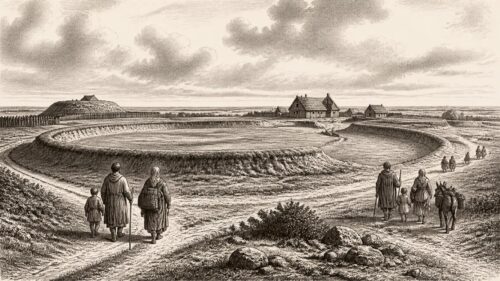
Flescach cannot now be located with certainty. Nor do the annals explain the immediate cause of the fighting, the size of the forces or the terms on which the victors and survivors settled their differences. Their spare wording is still significant. Cumascach represented Uí Cremthainn, a people of Airgíalla in the broad zone between the northern Uí Néill and the lands around Armagh. Crunnmáel belonged to Cenél nEógain, the powerful northern branch of the Uí Néill whose core territories lay in and around Inishowen and the north-west. The battle accordingly points to active pressure along the political frontier between Cenél nEógain and its southern neighbours.
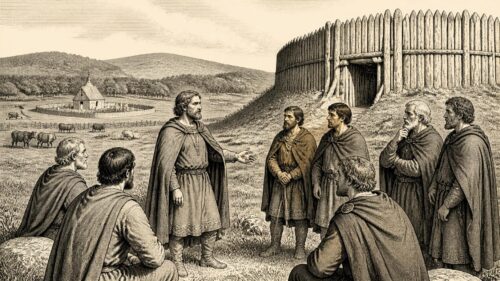
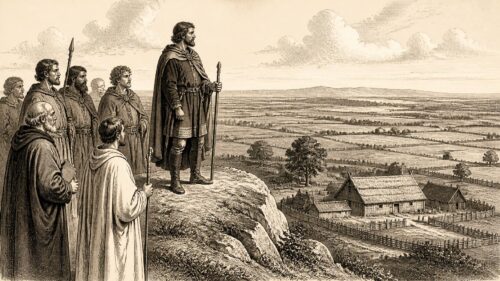
It would be misleading to picture this as warfare between modern nations or even as a struggle for control of a territorially fixed province. Early medieval Ireland contained numerous kingdoms, each centred on a ruling dynasty, its client peoples, estates, churches and assembly places. Kingship was personal as well as territorial: military success enhanced a ruler’s honour, helped secure tribute and hostages, and could alter the balance within a larger network of overlordship. Defeat, especially the death of a king, threatened a dynasty’s claims and exposed its dependants to demands from rivals. Cumascach’s death at Flescach was therefore more than an isolated casualty; it created an opening in Uí Cremthainn at a moment when Crunnmáel’s Cenél nEógain was asserting itself.
The notice also cautions against assuming that a single high king directed events across Ireland. Diarmait and Blathmac, sons of Áed Sláine, were prominent Uí Néill rulers in the mid-seventh century and later sources could call such men kings of Ireland. Yet their authority rested on negotiation, kinship, military expeditions and the willingness of regional rulers to accept a hierarchy that remained changeable. A victory by Crunnmáel in the northern sphere did not make him master of the island; it showed the importance of his own dynasty within the crowded politics of the north.
Deaths and Uncertain Year-Headings
Other entries associated with the same annalistic year reinforce the impression of a fragmented political order. The Annals of Tigernach record the death of Crunnmáel Erbolg son of Rónán, described as king of southern Leinster, and the death of Laidgnén son of Colmán, king of Connacht. These were substantial regional dignities, but they belonged to separate political worlds. Leinster was divided among competing dynasties and Connacht likewise contained several powerful kindreds. An obituary for a king tells us that a succession had to be managed; it does not identify the successor or prove that the death occurred in precisely the same twelve-month period as Flescach.
The annals also place the deaths of churchmen Aithchen of Tír dá Glas, now Terryglass in County Tipperary, and Cailcéne of Lothra, the site at Lorrha near the Shannon, in this chronological neighbourhood. Such short notices are not incidental. They show the geographical spread of ecclesiastical communities whose leaders were remembered by name in records ultimately compiled far from their homes. Tír dá Glas and Lothra stood in a riverine and overland landscape linking Munster, Mide and Connacht. Churches there were places of worship, burial and learning, but also holders of land and livestock, recipients of gifts and participants in the circulation of people and goods.
One must resist making the evidence say more than it can. It cannot demonstrate that every named community was large, wealthy or politically influential in 655. It does show that ecclesiastical office mattered enough for the deaths of local figures to enter historical memory. Monasteries and churches were not remote institutions outside ordinary society. Their estates required cultivation; their households included clerics, dependants, tenants and visiting travellers; and their leaders dealt with kings and aristocratic families. The survival of their names beside those of rulers reflects that entanglement.
Nem and the Aran Connection
A second dating problem centres on Nem mac Ua Birn, or Nem moccu Birn. The Annals of Ulster enter his death under U655, although the chronological apparatus transmitted with that entry equates it with 654. The much later Annals of the Four Masters place his death on 14 June 654 and identify him as successor of Enda of Aran. The evidence does not justify saying simply that Nem died in 655. It does, however, make his death and commemoration indispensable context for a year whose annalistic boundaries are demonstrably unstable.
Nem’s identity was preserved more fully in religious tradition. The Martyrology of Óengus, compiled centuries after his lifetime but drawing on earlier commemorative material, celebrates Nem mac Ua Birn on 14 June. Its accompanying tradition links him with Dál Birn, the ruling lineage of Osraige, and presents him as a successor of Enda on Aran. These details are not a contemporary biography, and they should not be used to reconstruct every stage of Nem’s life. They do show how an abbot of the Atlantic islands could be remembered within a far wider Irish web of kinship and devotion.
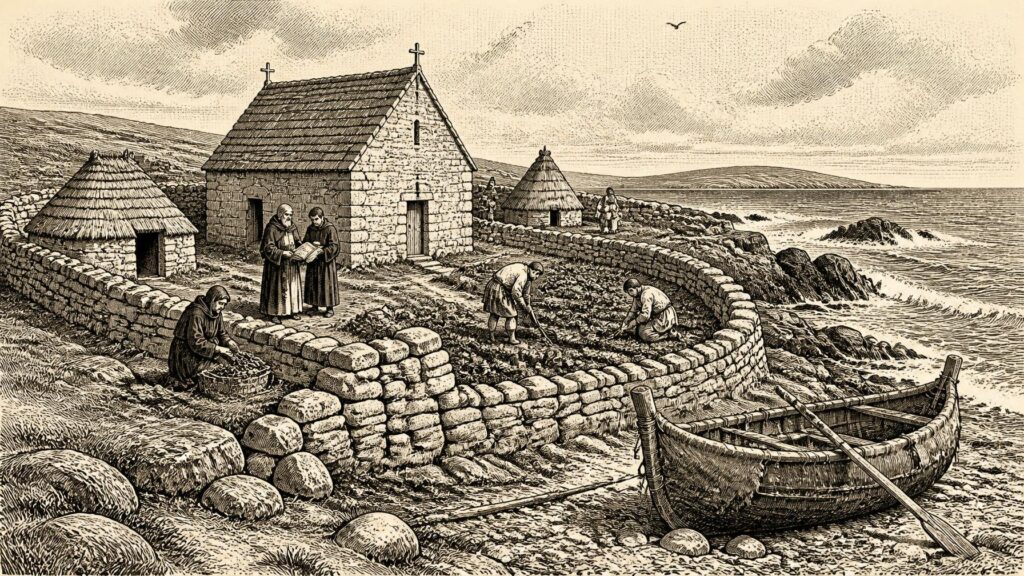
The Aran Islands were not an empty wilderness set apart from the mainland. Their exposed limestone terrain imposed real constraints: thin soils, stone, sea weather and limited timber all shaped settlement. Yet the islands lay on maritime routes around Galway Bay and the western seaways. An ecclesiastical community there depended on boats, food production, labour and relationships beyond the shore. The monastic ideal of withdrawal was compatible with intense connection. Aran’s churches and religious personnel belonged to a world in which coastal travel could carry pilgrims, clerics, books, news and political influence between islands and mainland communities.
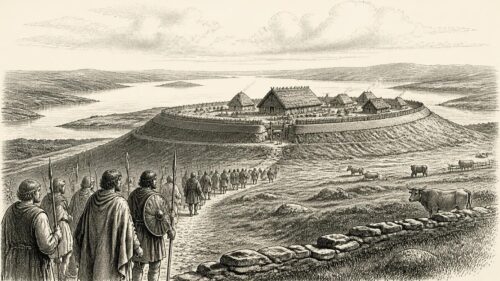
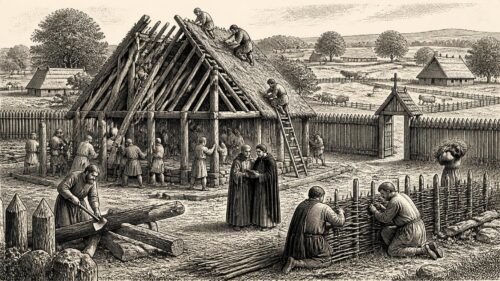
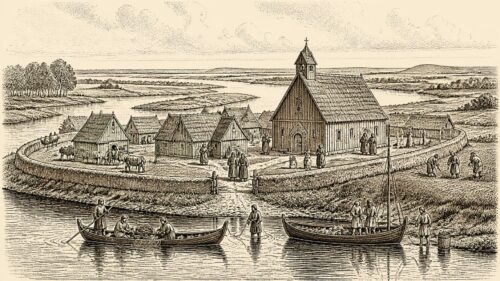
Later stone churches, enclosure walls and cells cannot be assumed to reproduce exactly the buildings present in Nem’s day. Nevertheless, the broader archaeological pattern of early Irish monasteries helps to make the setting intelligible. Religious settlements were usually bounded places, whether by earth, timber or stone, containing spaces for worship alongside dwellings, workshops, storage, animals and cultivation. On rocky Aran, dry-stone construction and careful use of scarce workable ground were practical necessities. The community remembered through Nem’s title of successor would have been a working settlement, not simply a retreat for solitary prayer.
Learning, Memory and Wider Horizons
The very form of the evidence is one of 655’s most revealing features. Irish annals juxtapose battles, royal deaths, clerical obituaries and, at times, happenings in Britain. The Annals of Tigernach include the defeat and death of the Mercian king Penda by Oswiu in a battle of Anglo-Saxon England within the same entry-group as Flescach. That British event was not an Irish affair, and it should not be treated as one. Its presence in an Irish chronicle, however, demonstrates that Irish ecclesiastical scholars followed developments across the Irish Sea, especially in a region bound to Ireland by travel, missionary links and shared debates over Christian practice.
Writing such records required Latin literacy, access to calendrical learning and the patient maintenance of institutional memory. Irish scholars were increasingly producing and copying texts in Latin and Irish, while vernacular legal and genealogical learning also developed within elite settings. The annals are not neutral notebooks: they privilege kings, churchmen, battles and exceptional events, and they often preserve later editorial decisions. But their terse notices are evidence of a learned culture capable of relating a local fight at Flescach, an abbot on Aran and royal changes in Leinster or Connacht to a larger Christian chronology.
For most people, the practical rhythms of 655 were less visible in the written record. Households raised cattle, cultivated grain where soils permitted, maintained dwellings and moved through obligations to lords, kin and churches. Cattle remained a fundamental measure of wealth, while agricultural produce, food-renders and labour supported both secular rulers and ecclesiastical establishments. Conflict could interrupt these routines through requisitioning, the loss of men and animals, or altered demands after a change of ruler. Yet no surviving source allows a responsible claim of famine, epidemic, national prosperity or environmental crisis for this particular year.
A Year of Fragments
Thus 655 CE is best understood not as a year with one commanding Irish event, but as a narrow window onto several connected realities. At Flescach, a northern king defeated a neighbouring ruler and changed the immediate balance of power. In the obituaries of rulers and churchmen, the annals register the continual turnover on which dynastic and ecclesiastical life depended. In the contested dating of Nem of Aran, they reveal both the reach of island monasticism and the limits of chronological certainty. The record is sparse, but it is not empty: it preserves a politically divided Ireland held together, in part, by kinship, travel, Christian institutions and the learned habit of remembering.
Primary Sources
- The Annals of Ulster
- The Annals of Ulster: diplomatic edition
- Part 656 of The Annals of Ulster
- The Annals of Tigernach
- Part 9 of The Annals of Tigernach
- Annals of the Four Masters
- Part 48 of Annals of the Four Masters
- The Martyrology of Oengus the Culdee
- The Martyrology of Oengus the Culdee: June text
- Early Irish Population-Groups: Their Nomenclature, Classification, and Chronology
- Irish Chronicles and Their Chronology
- Chronological Synchronisation of the Irish Annals
- The Chronology and Sources of the Early Irish Annals
- Exploring the Irish Annals
- Early Christian Monasteries
- Churches and Ecclesiastical Enclosures / Shéipéil agus Ráthanna
- Patrician and Early Christian Architecture
- Christian Ireland 5th – 8th Centuries
- Monasteries
- Dún Aonghasa – Ancient Stone Fort and Visitor Centre
- From Kingdom to Colony: Framing the English Conquest of Ireland
- The Ends of the Earth: The Insular World, c.450–c.750
- Viking Ireland and Its Aftermath