Carn Conaill649 CE
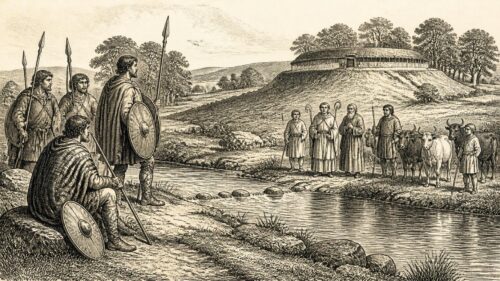
In 649, Irish annals record the killing of Raghallach mac Uatach, king of Connacht, and Diarmait mac Áedo Sláine’s defeat of Guaire of Aidne at Carn Conaill on Whit Sunday. Guaire fled, while allied rulers from Munster and neighbouring kingdoms were killed, showing the wide political connections involved. The events reflected rival dynasties, resource-based lordship and obligations of vengeance rather than a unified Irish state. Later tradition associated Diarmait’s victory with Clonmacnoise, royal patronage and St Ciarán’s protection. Although literary accounts added miracles and reconciliation, the reliable evidence confirms a significant battle, political disruption and enduring monastic influence.
Dateline
In 649 CE, Irish annalistic tradition places two violent political reversals in Connacht: the killing of Raghallach mac Uatach, described as king of Connacht, and the defeat of Guaire of Aidne by Diarmait mac Áedo Sláine at the battle of Carn Conaill. These were not incidents in the history of a unified Irish state. Ireland was divided among numerous peoples, dynasties and client kingdoms, while ambitious rulers sought influence through raiding, alliance, tribute and control of ecclesiastical centres. Yet the events associated with this year reveal how quickly local conflict could draw in rulers from across the island, and how monasteries could stand at the centre of political as well as religious life.
Dating a Difficult Year
The evidence requires care. The principal early annals preserve the killing of Raghallach and the battle of Carn Conaill together, but their year-numbering is not wholly consistent across surviving texts and later compilations. Modern historical convention places Carn Conaill in 649, and the Annals of Tigernach date it to Whit Sunday. The same chronicle names the leading casualties and says that Guaire fled while Diarmait was victorious. The Annals of Ulster preserve a shorter notice. Chronicon Scotorum, which shares much material with the annalistic tradition, offers an especially full version, including the later explanation of Diarmait’s dealings with Clonmacnoise.
That is firmer ground than the rich literary tale called Cath Cairn Chonaill, “The Battle of Carn Conaill”. Surviving in medieval manuscripts copied long after the event, the tale supplies speeches, motives, miracles and a final reconciliation between the protagonists. It is invaluable evidence for later Irish ideas about kingship, generosity and holy protection, but it should not be read as a contemporary campaign diary. The secure historical core is narrower: a battle was fought; Guaire lost; Diarmait won; and several important allied leaders died.
A King Killed in Connacht
Raghallach mac Uatach’s death was the first major blow recorded for the year. The Annals of Tigernach state that he “fell” at the hands of Máel Brigte son of Mothlachán and the Corcu Cullu; Chronicon Scotorum similarly attributes the killing to Máel Brigte and that population-group. The terse wording does not establish the immediate cause, site or sequence of the attack. It is safest to call it a killing or assassination rather than to reconstruct a battle for which the annals give no details.
Even so, the entry matters. Raghallach belonged to the Uí Briúin, a major Connacht dynasty whose branches competed for regional pre-eminence. To kill a king was to create a crisis not merely within his household but among the networks of kin, clients, churchmen and subordinate peoples attached to him. A verse appended to the Annals of Tigernach makes Raghallach’s son Cathal the agent of vengeance, claiming killings and devastations in retaliation. Such verses may be stylised and should not be treated as an audited record of casualties, but they preserve the political expectation that a ruler’s death demanded a response. In early medieval Ireland, failure to avenge a close kinsman could imperil a dynasty’s standing; retaliation, however, could also extend conflict across several territories.
The identity and location of the Corcu Cullu remain obscure. That obscurity is itself revealing. The sources do not offer a modern map of neatly bounded kingdoms. They record a world of smaller named peoples whose political importance could be briefly exposed when they killed, sheltered or allied with a king. Raghallach’s death should therefore not be forced into a simple narrative of “Connacht” against an external enemy. It was an internal western Irish struggle involving a Connacht overking and a less clearly documented community.
Guaire’s Defeat
The battle of Carn Conaill was a larger and more widely connected confrontation. It pitted Diarmait mac Áedo Sláine, of the powerful Síl nÁedo Sláine dynasty of Brega, against Guaire mac Colmáin of the Uí Fiachrach Aidni. Guaire’s power base lay in Aidne, in the south of modern County Galway. The annals report that Diarmait won and Guaire fled. They also name three men who fell on Guaire’s side: Cúán son of Énda, called king of Munster; Cúán son of Conall, king of Uí Fidgeinte; and Tolomnach, king of Uí Liatháin.
Those names show that the conflict reached far beyond a local quarrel in Aidne. Uí Fidgeinte occupied territory in what is now County Limerick, while Uí Liatháin were centred in east Cork. The participation and deaths of leaders associated with Munster underline the value of political and military connections across provincial labels. “Munster” and “Connacht” were meaningful regional frameworks, but men acted through personal lordship, kinship and negotiated alliance. The presence of allied kings did not mean that all Munster fought as a single army, any more than Diarmait’s victory demonstrates an uncontested authority over Ireland.
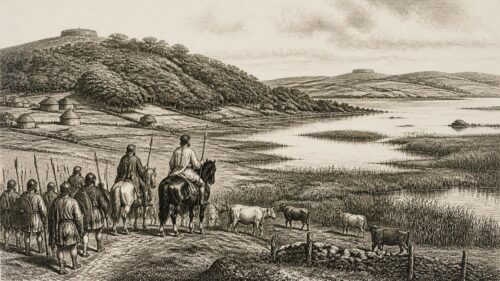
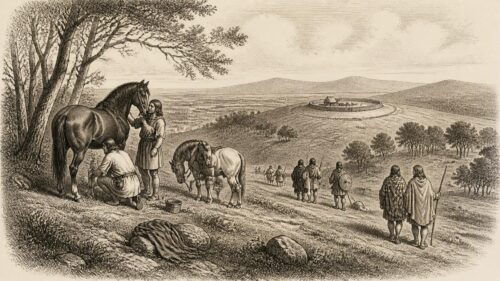
The annals name Whit Sunday as the day of battle. That detail gives the event a Christian temporal setting, though it does not make the fighting a religious war. Christian festivals structured the calendar of a society in which rulers, warriors and clerics increasingly shared religious language and institutions. Campaigning in spring or early summer also made practical sense: weather, pasture, fodder and the availability of men all affected military movement. An Irish army was not a permanent professional force. It was assembled through the obligations and loyalties of kings, lesser lords and their dependants, and it depended on food, animals, weapons and local knowledge.
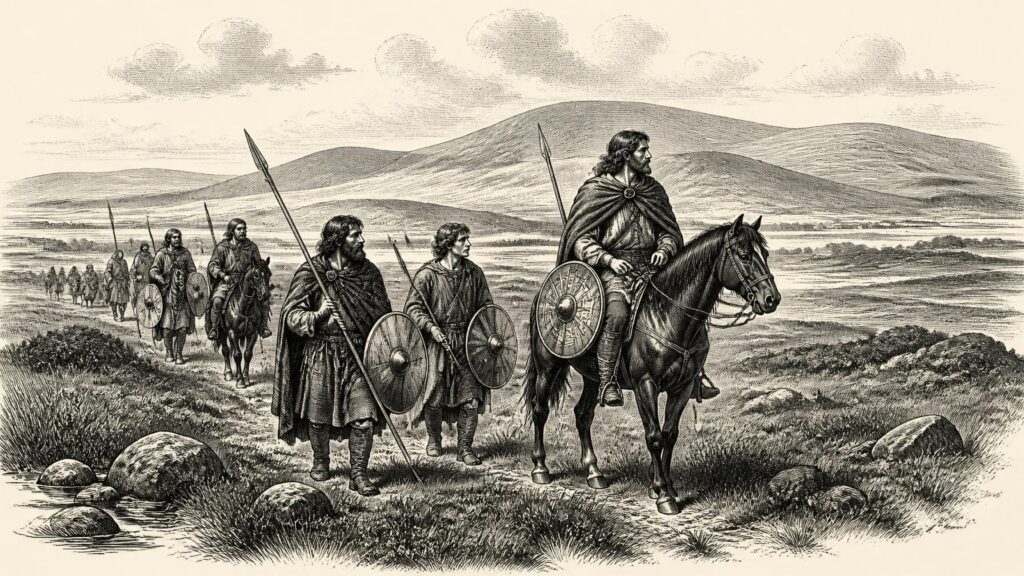
Weapons, as literary and archaeological evidence suggests, included spears, javelins, shields and swords among the better-equipped; mounted travel was important for elites, but battles were not simply cavalry encounters. The annals’ concentrated list of fallen rulers makes the human scale of Carn Conaill clear. It was remembered as a contest in which high-status men died, fled or prevailed. We cannot responsibly calculate the size of either host, identify a precise battlefield position, or describe its tactics from the surviving notices.
Clonmacnoise and Political Protection
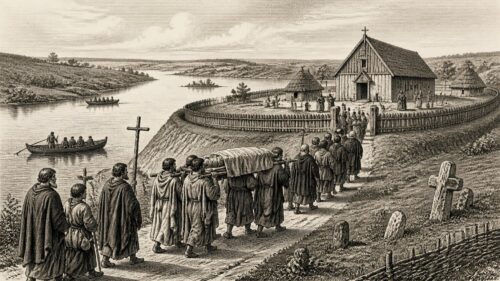
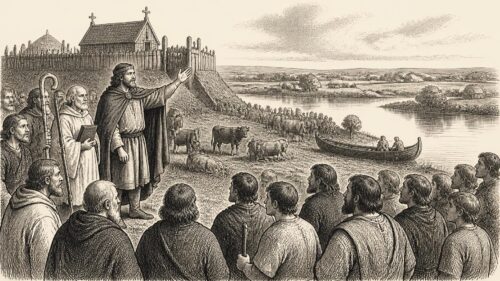
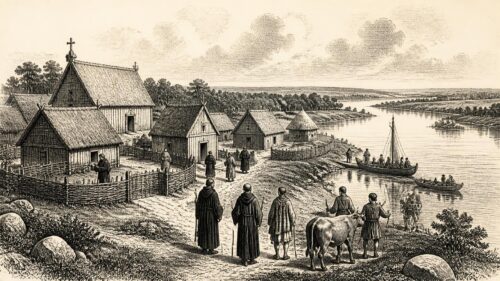
One of the most important traditions attached to Carn Conaill concerns Clonmacnoise, the great ecclesiastical settlement on the River Shannon. Chronicon Scotorum says Diarmait travelled through Clonmacnoise before the battle and that Ciarán’s community prayed for his safe return under their guarantee. After victory, according to the same account, he granted Tuaim nEirc and its divisions of land—identified there with Liath Manacháin—as a “sod on altar” to God and St Ciarán. It also says that he placed prohibitions on the king of Mide and his people against consuming even water there, and that Diarmait consequently chose burial at Clonmacnoise.
This passage is too elaborate to accept uncritically as a contemporary charter. It is best understood as a later annalistic and ecclesiastical memory of royal patronage. Nevertheless, its underlying assumptions fit the seventh-century setting. Churches and monasteries could receive land, livestock, food-renders and legal protection; rulers sought the prayers, prestige and political usefulness of prominent religious communities. The “sod on altar” is a striking image of land transferred in a sacred framework. Whether every detail belongs to 649 or to later remembrance, the tradition demonstrates why Clonmacnoise mattered: its community could be represented as a guardian of rulers, a beneficiary of victory and a keeper of royal memory.
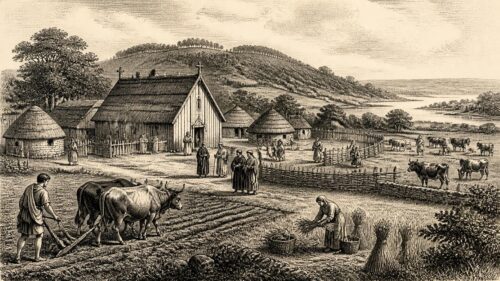
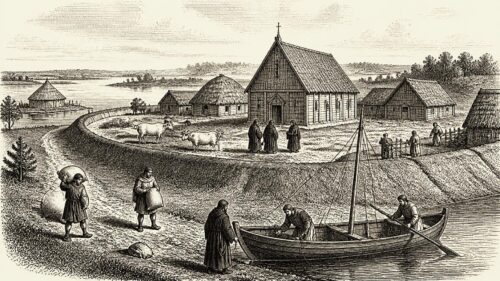
Clonmacnoise was not an isolated retreat. Positioned near major river routes and the central Midlands, it was linked to travel, exchange and lordship. Monastic settlements were places of worship and learning, but also households with land, labourers, food needs and patrons. Their churches, cemeteries, workshops and agricultural interests made them durable centres in a predominantly rural landscape.
Land, Cattle and Status
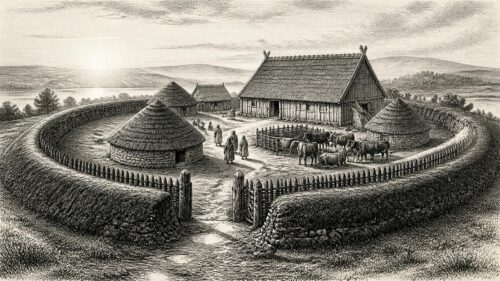
The Ireland of 649 was overwhelmingly rural. Most people lived in dispersed farmsteads and enclosed settlements, raising cattle and other livestock while also cultivating crops. Cattle were central to wealth, dairy production, hospitality, tribute and compensation. The annalistic verses connected with Carn Conaill include an attributed remark by the defeated Guaire about receiving cows for a feast. It cannot be used as literal evidence for the battle’s provisions, but it reflects the idiom of a cattle-centred society in which a king’s reputation could rest on generosity as much as on fighting success.
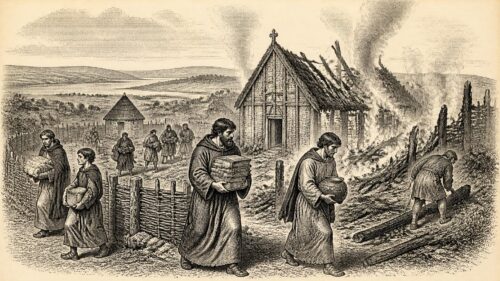
That generosity had a hard material basis. A ruler needed access to herds, food-renders and the labour of clients in order to feed followers, reward allies and maintain honour. Raiding could seize cattle and captives, but it also produced enduring obligations of revenge. The killing of Raghallach and the defeat of Guaire therefore belonged to the same broader political economy: control of people and resources was inseparable from claims to kingship. Beneath the named rulers were free and unfree dependants, cultivators, herders, craftsmen and religious personnel whose work sustained both secular households and churches.
Defeat, Memory and Limits
Neither development allows a claim that Connacht was conquered in 649. Guaire survived Carn Conaill and remained a figure of consequence in later tradition; the Uí Fiachrach Aidni did not disappear. Nor did Raghallach’s death end Uí Briúin ambitions. What the year records is sharper and more immediate: a Connacht king was killed, an Aidne ruler lost a major battle, and Diarmait of Brega demonstrated an ability to project force westward and defeat a coalition containing prominent southern leaders.
For contemporaries, the outcome would have been felt in bereaved households, disrupted clientships, demands for vengeance and renewed negotiation over land and allegiance. For later writers, Carn Conaill became a story about saintly favour, royal generosity and eventual peace. Holding those perspectives apart is essential. The firmly dated annalistic events of 649 CE are violent but concise; the wider tale built around them shows how Irish monasteries and learned writers transformed a battle into a lasting statement about power, piety and remembrance.
Primary Sources
- The Annals of Tigernach, Part 9
- The Annals of Ulster
- Chronicon Scotorum, Part 60
- Chronicon Scotorum
- Annals of the Four Masters
- Annals of the Four Masters (Irish text)
- The Battle of Carnn Chonaill
- The Battle of Carnn Chonaill (complete text)
- Irish Sagas: Cath Cairnn Chonaill Background
- Diarmait
- The History of Ireland, Section XIV
- Irish Hagiography and its Dating: A Study of the Ó Donohue Group of Irish Saints’ Lives
- Early Medieval Ireland: Archaeological Excavations, 1930–2009
- Early Medieval Dwellings and Settlements in Ireland, AD 400–1100, Volume 1
- Early Medieval Archaeology Project: Early Medieval Dwellings, Settlements and Landscapes
- Changing Human-Cattle Relationships in Ireland: A 6000-Year Isotopic Perspective
- Irish Society c. 700: I. Communities
- Religion and Society in Ireland
- Land Use and Economy AD 500–1100
- The Idea of the Three Orders of Society and Social Stratification in Early Medieval Ireland
- The Organization of Exchange in Early Christian Ireland
- Exploring the Irish Annals