Western Hardship
Limerick Archives — Monday, 1 January 1900
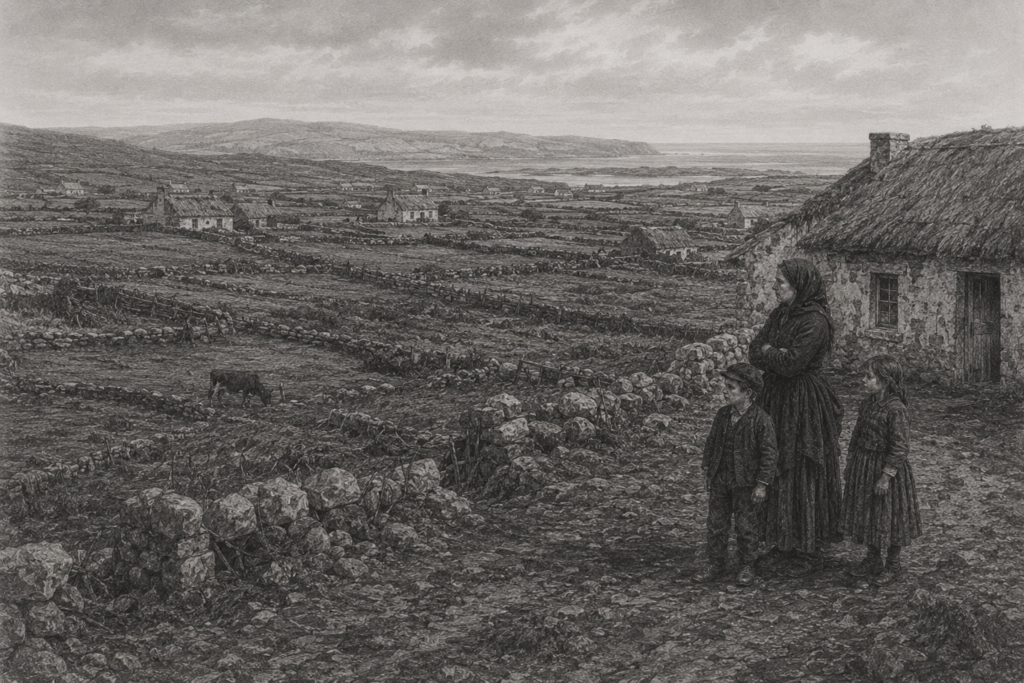
LIMERICK, Monday — Congestion, fragmented holdings and poor soil continue to govern the lives of thousands of families throughout western Ireland. In large districts of Galway, Mayo, Roscommon, Donegal, Kerry and western Cork, households depend upon small and scattered plots that cannot reliably support those working them. A family may cultivate several separate strips divided by neighbours’ land, bog or rocky ground, making improvement difficult and wasting valuable time. Similar hardship is familiar in poorer coastal and upland parts of Munster, where limited employment and uncertain harvests leave communities dependent upon fishing, seasonal labour, credit and remittances from relatives abroad.
The official meaning of congestion extends beyond crowded housing. It describes districts in which too many people depend upon land too poor or holdings too small to provide a reasonable livelihood. Potatoes, oats and a few animals may sustain a household during favourable seasons, but wet weather, animal disease or declining prices can quickly expose its insecurity. Subdivision between generations has reduced many farms to uneconomic proportions, while rundale arrangements and unfenced strips complicate drainage, grazing and cultivation. Families remain attached to their townlands, yet the structure of landholding repeatedly forces younger men and women towards migratory labour or permanent emigration.
The Congested Districts Board, established in 1891, has attempted to relieve these conditions through land purchase, improved farming, drainage, roads, piers, fishing assistance and the development of local industries. Its work has brought visible benefits to selected communities, but critics argue that its resources remain far below the scale of the problem. Parliamentary representatives have complained that entire districts receive little attention while families continue to occupy holdings from which no dependable living can be obtained. Experiments involving the enlargement or rearrangement of farms have strengthened demands for more extensive intervention, particularly where fertile grazing land lies near densely settled communities surviving upon poorer ground.
The consequences are carried within family life. Men travel to Britain or more prosperous Irish districts for seasonal work, leaving women to manage children, animals, crops and household debts. Shopkeepers frequently extend credit until wages, harvest money or remittances arrive. Children contribute through turf gathering, herding, fishing and domestic labour, while schooling may be interrupted whenever household survival demands additional hands. Poor roads and isolated settlements restrict access to markets, doctors and public services. A failed crop or damaged boat therefore becomes more than an individual misfortune, spreading pressure through neighbours, traders, landlords and relatives already living close to poverty.
Western congestion has consequently become central to the Irish land question. Tenant purchase alone cannot rescue families whose farms remain too small, divided or infertile to sustain them. Reformers increasingly demand the acquisition of large estates, the enlargement and consolidation of holdings, improved drainage and the movement of some families towards better land. Others fear that migration schemes may weaken ancient communities without creating secure livelihoods. For Limerick and Munster, the western crisis remains both a warning and a shared concern: political reform will mean little to rural families unless it changes the ground beneath their feet and gives future generations a realistic reason to remain.
- Congested Districts Board for Ireland, First Annual Report, covering operations from 5 August 1891 to 31 December 1892, Parliamentary Papers. The report defines the Board’s purpose and describes its early agricultural, fishing, industrial and public-works programmes.
- Congested Districts Board for Ireland, Ninth Annual Report, 1900, Parliamentary Papers. Consult the sections concerning agricultural improvement, land purchase, fisheries, local industries and conditions within designated congested districts. Exact volume, page and appendix should be confirmed before formal citation.
- House of Commons Debates, “Irish Congested Districts Board,” 14 March 1902, vol. 105. The debate records complaints concerning small uneconomic holdings, neglected districts, migratory labour and demands for wider land redistribution.
- House of Commons Debates, “Irish Land Question,” 23 January 1902, vol. 101. The debate describes severe congestion, threatened evictions and migratory labour on western estates.
- Census of Ireland, 1901, General Report and county tables concerning population, occupations, housing and agricultural holdings in western counties. Exact table, page and county return should be confirmed before formal citation.