Election Violence
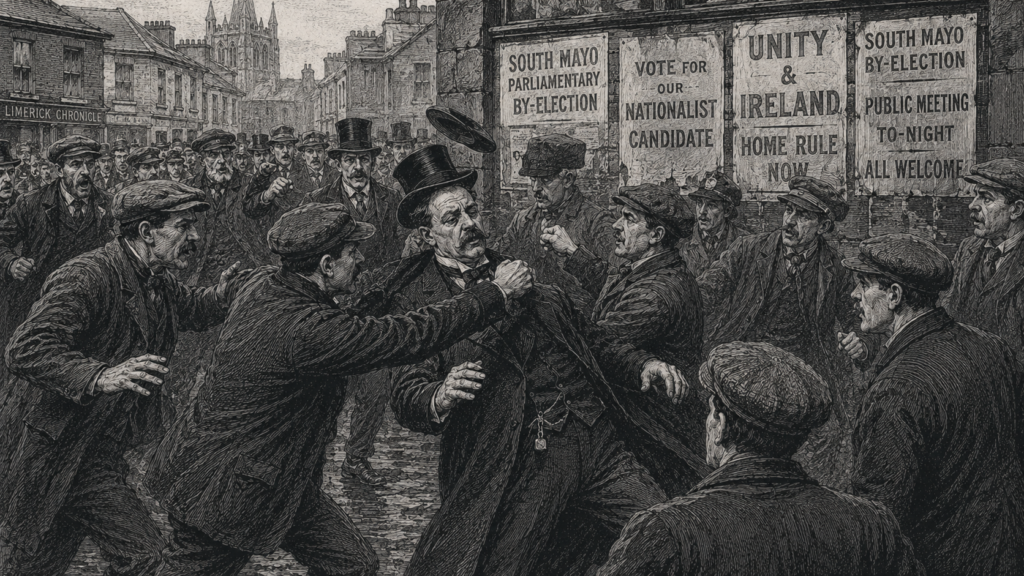
The South Mayo by-election of February 1900 drew Limerick directly into a bitter struggle over the direction of Irish nationalism. John Daly, the veteran Fenian then serving as Mayor of Limerick, travelled to County Mayo to support Major John MacBride, whose candidature was promoted while he fought beside the Boers in South Africa. Daly’s intervention carried symbolic importance: a former political prisoner and leading republican, he represented a separatist tradition sharply critical of parliamentary dependence upon Westminster. Reports that he was attacked during the campaign showed how readily political argument could pass into physical intimidation.
The vacancy had arisen when Michael Davitt resigned his parliamentary seat in protest against the South African War. The United Irish League selected John O’Donnell, its organiser in Mayo, while the Irish Transvaal Committee supported MacBride as an independent nationalist candidate. Neither man participated personally in the contest. MacBride remained in South Africa commanding the Irish Transvaal Brigade, and O’Donnell was confined in Castlebar Gaol following a coercion prosecution. Their absence transformed the election into a contest between rival organisations, newspapers and prominent campaigners who claimed to represent Ireland’s authentic national will.
MacBride’s supporters presented his candidature as a declaration against British imperial rule and an expression of solidarity with the Boer republics. O’Donnell’s advocates argued that the United Irish League offered a disciplined political organisation capable of restoring nationalist unity and advancing land reform. Michael Davitt and William O’Brien supported O’Donnell, while John Daly and the veteran Fenian John O’Leary campaigned for MacBride. The quarrel therefore crossed older divisions between parliamentarians, Fenians and emerging advanced nationalists. Agreement in opposing the war did not produce agreement over leadership, organisation or the usefulness of representation in the British Parliament.
The most disturbing episode associated with Daly’s intervention occurred at Ballinrobe, where a contemporary account reported that the Mayor of Limerick was attacked during a political meeting. The available evidence does not securely identify every assailant or establish the extent of any injury, but the report indicates an atmosphere in which rival crowds could subject visiting speakers to threats and physical pressure. Daly’s prominence made the incident especially serious. An assault upon a city’s mayor, while he supported a nationalist candidate in another county, demonstrated how factional loyalty could overwhelm the public dignity normally attached to civic office.
The result announced on 28 February was decisive. O’Donnell received 2,401 votes against MacBride’s 427, giving the United Irish League an overwhelming victory despite a turnout of only 31.2 per cent. The defeat exposed the limited electoral strength of the Irish Transvaal Committee and showed that admiration for MacBride’s service with the Boers did not necessarily translate into votes. For Limerick, Daly’s involvement and the reported attack linked local republican politics with a national contest over unity, constitutional action and resistance to empire. The campaign revealed a movement seeking reunion while remaining capable of profound internal hostility.
- The Times, “Election Intelligence,” no. 36077, London, Wednesday, 28 February 1900, p. 9.
- The Times, “Election Intelligence,” no. 36078, London, Thursday, 1 March 1900, p. 6.
- The United Irishman, Saturday, 3 March 1900, coverage and commentary concerning the South Mayo by-election result.
- The United Irishman, Saturday, 10 March 1900, post-election commentary concerning John O’Donnell and John MacBride.
- Brian M. Walker, ed., Parliamentary Election Results in Ireland, 1801–1922, Dublin: Royal Irish Academy, 1978, pp. 367, 394.
- John Drumm, “Divided Loyalties: The Effect the Boer War and its Aftermath had on how Irish Nationalists Interpreted the Irish Soldier Serving in the British Army,” British Journal for Military History, vol. 1, no. 1, October 2014, pp. 88–89.
- Ciarán Ó Gríofa, “John Daly, the Fenian Mayor of Limerick,” in David Lee, ed., Remembering Limerick: Historical Essays Celebrating the 800th Anniversary of Limerick’s First Charter Granted in 1197, Limerick: Limerick Civic Trust in association with FÁS, 1997, pp. 197–204.