Militia Mobilised
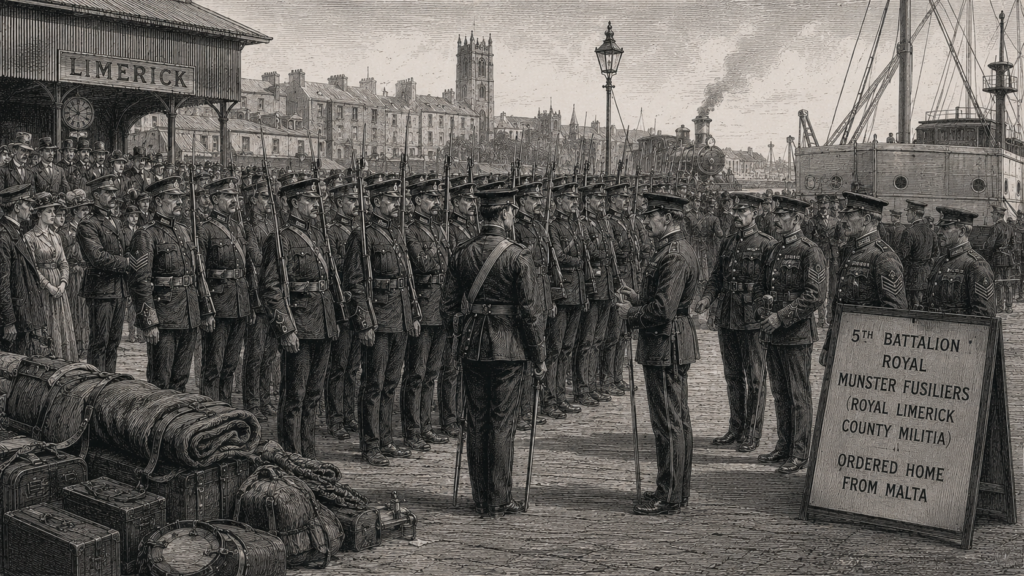
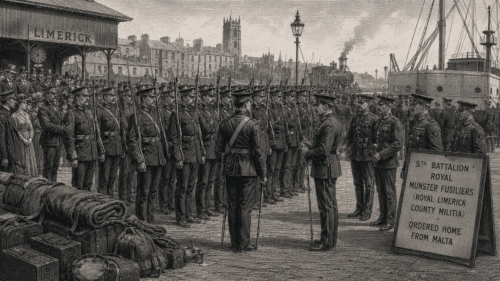
The South African War entered everyday life in Limerick during 1900 when the Royal Limerick County Militia was embodied for extended military service. Since the army reforms of 1881, the historic county force had formed the 5th Battalion of the Royal Munster Fusiliers and maintained its local headquarters at Strand Barracks. Its mobilisation connected families throughout Limerick city and county with the wider demands of an imperial conflict. Although the battalion did not campaign against the Boers as a complete unit, its men undertook duties that released regular soldiers for service elsewhere.
The Childers reforms had combined the 101st and 104th Regiments of Foot with three Munster militia units to create the Royal Munster Fusiliers. The South Cork Militia became the 3rd Battalion, the Kerry Militia the 4th, and the Royal Limerick County Militia the 5th. This arrangement preserved local recruiting identities while placing part-time soldiers within the organisation of a regular infantry regiment. The Limerick battalion therefore possessed both a county character and a defined place within the British Army, drawing its officers and men from communities where military service remained an important source of employment and family tradition.
Following mobilisation, the 5th Battalion left Strand Barracks in April 1900 under Lieutenant-Colonel John Massy-Westropp. Contemporary expectations were shaped by the emergency in South Africa, but the battalion’s own course led first to garrison service in England rather than direct deployment to the battlefield. This work was central to the mobilisation system. By guarding military installations and performing routine duties at home, militia battalions allowed regular formations to be concentrated for overseas operations. The contribution was less dramatic than combat, yet it formed an essential part of the army’s effort to sustain a prolonged war thousands of miles from Ireland.
The battalion subsequently reached Malta in February 1901 and assumed Mediterranean garrison duties. Its presence there again released regular troops for more urgent service while extending the separation of Limerick soldiers from their homes. Records of the return journey show the scale of the military community involved. On 29 September 1901, the battalion embarked for Queenstown aboard the transport Assaye with headquarters and eight companies, including 18 officers, 415 rank and file, soldiers’ wives and children. The party disembarked in Ireland on 8 October, bringing an extended period of overseas duty towards its conclusion.
The episode demonstrated how the South African War depended upon forces far beyond those fighting on the veld. The Royal Limerick County Militia helped maintain Britain’s military system through mobilisation, movement and garrison service in England and Malta. For Limerick, the consequences were measured through absence, interrupted employment and the uncertainty experienced by households awaiting the battalion’s next orders. The unit’s history also complicates simple accounts of Irish participation in the war: its men served within the British Army at a time when strong nationalist sympathy for the Boer republics made imperial military service a deeply contested subject at home.
- War Office, Monthly Army List, May 1900, distribution of militia battalions; entry for the 5th Battalion, Royal Munster Fusiliers, Royal Limerick County Militia.
- John S. Farmer, The Regimental Records of the British Army: A Historical Résumé Chronologically Arranged of Titles, Campaigns, Honours, Uniforms, Facings, Badges, Nicknames, etc., London: Grant Richards, 1901, entry for the Royal Munster Fusiliers.
- Limerick Museum, The Royal Munster Fusiliers, exhibition booklet, Limerick City and County Council, 2023.
- National Army Museum, “The Royal Munster Fusiliers,” regimental history and collection guide.
- Malta Royal Army Medical Corps, “The 1st/101st Royal Bengal Fusiliers,” section recording the 5th Battalion, Royal Munster Fusiliers, in Malta during 1901.
- Limerick Archives, “The Royal Limerick County Militia: Mobilisation and Deployment in the Context of the South African War,” 20 May 2023.