

Crag Cave Calcite Growth
Around 31,965 BCE, a retrospective and imprecise date, Ireland lay within the climatically unstable Upper Palaeolithic. It was not yet uniformly covered by the later maximum ice sheet: Fermanagh sediments and calcite growth at Crag Cave indicate local ice-free or intermittently unfrozen ground, although regional glaciation was advancing. Lower sea levels altered coastlines without guaranteeing land access. Open steppe-tundra supported fauna including reindeer, giant deer, mammoth and hyaena, though cave deposits are complex. No secure human settlement is known. A possibly cut-marked reindeer bone suggests brief human visitation, but not occupation. This glacial era shaped Ireland’s terrain and remains uncertain.
View Record
Before the Ice Maximum
Around 31,966 BCE, Ireland lay in the unstable later Marine Isotope Stage 3, before the fullest advance of the Last Glacial Maximum. Sea levels were lower, coastlines and possible routes changed, and expanding ice later destroyed much evidence. Southern caves, especially Castlepook, preserve remains of reindeer, mammoth, giant deer, bears and hyaenas, indicating cold, open mosaic habitats. A cut-marked reindeer femur, dated about 33,000 years ago, may record an early hunter visit, but lacks archaeological context or settlement evidence. No peoples, polities, beliefs or permanent communities can be identified. Knowledge relies on radiocarbon dating, faunal analysis, stratigraphy and ice-sheet reconstruction.
View Record
Castlepook Faunal Assemblage
At roughly 31,967 BCE, Ireland was a climatically unstable Late Pleistocene landscape approaching expanded glaciation, rather than uniformly ice-covered. Lower sea levels reshaped coasts and connections with Britain, though no specific land route or migration can be demonstrated. Castlepook Cave, County Cork, preserves Ireland’s richest pre-Last Glacial Maximum vertebrate assemblage, including reindeer, mammoth, giant deer, hyena, wolf, Arctic fox and lemmings. Its bones accumulated over long periods and reflect carnivore activity as well as natural processes. A marked reindeer femur may indicate early human butchery, but remains unconfirmed. Evidence supports intermittent fauna and possible human visits, not permanent occupation then.
View Record
Fermanagh Subglacial Organics
Around 31,968 BCE, Ireland lay in the climatically unstable Late Pleistocene, before the Last Glacial Maximum and without evidence permitting calendar-year reconstruction. Greenagho deposits indicate that parts of north-central Ireland remained ice-free until roughly 34,000 years ago, although ice, coastlines and sea levels were changing. Later glaciation created many familiar landforms. Castlepook Cave preserves evidence of diverse cold-climate fauna, including mammoth, reindeer, giant deer, bear and hyena, but accumulated remains cannot define a single moment. No secure human settlement is known. A possibly tool-marked reindeer bone suggests an uncertain brief visit. Ireland was a dynamic, ecologically connected, increasingly glaciated landscape.
View Record
Castlepook’s Glacial Fauna
31,969 BCE is a modern label rather than a recoverable Irish historical date, belonging to later Marine Isotope Stage 3 before the Last Glacial Maximum. Ireland experienced fluctuating cold conditions, regional ice growth and open habitats. Castlepook Cave, County Cork, preserves over 2,000 bones accumulated across millennia, including mammoth, reindeer, giant deer, bear and hyena, demonstrating complex Ice Age ecosystems. Its disturbed reindeer femur may bear stone-tool marks and suggest an early human visit, but remains unconfirmed. No securely dated settlements, occupations or cultural practices establish people in Ireland then. Later glaciation and dating uncertainties limit conclusions about human activity.
View Record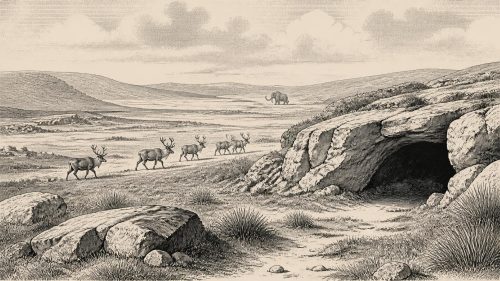
Castlepook Cave Deposits
About 31,970 BCE, Ireland lay in the unstable later Marine Isotope Stage 3, with advancing but uneven ice cover, lower sea levels and changing routes for animals. Castlepook Cave, County Cork, preserves over 2,000 vertebrate remains, including mammoth, reindeer, giant deer, bear and hyaena, indicating open, varied cold-climate habitats. Cave processes, water disturbance and old excavations complicate interpretation, however. No dated human settlement, tools or burial belongs to this period. A possibly butchered reindeer bone suggests a tentative Upper Palaeolithic visit, but requires further testing. Later glaciation destroyed much evidence; future dating, DNA and offshore research may refine Ireland’s history.
View Record
Ice-Age Ireland
Around 33,900 years ago, Ireland lay within a cold, unstable Late Pleistocene landscape, with regionally variable ice cover preceding the Last Glacial Maximum. Lower sea levels altered coastlines and potential animal routes. Open tundra-steppe habitats supported mammoth, giant deer, reindeer, bears and predators, evidenced especially at Castlepook Cave, County Cork. A cut-marked reindeer femur there provides limited evidence that Upper Palaeolithic hunters may briefly have visited or crossed Ireland. It does not demonstrate settlement, population continuity, polities or cultural practices. Subsequent ice expansion destroyed or obscured much evidence, leaving caves as selective archives. Post-glacial Mesolithic settlement occurred many millennia later.
View Record
Marine Isotope Stage Three
Around 31,972 BCE, approximately 33,900 cal BP, Ireland lay in the later Marine Isotope Stage 3, as climate deteriorated before the Last Glacial Maximum. Lower sea levels altered coasts and potential connections with Britain and Europe, while open tundra-steppe supported diverse Ice Age fauna. Castlepook Cave preserves remains including mammoth, giant deer, reindeer, hyaena and Arctic fox, though redeposition and revised dating prevent precise reconstruction. No securely dated human site exists from this period. Possible cut marks on a Castlepook reindeer bone may indicate an early visit, but remain unconfirmed. Later glaciation destroyed or obscured much evidence, leaving caves archives.
View Record
Castlepook’s Marked Reindeer Femur
Around 31,973 BCE, Ireland was part of a climatically unstable, open Ice Age landscape, with changing coastlines, ice conditions and access routes. Cave faunas show that reindeer, mammoths, giant deer, bears, wolves, hyaenas and smaller cold-adapted animals occupied the island intermittently. At Castlepook Cave, County Cork, a reindeer femur bears a deep mark possibly made by a stone tool during butchery, potentially indicating an early human visit. However, disturbed deposits, uncertain dating and absence of associated tools, hearths or settlements prevent confirmation of occupation. The find prompts further research into Ireland’s earliest, fragile evidence of human presence in deep prehistory.
View Record
Castlepook Reindeer Incision
Around 31,974 BCE, Ireland was entering an unstable, increasingly severe phase of the last glacial cycle, though conditions varied regionally and cannot be reconstructed for a single year. Ice had not yet reached its maximum extent, but landscapes, coastlines and routes of access were changing as sea levels fell. Cave finds show cold, open environments supporting reindeer, bears, mammoth and other fauna. At Castlepook Cave, County Cork, a reindeer femur possibly cut with a stone tool, dated about 33,000 years ago, may represent Ireland’s earliest human activity. It proves neither settlement nor hunting. Later glaciation obscured evidence; occupation came post-glacially.
View Record