
Southern Irish Raised Beaches
Around 31,952 BCE, Ireland lay in the unstable Late Pleistocene climate of Marine Isotope Stage 3, as the British–Irish Ice Sheet expanded. Southern raised-beach and marine deposits reveal shifting relative sea levels, while Castlepook Cave in County Cork preserves remains of mammoth, reindeer, giant deer, bears, wolves, hyaenas and fauna, indicating varied open, cold habitats. Cave deposits are disturbed and span long periods, limiting precision. A reportedly cut-marked reindeer bone, dated near 33,000 years ago, suggests possible Upper Palaeolithic visitation, but lacks secure context. Settlement remains unproven. This date represents ecological richness and uncertain human possibility before later glacial maximum.
View Record
Carden’s Reindeer Femur
Around 31,953 BCE, Ireland lay within the climatically unstable later Ice Age, approaching expanded glaciation. Evidence from Castlepook, or Mammoth, Cave in County Cork confirms a diverse Marine Isotope Stage 3 fauna, including reindeer, mammoth, giant deer, bears, wolves and Arctic species. A reindeer femur, dated about 33,000 years ago, has a possible stone-tool butchery mark, perhaps indicating Ireland's earliest human activity. However, disturbed cave deposits and lack of associated tools or habitation prevent conclusions about settlement. Ice later damaged much archaeological evidence. No local polities, warfare, art or culture can be established; human presence remains possible, fleeting and uncertain.
View Record
Ruth Carden’s Reassessment
31,954 BCE is a notional date within MIS 3, not a recorded Irish year. Ireland then comprised volatile Late Pleistocene environments supporting cold-adapted fauna, including reindeer, mammoth, giant deer and carnivores, before the Last Glacial Maximum. Castlepook Cave, County Cork, provides a possible earliest human trace: a reindeer femur with a mark plausibly made by a stone tool during butchery. Poorly recorded early excavations, disturbed cave deposits and uncertain dating prevent stronger conclusions about settlement, hunting or access routes. No evidence supports communities, culture or politics. Later glaciation obscured evidence; secure sustained settlement begins only in the Mesolithic millennia later.
View Record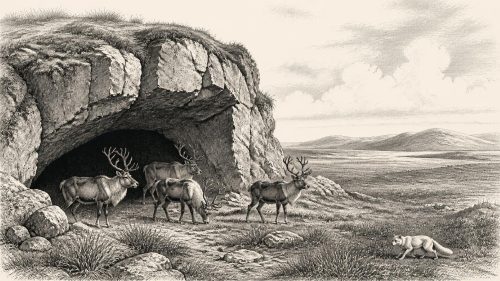
British-Irish Ice Sheet Expansion
Around 31,955 BCE, Ireland was an unstable Late Pleistocene landscape approaching major glaciation, not a documented historical society. Castlepook Cave, County Cork, preserves important MIS 3 animal remains, including mammoth, reindeer, giant deer, predators and cold-adapted species. A reportedly stone-tool-marked reindeer femur, dated broadly around 33,000 years ago, suggests a possible fleeting human presence, but cannot establish settlement or a specific event. Disturbed deposits, uncertain dating and carnivore activity require caution. As the British–Irish Ice Sheet expanded, changing climates, sea levels and routes shaped animal movement. Future excavation, dating, taphonomic study and ancient-DNA research may clarify Ireland’s earliest human evidence.
View Record
Castlepook’s Reindeer Bone
Around 31,956 BCE, Ireland lay within the variable cold conditions of Marine Isotope Stage 3, before the Last Glacial Maximum. Its landscapes included tundra-like open vegetation, periglacial environments and regionally uncertain ice cover, while lower seas did not guarantee human access. Castlepook Cave in County Cork preserves Ireland’s pre-maximum vertebrate assemblage, including mammoth, reindeer, giant deer, hyaena and predators. A possibly cut-marked reindeer bone, dated near 33,000 years ago, may indicate brief human activity, but remains unconfirmed and cannot establish settlement. No secure Palaeolithic habitation, tools, burials or art date to this period. Evidence instead depicts changing environments and fauna.
View Record
Carden’s Reindeer Cut Mark
Ireland around 31,957 BCE lay within Marine Isotope Stage 3, a cold, changing Late Pleistocene period lacking written history or proven settlement. Castlepook Cave in County Cork yielded reindeer and other cold-stage fauna. A marked reindeer femur, interpreted as stone-tool butchery, may indicate brief human presence, but lacks securely associated tools or occupation evidence. Radiocarbon dates require calibration and cannot establish an exact year. Cave deposits were disturbed, while later glaciers erased or rearranged much evidence. Growing ice eventually covered Ireland at the Last Glacial Maximum. The find suggests possible early, discontinuous contact, but future excavation and dating remain necessary.
View Record
Cork Animal Processing
31,958 BCE is a modern notional date within the unstable Late Pleistocene, not a precisely identifiable Irish year. County Cork’s Castlepook Cave offers potentially significant evidence: a reindeer femur, dated around 31,000 BCE, bears a deep mark possibly made by a stone tool during butchery. Poor antiquarian excavation records and alternative causes of bone damage require caution. Cave fauna, including reindeer, mammoth, giant deer, bear and hyaena, demonstrates a changing, animal-rich landscape before maximum glaciation. Human visits, routes and occupation remain unproven. Later ice and rising seas obscured evidence. Renewed investigation may clarify whether Castlepook records Ireland’s earliest human presence.
View Record
Mammoth Cave Fauna
Around 31,959 BCE, Ireland was an unstable Late Pleistocene landscape, not a recorded society. Before the Last Glacial Maximum, exposed areas may have supported open steppe and tundra vegetation and fauna. Castlepook, or Mammoth Cave, County Cork, contains bones of mammoth, reindeer, giant deer, bears, wolves, foxes and hyaenas, although its disturbed deposits represent long periods rather than a single moment. A cut-marked reindeer femur may indicate human butchery about 33,000 years ago, but remains contested and lacks context. It cannot prove settlement, culture or routes of arrival. Glaciation, sea-level change and poor preservation leave human presence uncertain, pending research.
View Record
Exposed Celtic Sea Shelf
Around 31,960 BCE, Ireland was a cold, glaciated Late Pleistocene landscape, though not uniformly ice-covered. Lower sea levels exposed surrounding shelf lands, but changing channels, ice and difficult terrain still impeded access. Castlepook Cave in County Cork preserves important, imperfectly excavated animal remains, including mammoth, reindeer, giant deer, bear and hyaena, indicating open habitats and diverse fauna accumulated over long periods. A cut-marked reindeer bone may record butchery by Upper Palaeolithic visitors, potentially Ireland’s earliest human trace. However, no tools, hearths or settlements confirm occupation. Later glaciation and disturbed cave deposits limit interpretation; Ireland remains an intermittently habitable Ice-Age frontier.
View Record
Castlepook’s Marked Bone
31,961 BCE is an imprecise label for a Late Pleistocene MIS 3 interval, when Ireland experienced cold conditions and advancing ice preceding the Last Glacial Maximum. Geological and cave-faunal evidence, especially from Castlepook Cave, records mammals including cold-adapted and open-country species, though deposits span long periods and were imperfectly excavated. A reportedly cut-marked reindeer bone may indicate human activity around 33,000 years ago, but lacks secure context and remains under investigation. No contemporary settlement, tools, hearths or cultural assemblage is known. Later bear-bone evidence confirms human presence only about 10,800–10,500 BCE. Ireland’s period remains an environmentally documented, uncertain human prehistory.
View Record