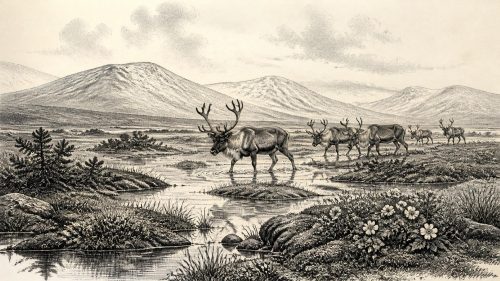
Derryvree’s Trifoliate Waterline
31,471 BCE is a modern retrospective date, not an identifiable Irish event. Derryvree, County Fermanagh, preserves freshwater sediments between glacial tills, dated broadly to 36,900–31,700 years before present. Its plants, insects and sediments indicate an ice-free but cold periglacial wetland of pools, sedges, mosses, herbs and open ground during an unstable Ice Age. Lower sea levels reshaped Ireland and surrounding routes, while later ice expansion transformed the landscape. Castlepook Cave, County Cork, records diverse cold-adapted fauna, including mammoth and reindeer. A possibly stone-cut reindeer bone suggests brief Upper Palaeolithic human visitation, but neither settlement nor social organisation is securely evidenced.
View Record
Sedges Between the Tills
31,472 BCE is a modern label within a broad Late Pleistocene dating range, not a recoverable Irish historical year. Derryvree, County Fermanagh, preserves freshwater sediments between glacial tills, indicating locally ice-free, treeless tundra with sedges, mosses and wet hollows during MIS 3. Castlepook Cave, County Cork, contains diverse cold-stage fauna, including reindeer, mammoth, giant deer, predators and lemmings, though its bones accumulated over long periods. A marked reindeer femur may indicate human butchery around 31,000 BC, but cannot prove settlement. Ireland was climatically unstable, intermittently accessible and increasingly affected by advancing ice, known only through fragmentary environmental and archaeological evidence.
View Record
BIRM-166 and Mammoth Cave
About 31,473 BCE, Ireland lay within the climatically unstable later Marine Isotope Stage 3, not a precisely datable historical year. Derryvree, County Fermanagh, preserves freshwater silts between glacial tills, dated broadly to 31,700–36,900 calibrated years BP, demonstrating ice-free, treeless wetland conditions. Castlepook Cave, County Cork, produced pre-Last Glacial Maximum bones of mammoth, reindeer, giant deer, predators and cold-adapted mammals, although its mixed deposits require caution. A possibly cut-marked reindeer femur suggests human activity, not settlement. Later ice advances destroyed earlier evidence. No political, cultural or economic history can be reconstructed; the surviving record chiefly documents changing environments, fauna and uncertainty.
View Record
Derryvree’s Tundra Clock
31,474 BCE is a modern label rather than a recoverable Irish year, corresponding roughly to 33,400 calibrated years before present in climatically unstable MIS 3. Derryvree, County Fermanagh, preserves sediments between glacial tills, dated broadly 36,900–31,700 cal BP, revealing treeless tundra wetlands with grasses, sedges, juniper, insects and seasonal freshwater. Castlepook Cave, County Cork, yielded bones of mammoth, giant deer, reindeer, bear and hyaena, though its mixed deposits cannot establish contemporaneity. No secure evidence proves human settlement, culture or economy. A possibly tool-marked reindeer bone may indicate brief human presence. Later glaciation obscured much evidence from this shifting ice-age frontier.
View Record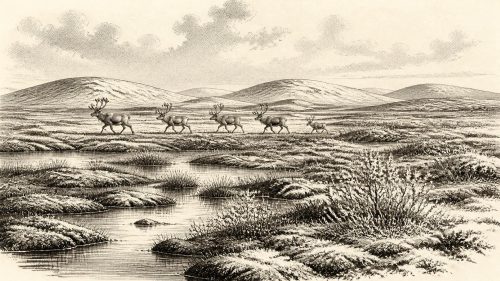
Derryvree’s Intertill Reedland
31,475 BCE is a modern label for an unrecorded MIS 3 interval, when Ireland experienced fluctuating cold conditions before the Last Glacial Maximum. Derryvree, County Fermanagh, preserves freshwater sediments between tills, indicating treeless, waterlogged tundra supporting mosses, sedges, aquatic plants and insects. Castlepook Cave, County Cork, contains MIS 3 fauna including reindeer, mammoth, giant deer and predators, demonstrating connections with north-west Europe despite uncertain routes. A marked reindeer bone may indicate human butchery, but its context is disputed and proves neither settlement nor society. Later glaciation transformed landscapes and destroyed evidence, leaving a fragmentary record of wetlands, animals and visitors.
View Record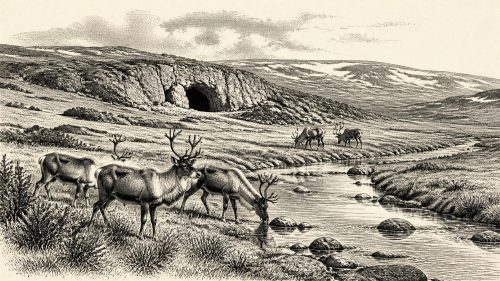
The Awbeg Femur Question
31,476 BCE is an imprecise modern label for a fluctuating Late Pleistocene interval in Ireland, within Marine Isotope Stage 3. Environmental evidence, including Derryvree freshwater deposits, cave calcite and glacial landforms, indicates alternating cold and milder conditions, varied habitats, advancing ice and uncertain routes from Britain. Castlepook Cave in County Cork produced cold-stage fauna and a reindeer femur bearing a possible stone-tool cut mark, dated around 31,000 BC. If anthropogenic, it suggests brief Upper Palaeolithic human activity. However, disturbed cave contexts, absent tools, hearths and human remains preclude claims for settlement or population. The femur remains important but contested evidence.
View Record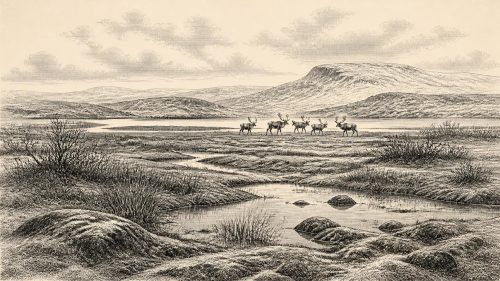
Maguiresbridge’s Mid-Glacial Marsh
31,477 BCE is a modern approximation within a broad Late Pleistocene radiocarbon horizon, not a recoverable historical year. At Derryvree near Maguiresbridge, deposits between glacial tills record an ice-free interval, dated broadly to 36,900–31,700 cal BP, with freshwater wetlands, tundra-like vegetation and insect life. Ireland’s conditions varied regionally amid volatile Marine Isotope Stage 3 climates and advancing glaciers. Castlepook Cave preserves remains of mammoth, reindeer, giant deer, predators and other cold-stage fauna, although its early excavations complicate interpretation. A marked reindeer bone may indicate human butchery, but cannot prove settlement or continuity. Evidence reveals changing Ice Age landscape, not society.
View Record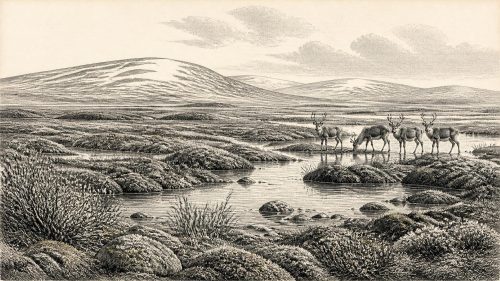
Maguirebridge’s Ice-Age Wetland
At roughly 33,400 years before present, Ireland lay within the climatically unstable later Last Glacial Period. Evidence is fragmentary, but Derryvree, County Fermanagh, preserves freshwater wetland sediments, indicating open tundra-like ground, mosses, sedges, shrubs, pools and insects between glacial advances. Southern caves document presence of reindeer, mammoth, horse, giant deer, carnivores and other cold-adapted fauna. Ice cover and access varied before the Last Glacial Maximum. A marked reindeer femur from Castlepook Cave may indicate Upper Palaeolithic butchery, although human settlement remains unproven. Lower seas altered routes, without demonstrating a land bridge. Climate, ice, fauna and visits shaped Ireland’s Ice-Age environment.
View Record
A Femur Beneath Castlepook
Around 31,479 BCE, Ireland lay in the unstable, cold Late Pleistocene, before maximum glaciation. Much terrain was probably ice-free, supporting tundra, steppe-tundra, wetlands and sparse shrubs, while later ice destroyed much evidence. Deposits at Derryvree and Maguiresbridge show wetland habitats with cold-adapted plants. Castlepook Cave in County Cork yielded fauna including reindeer, mammoth, giant deer, hyaena and Arctic fox. An incised reindeer femur, dated broadly to about 31,000 BC, may indicate human butchery, but lacks a secure archaeological context. It cannot prove settlement. Ireland’s evidence instead suggests a changeable landscape, rich Ice Age fauna, and only possible brief human visits.
View Record
Maguirebridge’s Buried Bogbean
Around 31,480 BCE, Ireland’s history is reconstructed from environmental evidence rather than records. At Derryvree near Maguiresbridge, Fermanagh, freshwater sediments trapped between glacial tills preserve pollen, mosses, insects and bogbean seeds, indicating treeless, tundra-like wetland during part of MIS 3. Radiocarbon dating places this landscape broadly between 36,900 and 31,700 calibrated years BP, not at a precise year. Southern caves reveal a varied cold-climate fauna, including mammoths, reindeer, lemmings, predators and giant deer. A cut-marked reindeer bone from Castlepook may indicate human butchery, but no securely dated settlement exists. Later ice advances destroyed evidence, leaving a regionally varied, uncertain picture.
View Record