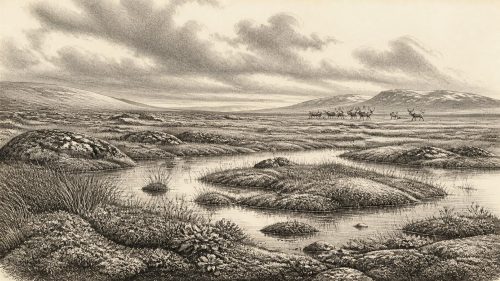
Castlepook’s Reindeer Debate
Around 31,481 BCE, Ireland experienced a variable MIS 3 glacial climate rather than uniform ice cover. Derryvree sediments in Fermanagh record cold, treeless wetlands during an ice-free interval, while Crag Cave calcite indicates episodic milder conditions in Kerry. Expanding ice sheets created a regional mosaic of glaciers, open ground and freshwater habitats. Castlepook Cave’s fauna, including reindeer, mammoth, hyena and arctic fox, demonstrates cold-stage animal presence, though deposits span time and were disturbed. A marked reindeer femur may indicate butchery by Upper Palaeolithic people, but cannot prove settlement. Evidence supports temporary environmental and human access, while social history remains unknown.
View Record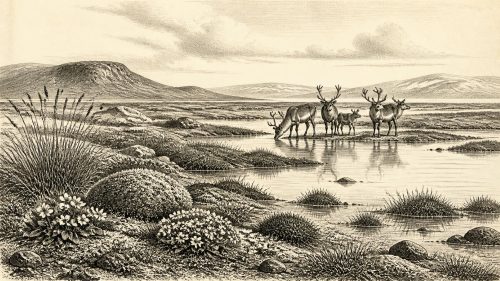
Derryvree’s Fringed Sandwort
Around 31,482 BCE, Ireland has no recoverable written or event history, but environmental evidence indicates varied Late Pleistocene conditions. At Derryvree, County Fermanagh, freshwater sediments between tills, dated broadly to 36,900–31,700 cal BP, preserve tundra plants, mosses, insects and wetland habitats during an ice-free interval. Climate fluctuated sharply as the Irish Ice Sheet expanded towards its later maximum. Castlepook Cave, County Cork, contains time-averaged remains of mammoth, reindeer, giant deer, predators and fauna. A cut-marked reindeer bone may indicate human butchery, but disturbed deposits and absent artefacts leave this unconfirmed. The evidence depicts dynamic, biologically active landscapes, not settled society.
View Record
Derryvree’s Interstadial Waters
Around 31,483 BCE, Ireland lay within the climatically unstable Late Pleistocene, but evidence cannot define a single year or permanent human population. At Derryvree, County Fermanagh, freshwater sediments between glacial tills record an ice-free interval, broadly dated to 34,950–29,750 BCE, with cold, treeless wetlands, mosses, sedges and diverse local habitats. Cave formations and faunas indicate fluctuating conditions and episodic animal movements, including reindeer, mammoth, giant deer, bears and hyaenas. A marked reindeer bone from Castlepook Cave may indicate Upper Palaeolithic human processing, but remains unconfirmed. Ireland’s record documents shifting ice, environments and ecological opportunities, not settlements, politics or sustained occupation.
View Record
Derryvree’s Radiocarbon Silt
Around 31,484 BCE, Ireland lay within the unstable cold conditions of Marine Isotope Stage 3, not a recoverable historical year. Derryvree, County Fermanagh, preserves freshwater silts between glacial tills, indicating open tundra wetlands supporting sedges, arctic-alpine plants, insects and grazing animals during an ice-free interval. Castlepook Cave, County Cork, contains varied fauna, including mammoth, reindeer and predators, although poorly recorded deposits complicate interpretation. A cut-marked reindeer femur may indicate human butchery, but cannot prove settlement. Later ice advances reshaped landscapes and destroyed evidence, leaving Ireland’s possible Upper Palaeolithic presence uncertain and intermittent. No evidence supports communities, farming, or continuous occupation.
View Record
Castlepook’s Palaeolithic Claim
Around 31,485 BCE, Ireland lay within the climatically unstable Middle Midlandian/MIS 3, not a historically datable year. Evidence from Derryvree indicates wet, open tundra environments before later ice advances, while Crag Cave speleothems show intermittent milder, above-freezing conditions. Castlepook Cave preserves a long, mixed faunal record, including mammoth, reindeer, giant deer, bear and hyena, demonstrating periodically accessible, productive open landscapes before the Last Glacial Maximum. A reindeer femur, about 33,000 years old, bears a possible stone-tool cut mark and may signal brief Upper Palaeolithic human presence. However, disturbed deposits and absent associated artefacts preclude claims for permanent settlement or society.
View Record
BIRM-166’s Trifoliate Basin
Around 31,486 BCE, Ireland cannot be described through conventional history, as no calendar, writing, polity or dated events existed. Derryvree, County Fermanagh, preserves freshwater sediments between glacial tills, broadly dated to the later 30,000s–early 30,000s calibrated BP. Fossil plants and insects reveal open, wet tundra with mosses, sedges, dwarf willow, mountain avens and bogbean during an ice-free interval. Climatic instability and growing glaciers preceded the Last Glacial Maximum. Cave remains indicate diverse cold-adapted fauna, but accumulated over long periods. A cut-marked Castlepook reindeer bone may suggest transient human presence, yet cannot establish settlement. Evidence supports cautious environmental reconstruction, not history.
View Record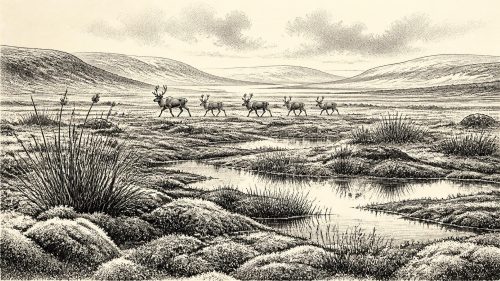
Fermanagh’s Sealed Freshwater
31,487 BCE is a modern label within unstable MIS 3, not a datable Irish event. At Derryvree, County Fermanagh, freshwater silts sealed between tills record a non-glacial interval of cold, treeless tundra wetland, dated broadly to 36,900–31,700 calibrated years before present. Castlepook Cave, County Cork, preserves a time-depth assemblage of Ice Age fauna, including reindeer, mammoth, hyaena and predators, demonstrating favourable open habitats during parts of MIS 3. A marked reindeer femur may indicate human butchery about 33,000 years ago, but insecure contexts prevent firm conclusions. Later glaciation erased evidence; no settlements, tools, burials, trade or political life are established.
View Record
Castlepook’s Distant Reindeer
The label 31,488 BCE denotes a broad late-MIS-3 interval rather than a recoverable Irish event, as deep radiocarbon dates carry substantial uncertainty. Ireland’s political and human history is unknown; surviving evidence is environmental. Patchy deposits indicate cold conditions, open tundra wetlands and varied ice cover before maximum glaciation. Cave remains, especially from Castlepook, show mammoth, reindeer and cold-adapted fauna, although old excavations and dating methods require reassessment. A possibly cut-marked reindeer bone raises the prospect of brief Upper Palaeolithic human activity, but proves neither its date nor permanent occupation. These fragments reveal ecological opportunity in landscapes later erased by ice.
View Record
Derryvree’s Eight-Petalled Dryas
Around 31,489 BCE, Ireland’s history is recoverable only through broad environmental evidence, not annual events or human communities. Derryvree, County Fermanagh, preserves freshwater silts between glacial tills, dated broadly to MIS 3. Its Dryas, mosses, bogbean, herb pollen and insects indicate cold, wet, treeless tundra-like terrain. Ireland experienced unstable climates, changing coasts and growing ice sheets, though not universal glaciation. Castlepook Cave fauna demonstrates mammals including mammoth, reindeer, giant deer, bear and hyaena, but accumulated remains cannot date coexistence precisely. A marked reindeer bone may indicate human processing, yet sustained occupation remains unproven. These archives document transformation before extensive glaciation.
View Record
Derryvree’s Permafrost Fen
Approximately 31,490 BCE, Ireland lay within the climatically unstable Late Pleistocene, not a knowable single year. At Derryvree, County Fermanagh, organic silts between glacial tills preserve a cold, periglacial freshwater fen, with open tundra-like vegetation, shallow water and seasonal freezing. Castlepook Cave, County Cork, yielded remains of reindeer, mammoth, giant deer and predators, demonstrating wider Late Pleistocene animal dispersal, though not one simultaneous community. A cut-marked reindeer femur may indicate Upper Palaeolithic human processing, but remains contested and proves neither settlement nor continuous occupation. Later ice expansion reshaped Ireland and destroyed much earlier evidence, leaving a fragmentary environmental archive today.
View Record