
BIRM-166’s Bogbean Horizon
31,449 BCE is a modern label within volatile Late Pleistocene MIS 3, not a datable Irish year. Derryvree, County Fermanagh, preserves freshwater silts between glacial tills, radiocarbon-calibrated broadly to 34,950–29,750 BCE. Its bogbean, dwarf willow, clubmoss, pollen and insects demonstrate locally ice-free, treeless tundra-like wetlands before later ice advance. Castlepook Cave’s fauna, including mammoth, reindeer, giant deer, predators and small mammals, confirms links with wider Pleistocene Europe. A possibly cut-marked reindeer bone may indicate early human butchery, but remains disputed and cannot prove settlement. No Irish evidence establishes society, institutions or regular exchange. They reveal a living Ice Age landscape.
View Record
Hyenahall’s Cold Fauna
Around 31,450 BCE, Ireland lay within a fluctuating Late Pleistocene environment rather than a datable historical moment. Derryvree sediments in Fermanagh record an ice-free, treeless periglacial wetland between glacial advances, demonstrating locally habitable conditions before later extensive ice cover. Castlepook Cave in Cork preserves a time-mixed assemblage of mammoth, reindeer, giant deer, bears, hyaenas and other cold-adapted animals, reflecting links with north-west European fauna. A possibly cut-marked reindeer femur may indicate Upper Palaeolithic human activity, but remains inconclusive without associated tools or habitation evidence. Environmental change, animal movement and advancing ice chiefly shaped Ireland; routes and human presence remain uncertain.
View Record
Maguirebridge’s Brief Thaw
31,451 BCE is a modern label for a broad Late Pleistocene interval, not a recoverable Irish historical year. Derryvree, County Fermanagh, preserves freshwater sediments between glacial tills, indicating a temporary ice-free, periglacial landscape of tundra wetlands, sparse vegetation and invertebrates before renewed glaciation. Castlepook Cave fauna demonstrate that reindeer, giant deer, mammoth, predators and other open-country animals occurred in MIS 3, though deposits span time. A cut-marked reindeer femur may indicate brief Upper Palaeolithic human activity, but cannot prove settlement. Shifting ice, low sea levels and uncertain routes linked Ireland variably to north-west Europe, while later ice destroyed much evidence.
View Record
Awbeg’s Limestone Winter
31,452 BCE is a modern label for a fluctuating Late Pleistocene environment, not a documented Irish year. Lower sea levels altered connections, but shifting ice, waterways and terrain restricted movement. Sediments at Fermanagh and marine evidence in the west show that some regions were ice-free or open before the Last Glacial Maximum. Treeless tundra-steppe, wetlands and severe seasonal cold supported cold-adapted fauna. Castlepook Cave in Cork preserves mammal remains, including reindeer. A possibly cut-marked reindeer femur suggests brief Upper Palaeolithic human contact, but cannot establish settlement. Ireland was a changing northern landscape, later glaciation having erased or buried much evidence.
View Record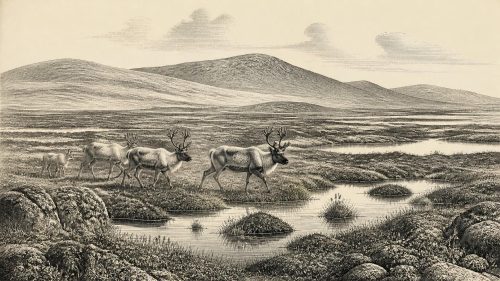
Greenagho’s Mossy Interstadial
31,453 BCE is a modern reference rather than a recorded Irish year. During unstable Marine Isotope Stage 3, Ireland experienced variable, local conditions rather than uniform ice cover. Freshwater deposits at Derryvree and Greenagho indicate ice-free, treeless tundra wetlands during intervals, while Crag Cave confirms episodic milder conditions supporting flowing water. Castlepook Cave preserves remains of mammoth, giant deer, reindeer, bears and hyenas, though mixed deposits limit precise reconstruction. A cut-marked reindeer bone may indicate brief Upper Palaeolithic human activity, not settlement. No contemporary houses, tools, burials, communities, politics or culture are securely known. Ireland was a frontier for fauna.
View Record
Crag Cave’s Interstadial Dripstone
31,454 BCE is a modern label for later Marine Isotope Stage 3, not a dateable Irish event. Buried sediments at Derryvree, Fermanagh, indicate an ice-free interval between glacial advances, with treeless tundra, wetlands and cold-adapted life. Crag Cave, Kerry, preserves dripstone formed during episodic milder conditions, confirming climatic instability. Castlepook Cave, Cork, contains reindeer, mammoth, hyaena and other fauna accumulated over long periods, demonstrating links with north-west European ecosystems. A cut-marked reindeer bone may indicate Upper Palaeolithic human activity, but cannot prove settlement. Evidence reveals a changing Ice-Age landscape, not societies, monuments or historical communities across a fluctuating glacial margin.
View Record
The Mammoth and the Cutmark
31,455 BCE is a modern label rather than a recoverable Irish date. Environmental evidence from Derryvree in Fermanagh indicates cold, treeless tundra wetlands during Marine Isotope Stage 3, when parts of Ireland remained ice-free before major later glaciation. Castlepook Cave, County Cork, preserves a disturbed but important pre-Last Glacial Maximum fauna, including mammoth, reindeer, lemmings, hyaena and Arctic fox. Ancient DNA suggests links with Eurasian populations, though routes remain uncertain. A cut-marked reindeer femur may indicate brief human carcass processing, but cannot prove settlement. No securely associated tools, hearths, dwellings or human remains establish sustained occupation, political life, or culture.
View Record
The Drumlin’s Freshwater Core
31,456 BCE is not a precise Irish historical date but falls within a broad MIS 3 interval. At Derryvree, County Fermanagh, organic sediments between glacial tills record an ice-free phase, dated roughly 36,900–31,700 calibrated years BP, with cold, treeless freshwater wetlands. Castlepook Cave, County Cork, preserves diverse open-country fauna, including mammoth, reindeer, giant deer, hyaena and Arctic fox, accumulated across multiple periods. A marked reindeer femur may indicate human butchery around 31,000 BC, but cannot prove settlement or continuity. No evidence supports prehistoric polities or culture. Later ice expansion destroyed much evidence, leaving ecological archive and possibilities of human presence.
View Record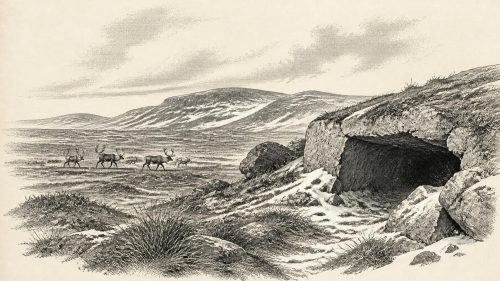
Castlepook’s Iceward Threshold
About 31,457 BCE, Ireland lay within the unstable later Last Glacial Period, before the British–Irish Ice Sheet reached its fullest extent. Cold conditions, changing ice margins, lowered seas and altered coastlines shaped a variable landscape rather than a uniformly frozen island. Cave faunas, notably at Castlepook, include reindeer, mammoth, giant deer and predators, indicating intermittent tundra-steppe ecosystems. Wetland deposits show local environmental diversity between ice advances. A marked Castlepook reindeer bone may record stone-tool butchery and exceptionally early human visitation, but lacks secure archaeological context. No settlement, society or continuous occupation can be inferred. Ireland’s history remains geological and ecological.
View Record
Doneraile’s Mammoth-Steppe
31,458 BCE is a chronological label, not evidence for a dateable Irish event. During MIS 3, Ireland experienced unstable cold conditions, fluctuating ice margins, sea levels and habitats. Deposits at Fermanagh preserve non-glacial wetlands, while Castlepook Cave near Doneraile yielded mammoth, reindeer, horse, giant deer, carnivores and fauna, indicating steppe-tundra and wetlands during favourable intervals. Changing geography permitted animal dispersal from north-west Europe, though no permanent land bridge can be assumed. No secure human settlement exists. A possibly modified reindeer bone may indicate brief Upper Palaeolithic activity, but disturbed deposits and uncertain dating prevent conclusions. Predating Irish politics and writing.
View Record