
Maguiresbridge’s Tundra Pools
Around the interval containing 31,545 BCE, Ireland experienced unstable Late Pleistocene conditions during Marine Isotope Stage 3. At Derryvree near Maguiresbridge, inter-till freshwater sediments dated broadly to 36,900–31,700 calibrated years BP preserve evidence of treeless, tundra-like wetlands with sedges, mosses, herbs and shallow pools. Castlepook Cave in Cork records changing cold-adapted fauna, including reindeer, mammoth, lemmings and hyaenas. A possibly cut-marked reindeer femur suggests, but does not prove, human activity. No secure settlements, tools, hearths or social evidence survive. Glacial expansion, erosion and sea-level change obscured earlier landscapes, leaving fragments that demonstrate environmental possibilities rather than a recoverable annual history.
View Record
Beneath Fermanagh’s Drumlin
Around 31,546 BCE, a modern label rather than a recoverable year, Ireland experienced the variable cold conditions of Marine Isotope Stage 3. At Derryvree, County Fermanagh, freshwater silts between glacial tills preserve evidence of treeless, wet tundra-like habitats, demonstrating intervals of life between ice advances. Lower sea levels connected Ireland more closely to wider European landscapes, though routes remained unstable. Castlepook Cave, County Cork, contains cold-stage fauna including mammoth, reindeer, predators and small mammals. A possibly stone-cut reindeer bone may indicate Upper Palaeolithic visitors, but lacks corroborating settlement evidence. Ireland’s record remains chiefly ecological, geological and profoundly uncertain in character.
View Record
The Derryvree Drumlin Cut
31,547 BCE is a modern chronological label, not a recoverable Irish event. Derryvree, County Fermanagh, preserves freshwater sediments between glacial tills, dated broadly to late Marine Isotope Stage 3, indicating locally ice-free, cold, open wetland with tundra vegetation, insects and seasonal hardship. Ireland’s changing coasts and ice margins allowed cold-adapted mammals to reach the region, though routes remain uncertain. Castlepook Cave, County Cork, records diverse fauna, including mammoth, reindeer, giant deer and predators, accumulated over extended periods. A cut-marked, dated reindeer femur may indicate brief human carcass processing, but lacks supporting occupation evidence. Renewed glaciation increasingly constrained habitats and movement.
View Record
Castlepook’s Mammoth Country
31,548 BCE is a modern label within a broad, uncertain Late Ice Age horizon, not a recoverable Irish year. Derryvree, County Fermanagh, preserves freshwater sediments between glacial tills, indicating a temporary ice-free, treeless tundra wetland during Marine Isotope Stage 3. Castlepook Cave, County Cork, contains rich but disturbed animal remains, including mammoth, reindeer, giant deer, bear and hyaena, showing intermittent connections with north-western European fauna. A marked reindeer bone may indicate Upper Palaeolithic butchery, but cannot prove settlement. Ireland remained cold, environmentally variable and sparsely evidenced before major ice expansion later reshaped its landscapes and obscured earlier traces from view.
View Record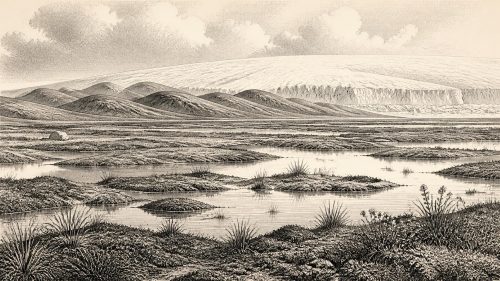
The North Channel Advance
At 31,549 BCE, Ireland had no recorded human history and no secure evidence of occupation. The island formed part of a changing Late Pleistocene glacial environment, preceding the Last Glacial Maximum. Ice within the growing British–Irish Ice Sheet advanced unevenly, with Scottish and Irish centres interacting around the North Channel. At Derryvree, County Fermanagh, freshwater sediments between till layers preserve a temporary ice-free or marginal landscape of wet, treeless tundra, sedges, mosses and cold-adapted plants. Cave remains suggest reindeer, mammoth and hyena occurred during broadly comparable intervals. Glacial processes reshaped drainage, soils, coasts and landforms, establishing conditions inherited by settlers.
View Record
Derryvree Intertill Wetland
Around 33,500 years before AD 1950, Derryvree in County Fermanagh preserved evidence of a locally ice-free, cold periglacial wetland between glacial advances. Pollen, plants and invertebrates indicate open tundra-like vegetation, shallow freshwater and severe seasonal conditions during unstable Marine Isotope Stage 3. Castlepook Cave in County Cork records diverse Pleistocene mammals, including reindeer, mammoth, giant deer and predators, although its deposits are chronologically mixed. A debated cut-marked reindeer bone may indicate transient Upper Palaeolithic visitors, but no secure settlement or population is known. These sites reveal mobile fauna and fragile ecosystems before later ice-sheet expansion, not a documented Irish society.
View Record
Juniper Below the Drumlin
31,551 BCE represents a broad later Middle Midlandian, Marine Isotope Stage 3 interval, rather than a dateable Irish year. At Derryvree, County Fermanagh, freshwater organic sediments between glacial tills indicate a locally ice-free cold phase, broadly dated 36,900–31,700 calibrated years BP. Pollen and plant remains describe treeless, wet, frost-affected terrain with grasses, sedges, juniper and arctic-alpine flora. Southern cave faunas include reindeer, mammoth, giant deer, bear, fox and hyaena, but their associations remain uncertain. A possibly cut-marked reindeer femur from Castlepook suggests a provisional early human visit, not settlement. Glacial erosion, inundation and poor preservation limit reconstruction of Ice-Age Ireland.
View Record
Derryvree’s Moss-and-Sedge Flora
Around 31,552 BCE, Ireland has no recoverable yearly history; evidence instead describes a fluctuating Late Pleistocene environment. At Derryvree, County Fermanagh, freshwater sediments between glacial tills preserve a treeless tundra wetland of sedges, grasses, mosses, bogbean, juniper and sparse herbs, formed during an interval between ice advances. Castlepook Cave, County Cork, contains MIS 3 remains of mammoth, reindeer and other open-country, cold-adapted animals, although its deposits are mixed. A marked reindeer femur may indicate Upper Palaeolithic butchery, but cannot prove occupation. The evidence shows changing ice, wetlands and fauna, not settled communities, politics, farming or identifiable peoples for this date.
View Record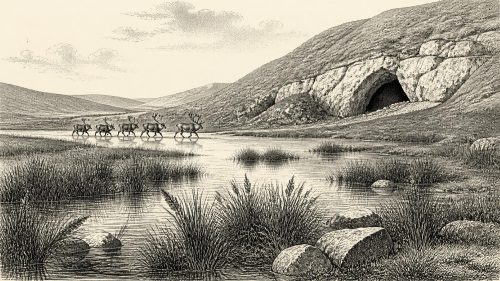
Awbeg’s Vanishing Herds
Around 33,500 years before present, Ireland lay within climatically unstable Marine Isotope Stage 3, before maximum glaciation. Evidence from Fermanagh indicates locally ice-free, treeless wetlands, while southern caves record cold-stage fauna including reindeer, mammoth, giant deer, bears, wolves and hyaenas. Castlepook Cave in north Cork preserves important but poorly contextualised bones. A marked reindeer femur may indicate Upper Palaeolithic human handling, but cannot prove hunting, settlement or repeated occupation. No securely identified Irish camps, tools, burials or social institutions date to this period. Advancing ice later transformed habitats, eliminated fauna and obscured evidence, leaving environmental history firmer than human history.
View Record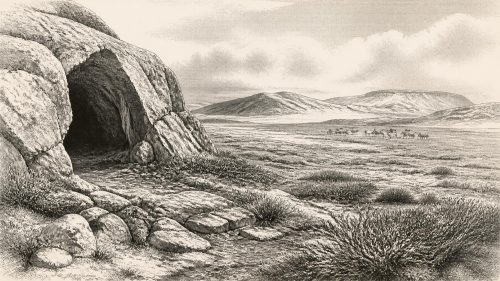
Castlepook’s Reindeer Femur
Around 31,554 BCE, Ireland lay within the unstable cold conditions of Marine Isotope Stage 3, before the Last Glacial Maximum. Dates from this period are calibrated scientific ranges, not recoverable calendar years. Derryvree’s organic silts, between glacial tills, preserve evidence of treeless, freshwater wetlands supporting cold-adapted plants, insects and mosses. Castlepook Cave contains fauna including reindeer, mammoth, giant deer, hyaena, Arctic fox and lemmings, although its mixed deposits cannot represent one moment. A marked reindeer femur may indicate human butchery and a brief Upper Palaeolithic visit, but cannot prove settlement. Later ice damaged evidence, leaving an environmental history of Ireland.
View Record