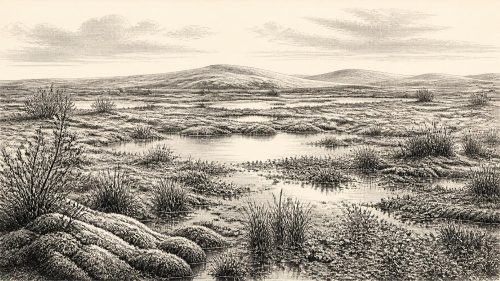
Water-Milfoil Beneath Maguiresbridge
31,556 BCE is best understood as part of Ireland’s climatically unstable Middle Midlandian, not a recorded year. At Derryvree, County Fermanagh, organic sediments dated broadly to this period preserve evidence of a cold, treeless tundra wetland between glacial advances, containing aquatic plants, mosses, insects and hardy herbs. Castlepook Cave, County Cork, preserves a complex, long-accumulated fauna including reindeer, mammoth, giant deer, bears and hyenas. A marked reindeer bone may indicate human butchery, but remains disputed and cannot prove settlement. Ireland’s surviving evidence reveals changing ice, water, vegetation and animal communities, while offering no secure account of peoples, institutions or events.
View Record
Derryvree’s Treeless Muskeg
Around 31,557 BCE, Ireland lay within the unstable later Pleistocene climate of Marine Isotope Stage 3, not a documented historical era. At Derryvree, County Fermanagh, freshwater sediments between tills reveal a locally ice-free, treeless muskeg of mosses, sedges and cold-adapted plants during an interval between glacier advances. Castlepook Cave, County Cork, preserves evidence of diverse fauna, including mammoth, reindeer, giant deer, predators and scavengers, indicating open steppe-tundra habitats at different times. A possibly tool-marked reindeer femur may suggest brief human activity, but lacks associated archaeology. Environmental change, animal movements and uncertain human presence define this remote period in Irish prehistory.
View Record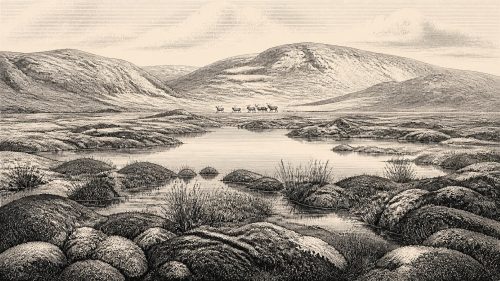
Derryvree’s Buried Poolscape
The modern label 31,558 BCE cannot identify a precise Irish event, but falls within a climatically variable late Ice Age interval. Sediments beneath Derryvree drumlin in County Fermanagh preserve freshwater silts between glacial tills, showing a locally ice-free, treeless tundra wetland later overridden by ice. Pollen, plants and insects indicate cold, open, waterlogged ground. Ireland’s ice sheet changed regionally before its later maximum, while cave fossils confirm large mammals, including reindeer and mammoth. A cut-marked Castlepook reindeer femur may indicate human carcass processing, but lacks secure context or associated occupation evidence. No evidence supports settlement, society, culture or migration routes.
View Record
Castlepook’s Ancient Femur
Although 31,559 BCE cannot identify an Irish event, it falls within volatile Marine Isotope Stage 3, before the Last Glacial Maximum. Derryvree, County Fermanagh, preserves an ice-free interval dated broadly 36,900–31,700 calibrated years BP, revealing cold, treeless wetlands with mosses, sedges, herbs and pools. Castlepook Cave, County Cork, contains a mixed fauna including mammoth, reindeer, giant deer, predators and Arctic-adapted species, demonstrating intermittent ecological links with north-west Europe. A marked, dated reindeer femur may indicate stone-tool butchery and a brief human visit. However, no undisturbed settlement, hearth, tools or cultural evidence proves permanent occupation, migration routes, or an Irish society.
View Record
Maguirebridge’s Ice-Sealed Pools
At the notional date of 31,560 BCE, Ireland lay within the climatically unstable MIS 3 phase of the Late Pleistocene, not a recoverable historical year. Derryvree, County Fermanagh, preserves freshwater silts between glacial tills, revealing tundra wetland vegetation during an ice-free interval. Crag Cave records intermittent milder conditions, while southern caves, especially Castlepook, contain MIS 3 fauna including reindeer, mammoth, giant deer and predators. A possible cut-marked reindeer bone suggests, but does not prove, early human activity. No settlement evidence exists. Expanding ice later erased much evidence, leaving fragmentary records of shifting habitats, fauna and climate during this broad period.
View Record
Mammoth Cave’s Open Country
Around 31,561 BCE, Ireland was a cold, environmentally unstable Pleistocene landscape, increasingly affected by expanding ice but not wholly glaciated. Lower sea levels exposed or altered surrounding seas, allowing intermittent animal and potentially human movement. Fermanagh’s Derryvree deposits indicate open tundra-steppe with freshwater habitats and seasonal vegetation. Castlepook Cave in Cork preserves cold-adapted fauna, including mammoth, reindeer, bear, wolf and hyaena, demonstrating links with wider Ice Age Europe. A possibly butchered, approximately 33,000-year-old reindeer femur may represent Ireland’s earliest human activity, but lacks secure archaeological context. Later glaciation and rising seas destroyed evidence, precluding claims for permanent settlement or society.
View Record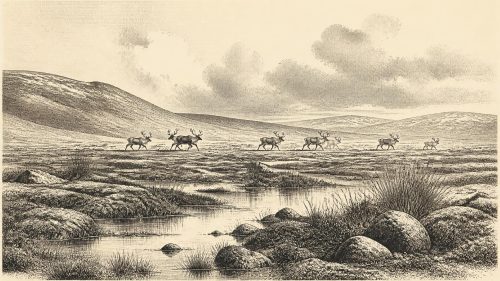
Crag Cave’s Interstadial Water
Around 31,562 BCE, Ireland was part of a climatically unstable Late Pleistocene landscape, not a documented historical year. Derryvree sediments in Fermanagh indicate cold, open tundra and freshwater wetlands during an ice-free or less-glaciated interval. Crag Cave speleothems in Kerry record episodic liquid water, showing warmer interstadials amid severe conditions. Southern cave faunas included reindeer, horse, mammoth, giant deer and hyaena, demonstrating habitats for herbivores and predators. A marked Castlepook reindeer bone may indicate human butchery, but lacks secure archaeological context and cannot prove settlement. Subsequent ice-sheet growth reshaped and buried landscapes, leaving a fragmentary record requiring cautious interpretation today.
View Record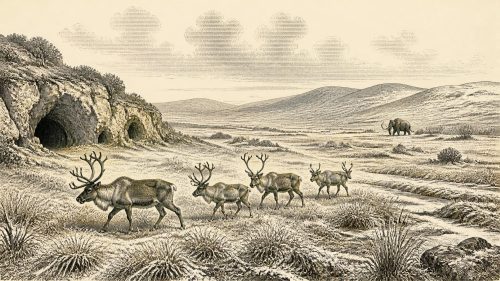
Cave Hyenas of Doneraile
Around 33,500 calibrated years before present, later Marine Isotope Stage 3 Ireland was a cold, changing, largely treeless landscape, not an unbroken glacier. Castlepook Cave near Doneraile, County Cork, preserves important but mixed animal deposits, including mammoth, giant deer, reindeer, brown bear and spotted hyena. These animals indicate productive open steppe-tundra and complex predator-scavenger activity. Revised radiocarbon dates place some fauna well before the Last Glacial Maximum. A marked reindeer femur may record stone-tool butchery about 31,000 BC, suggesting fleeting Upper Palaeolithic visitors. However, no associated settlement, hearth, tools or other proof establishes permanent human occupation, institutions or continuous habitation.
View Record
Crocuta at Mammoth Cave
Around 31,564 BCE, Ireland lay in a cold, unstable Late Pleistocene interval of Marine Isotope Stage 3, before the Last Glacial Maximum. Dating is necessarily approximate: evidence indicates ice-free patches, not conditions across the entire island. Organic sediments beneath tills at Derryvree, County Fermanagh, preserve wet tundra vegetation, including sedges, mosses and dwarf willow. Castlepook Cave, County Cork, produced MIS 3 remains of mammoth, reindeer, giant deer, bears, wolves, Arctic foxes, lemmings and spotted hyaenas. Changing sea levels and ice permitted intermittent animal movement. A cut-marked reindeer femur may indicate human butchery, but cannot establish settlement or a permanent population.
View Record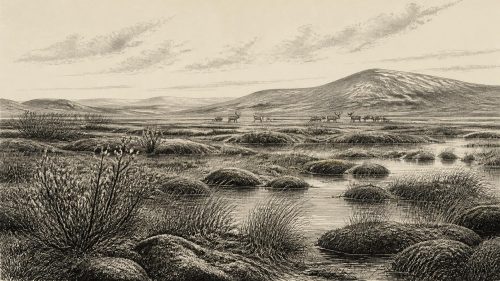
A Reindeer Bone at Doneraile
Around 31,565 BCE, Ireland’s record is environmental rather than historical, and cannot support calendar precision or claims of settlement. Derryvree, County Fermanagh, preserves a broadly dated MIS 3 interstadial deposit, indicating locally ice-free, periglacial tundra with freshwater wetlands, open vegetation and severe seasonal conditions. Castlepook Cave near Doneraile contains cold-stage fauna including reindeer, mammoth, giant deer, predators and lemmings, although deposits may combine separate episodes. A scored reindeer femur, perhaps 33,000 years old, may show stone-tool butchery and Ireland’s earliest human trace. It cannot establish a kill site, continuous occupation, settlement, society, travel routes or a single specific dated event.
View Record