Troubles Trilogy
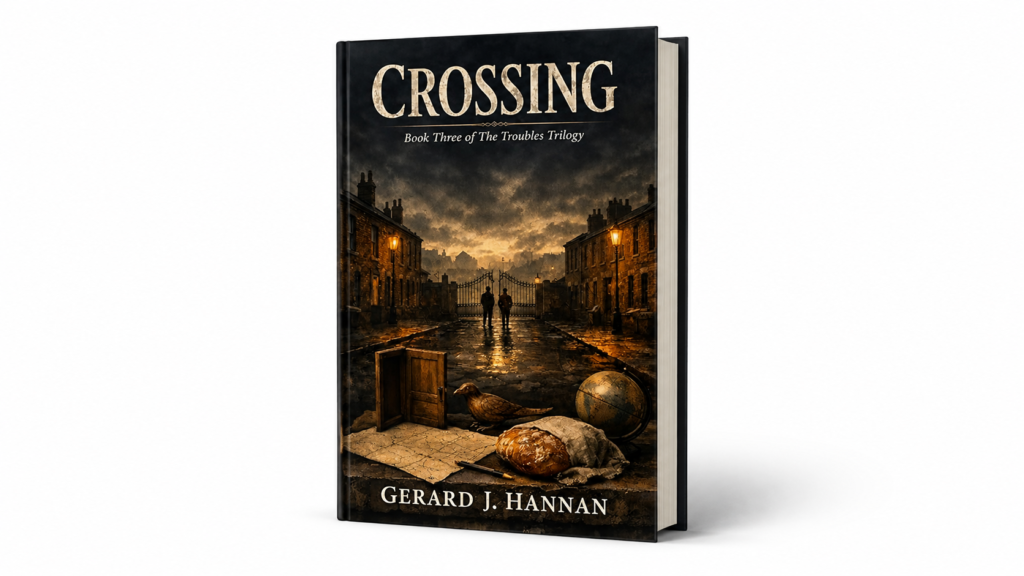
Book 3 of 3: Crossing
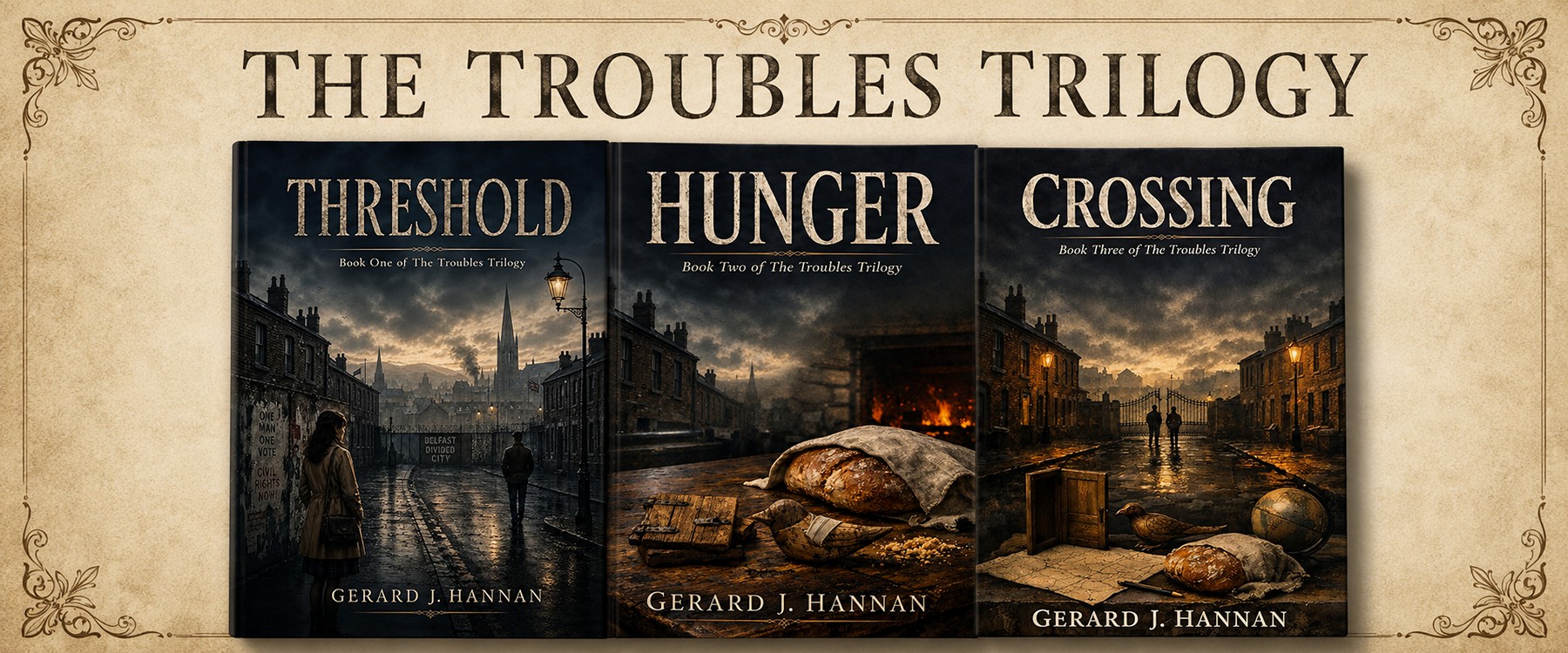
Crossing is the third and final part of Gerard J. Hannan’s Troubles Trilogy, bringing two ordinary families into the last turbulent decade of Northern Ireland’s conflict. Set between 1990 and 2000, the novel follows people who have already endured fear, bereavement, suspicion, and division, yet still search for some possibility beyond violence. The Devlins and the Morrows do not command armies, lead parties, or shape public policy. They live with the consequences of decisions made elsewhere. Their homes, relationships, loyalties, and private hopes become the ground upon which history presses, demanding choices nobody feels prepared to make for themselves.
The story begins as the Troubles enter a period of exhaustion without yet offering safety. Violence remains close, language remains hard, and memories continue to divide neighbours who have learned to measure every word. The Catholic Devlin family and the Protestant Morrow family carry the burdens of earlier years into a decade that promises change but threatens disappointment. Ceasefires bring hope, yet hope itself becomes dangerous when trust has been broken so often. Each family must decide whether peace can be believed before it can be secured, and whether old fears can be loosened without inviting betrayal into their homes.
At the centre of Crossing is Claire Devlin, no longer the child who watched adults make sense of danger around her. She is growing into her beliefs while living in a society that demands identity before understanding, loyalty before reflection, and allegiance before freedom. Conversation appears to ask where she belongs, whom she trusts, and what she is prepared to reject. Claire resists the pressure to become a symbol for anyone else’s cause. Her journey is one of moral independence, shaped by grief, family history, unexpected tenderness, and the knowledge that crossing a boundary may require courage than defending one.
Around Claire stand Aileen, Martin, Thomas, Samuel, Elizabeth, Albert, Molly, and others whose lives have been marked by years of conflict. Each carries memories that cannot simply be abandoned when politicians announce progress. Old injuries survive inside marriages, friendships, silences, routines, and family stories. Some characters are drawn towards forgiveness, while others fear that forgiveness will erase the dead or excuse the guilty. Their loyalties remain divided between community, blood, conscience, and survival. Yet amid suspicion and sorrow, stubborn acts of mercy continue. A meal shared, a door opened, or a warning given becomes a quiet refusal of inherited hatred.
The final decade of the Troubles unfolds through ceasefires, negotiations, renewed attacks, political uncertainty, and the Good Friday Agreement. Crossing shows these developments not as distant milestones but as events entering homes, workplaces, streets, and private conversations. Public declarations alter how people travel, whom they visit, what they dare to hope, and how they understand the future. Every advance is accompanied by doubt, and every setback awakens memories of earlier losses. Peace is never presented as a single triumphant moment. It emerges slowly, unevenly, and painfully, through compromises that satisfy nobody completely but may allow another generation to live differently.
This is not a novel concerned only with politicians, gunmen, organisations, slogans, or official agreements. Its true landscape is domestic: kitchens where news is discussed, tables where bread is shared, doors that remain locked, maps that divide familiar streets, and rooms where grief settles long after funerals end. History appears through ordinary objects and routines because conflict is experienced most deeply in daily life. A missing chair, an unopened letter, a hurried journey, or a neighbour’s silence can carry more meaning than a speech. Crossing restores attention to the private spaces where fear is absorbed and courage is quietly practised.
Love moves through the novel, refusing the boundaries that politics and history have imposed. Relationships across community lines carry risk because affection can be treated as disloyalty, weakness, or betrayal. Yet the willingness to care for someone from the other side becomes one of the book’s forms of resistance. Love does not erase difference, nor does it solve every injustice. It asks people to remain human when fear encourages hardness. Through tenderness, loyalty, and sacrifice, the characters discover that peace must begin long before it is signed, wherever one person chooses to see another as more than an inherited label.
Crossing also confronts the cost of surviving. Those who reach the end of conflict are not untouched because they remain alive. They carry trauma, guilt, resentment, and unanswered questions into the years that follow. Some mourn people who cannot return; others regret choices made under pressure. The novel asks whether peace can honour the dead without becoming imprisoned by them. It considers how families rebuild trust when memory remains divided and how communities continue when justice feels incomplete. Survival, in this world, is not an ending. It is the beginning of a responsibility to live without repeating what was endured.
The Good Friday Agreement offers possibility, but Crossing refuses to treat it as a magical conclusion. Agreements can create structures, reduce violence, and open political doors, yet they cannot heal damaged families or erase suspicion from divided streets. Peace requires patience from people who have spent years expecting danger. It demands compromise from those taught that compromise means surrender, and imagination from those who have never experienced security. The characters must learn that crossing towards peace does not mean forgetting where they came from. It means carrying memory differently, without allowing pain to dictate every relationship, decision, and future choice.
Moving, humane, and unflinching, Crossing concludes Gerard J. Hannan’s Troubles Trilogy with a story about family, division, endurance, and the courage required to choose another person over inherited hatred. The Devlins and Morrows have lived through years when identity could determine safety, opportunity, friendship, and fate. Their final struggle is not simply to survive violence, but to imagine life beyond it. Crossing asks whether ordinary people can build what history has repeatedly destroyed. Its answer lies not in certainty or easy reconciliation, but in mercy, persistence, and the quiet decision to remain open when everything has taught them to close.