Article
24 June 2026
Kincora Committees
A large public meeting assembled in the Lecture Hall of Limerick’s Catholic Institute to organise a fête and fancy fair for the new church of St Joseph then rising within St Michael’s Parish. The gathering, reported on 4 January 1900, was promoted by the parish clergy and presided over by Bishop Edward Thomas O’Dwyer. Clergy, women and men attended in considerable numbers, demonstrating broad interest in completing the additional parochial church. The meeting agreed that the fundraising celebration would take place in June and established committees to undertake the detailed work required before the event could open.
Read ArticleArticle
25 June 2026
Terminus Tragedy
A serious accident at Limerick railway terminus left labourer James Davoren requiring the amputation of his right leg. The Irish Times reported on 2 January 1900 that Davoren had gone to the station to see his brother, described as a solicitor, depart by train for Fermoy. During the farewell, he fell from the platform onto the permanent way and was caught beneath the passing train. Railway staff and bystanders found him lying on the rails after the carriages had cleared. He was removed without delay to Barrington’s Hospital, where surgeons determined that the injured limb could not be saved.
Read ArticleArticle
24 June 2026
Champion Born
Joseph Francis Devlin, later known throughout international badminton as Frank Devlin, was born at 11 Wellington Place in Dublin on 19 January. He was the son of Joseph Edmund Devlin, a government official, and his wife, Elizabeth. Nothing surrounding the arrival of the child suggested that he would become one of the most successful competitors in the history of his sport. Badminton remained largely associated with private clubs, schools and middle-class recreation, but the game was developing rapidly. Devlin’s extraordinary ability would eventually carry an Irish player from domestic competition to sustained success at the most prestigious championship in the…
Read ArticleArticle
19 June 2026
Royal Farewell
Queen Victoria arrived at Kingstown today for what would prove to be her final visit to Ireland, beginning a three-week residence centred largely upon Dublin and the Vice-Regal Lodge in Phoenix Park. Although the royal party will not travel to Limerick, accounts of the landing, the ceremonial procession and the extensive public decorations are already attracting attention throughout the city and county. Unionist residents may regard the visit as an affirmation of loyalty to the Crown, while nationalists are likely to judge it against continuing demands for Home Rule, land reform and recognition of Ireland’s political grievances. The Queen travelled…
Read ArticleArticle
31 July 2026
Boyne Approaches
For Limerick, the events of 1690 marked the beginning of the campaign that would eventually drive the Jacobite army towards the Shannon and make the city central to Ireland’s resistance. The fall of Charlemont, the arrival of French troops and William of Orange’s decision to command the invasion personally transformed the war. From this point onward, every strategic mistake brought the conflict closer to Limerick’s walls.
Read ArticleImage
15 July 2026
Edwardian Limerick
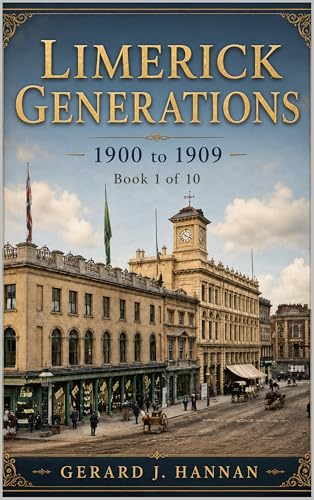
At the beginning of the twentieth century, George Street stood at the centre of commercial life in Limerick. Today known as O’Connell Street, it was bordered by impressive Georgian buildings housing hotels, shops, offices and established local businesses. Horse-drawn carts, private carriages and crowds of pedestrians moved constantly along the busy thoroughfare, while traders brought additional noise and colour to the scene. Landmarks included the Royal Hotel, MacMahon’s Temperance Hotel and firms such as O’Mahony & Company. The street’s elegant architecture and lively commerce made it one of Edwardian Limerick’s most important and recognisable urban spaces for residents and visitors.
View ImageImage
13 July 2026
Limerick Stone
This February 1937 photograph shows a weathered stone cottage in Limerick, with children gathered at its doorway and along the narrow street outside. The rough masonry, patched walls, boarded upper windows and low, sloping roof reveal the building’s age and modest condition. Electrical wires cross above the house, suggesting the gradual arrival of modern services within an older urban landscape. The children’s presence brings warmth and life to the scene, contrasting with the severe exterior and surrounding ruins. The image provides a valuable record of working-class housing, childhood and community life in pre-war Limerick during a period of social change.
View ImageImage
15 July 2026
Edwardian Limerick
At the beginning of the twentieth century, George Street stood at the centre of commercial life in Limerick. Today known as O’Connell Street, it was bordered by impressive Georgian buildings housing hotels, shops, offices and established local businesses. Horse-drawn carts, private carriages and crowds of pedestrians moved constantly along the busy thoroughfare, while traders brought additional noise and colour to the scene. Landmarks included the Royal Hotel, MacMahon’s Temperance Hotel and firms such as O’Mahony & Company. The street’s elegant architecture and lively commerce made it one of Edwardian Limerick’s most important and recognisable urban spaces for residents and visitors.
View ImageImage
10 July 2026
Memorial 1940s
On Sarsfield Bridge in 1940s Limerick, the 1916 Memorial rises proudly beside the roadway, enclosed by green iron railings and watched over by elegant lamps. Its pale stone pedestal supports bronze figures commemorating the Rising, their solemn poses lending dignity to the riverside setting. Trees line the background, softening the urban scene and framing the monument against a bright open sky. Pedestrians in period dress walk along the bridge, suggesting ordinary city life continuing around a place of remembrance. The image captures civic pride, republican memory, and the enduring presence of national history within Limerick’s daily landscape and local identity.
View ImageImage
16 July 2026
Glenduff Castle
Glenduff Castle is shown restored to its former splendour, standing proudly amid landscaped gardens in rural County Limerick. Built around 1840 for the Ievers family, the castellated country house incorporated an earlier tower house dating from about 1600. Its battlements, flanking towers, arched entrance and long stone façade created a striking Gothic Revival residence. The scene imagines the estate before its destruction, with residents, visitors and a horse-drawn carriage bringing the grounds to life. Glenduff Castle was burned during the Irish Civil War on 29 June 1922, leaving the picturesque ivy-covered ruin that survives on private farmland near Broadford today.
View Image