Image
10 July 2026
Pery Square
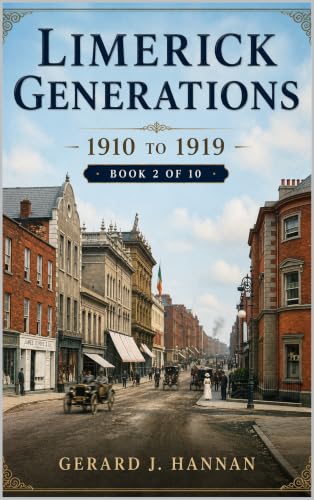
Around 1900, Pery Square presented one of Limerick’s most elegant urban settings, facing the newly opened People’s Park and framed by distinctive Georgian terraces. The celebrated Tontine Buildings, built between 1835 and 1838 as a speculative venture, gave the square a story as unusual as its architecture. Their shares, tied to named lives in the so-called Life and Death Lottery, were still gaining value as horse-drawn traffic, pedestrians, gas lamps, and civic buildings animated the street. The tontine was finally won in 1913 by Sophia Vanderkiste, closing a remarkable chapter in Limerick’s local social and architectural history.
View ImageImage
10 July 2026
Boat Club
Athlunkard Boat Club was founded in 1898, taking its name from its home beside O’Dwyer Bridge at the end of Athlunkard Street. By the 1930s, the club was already firmly woven into Limerick’s rowing tradition, with a proud record on the water. Its greatest distinction came through the Senior Eight Championship, which Athlunkard won twice, in 1913 and 1923. That achievement made it the only Limerick club to secure the title on two occasions. Its riverside presence and competitive success gave Athlunkard Boat Club a lasting place in the sporting history of the city and the wider Shannon rowing community.
View ImageImage
10 July 2026
Wellesly Bridge
A sweeping view of Wellesley Bridge, now Sarsfield Bridge, crossing the River Shannon in Limerick City. The elegant 1835 structure rises with restrained neoclassical grace, its stone arches carrying traffic between the historic city centre and Thomondgate on the northern shore. Calm river water reflects the bridge’s pale masonry, while quays, rooftops, and distant activity suggest a city expanding beyond its old boundaries. Maritime details, mooring points, and riverside movement evoke Limerick’s trading past. The scene should feel dignified, atmospheric, and historically grounded, presenting the bridge as both active crossing and enduring architectural landmark.
View ImageImage
16 July 2026
Shortest Street
Quinlan Street is one of the shortest principal streets in Limerick City, measuring approximately eighty-five feet at its centre. Located within the historic Georgian Quarter, it forms an important connection between the Crescent, at the southern end of O’Connell Street, and O’Connell Avenue. Developed between the 1820s and 1840s, the street is lined with distinctive multi-storey red-brick Georgian townhouses built over basements. Its unusual layout means that one side is longer than the other. The street was named after Thomas Quinlan, the builder responsible for the original houses at numbers 1 and 2, preserving his contribution to Limerick’s urban development.
View ImageImage
15 July 2026
Edwardian Limerick
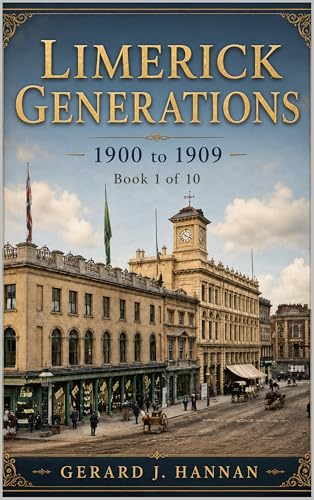
At the beginning of the twentieth century, George Street stood at the centre of commercial life in Limerick. Today known as O’Connell Street, it was lined with impressive Georgian buildings containing hotels, shops, offices and established local businesses. Horse drawn carts, private carriages, traders and crowds of pedestrians moved constantly along the busy thoroughfare. Prominent landmarks included the Royal Hotel, MacMahon’s Temperance Hotel and firms such as O’Mahony & Company. Its elegant architecture, lively street activity and concentration of commerce made George Street one of Edwardian Limerick’s most important, prosperous and recognisable urban spaces for residents, workers, shoppers and visitors.
View ImageArticle
25 June 2026
Tenant Payments
Judge Richard Adams delivered an important ruling during the Limerick Quarter Sessions concerning the fixing of fair rents on Irish agricultural holdings. He declared that money already paid by a tenant to obtain possession of a farm should be taken into account when the judicial rent was assessed. Such payments commonly represented the purchase of the outgoing tenant’s interest, goodwill or tenant-right rather than money paid directly to the landlord. Adams’s statement recognised that an incoming occupier might have invested a substantial sum before paying a single year’s rent and that this financial burden formed part of the true circumstances…
Read ArticleArticle
22 June 2026
Farming Progress
The Department of Agriculture and Technical Instruction is promoting improved farming methods, livestock breeding, dairying and practical education as part of its new programme for Irish rural development. Established under the Agriculture and Technical Instruction Act of 1899, the Department has begun bringing agricultural advice, scientific knowledge and technical training under one central authority. Farmers in County Limerick are watching closely, particularly in districts where cattle raising, milk production and butter making sustain local households, creameries, merchants and labourers. The initiative promises a more organised relationship between government, local committees, agricultural societies and the people working directly upon the land.…
Read ArticleArticle
19 June 2026
Loyal Ireland
Unionist opinion has interpreted the enthusiastic public welcome given to Queen Victoria as convincing evidence that Ireland remains loyal to the Crown and firmly attached to the United Kingdom. Reports from Dublin describe immense crowds lining the route from Kingstown, cheering as the royal carriage passed through extensively decorated streets towards Phoenix Park. Loyalist newspapers and organisations argue that such scenes contradict nationalist claims to speak for the whole Irish population. In Limerick, supporters of the Union will regard the reception as proof that allegiance to the monarchy continues among military families, merchants, officials, Protestants and many citizens attracted by…
Read ArticleArticle
25 June 2026
Observer Expelled
The Limerick Board of Guardians unanimously ordered a police constable to leave its meeting after members discovered that he was taking notes of the proceedings while dressed in civilian clothing. The incident, reported on 13 January 1900, interrupted the ordinary work of the board and immediately raised questions about why a police observer had entered the room without openly declaring his purpose. Mr Fitzgerald drew attention to the constable’s presence and proposed that the chairman require him to withdraw. Mr Kelly seconded the motion, which passed without dissent, leaving the officer no choice but to depart.
Read ArticleArticle
25 June 2026
Summit Disaster
For Limerick, whose city and county belonged to the recruiting region of the Royal Munster Fusiliers, reports from Spion Kop carried immediate human significance even though that regiment did not fight upon the summit. During the night of 23–24 January 1900, British troops commanded by Major-General Edward Woodgate climbed the steep hill in Natal as part of Sir Redvers Buller’s renewed attempt to relieve besieged Ladysmith. The attackers surprised a Boer outpost and secured part of the summit before dawn, but mist and darkness concealed the true shape of the ground and the stronger positions lying beyond them.
Read Article