
Loyal Ireland

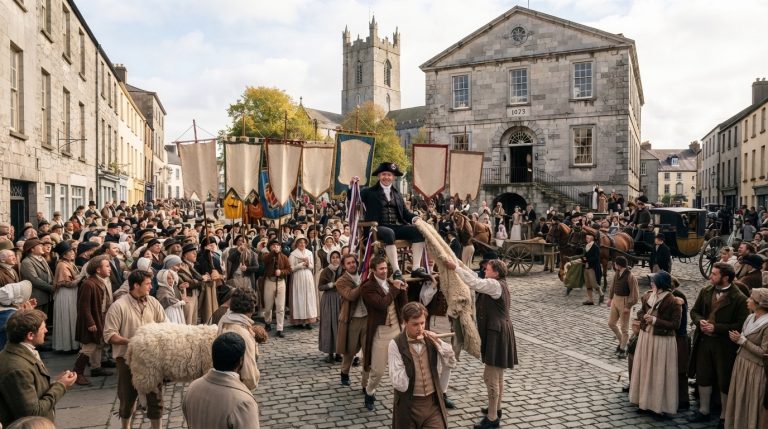
Unionist opinion has interpreted the enthusiastic public welcome given to Queen Victoria as convincing evidence that Ireland remains loyal to the Crown and firmly attached to the United Kingdom. Reports from Dublin describe immense crowds lining the route from Kingstown, cheering as the royal carriage passed through extensively decorated streets towards Phoenix Park. Loyalist newspapers and organisations argue that such scenes contradict nationalist claims to speak for the whole Irish population. In Limerick, supporters of the Union will regard the reception as proof that allegiance to the monarchy continues among military families, merchants, officials, Protestants and many citizens attracted by imperial identity.
The Queen herself recorded a loud and enthusiastic reception throughout her journey into Dublin. Unionist commentators have emphasised the crowds gathered along the quays and in poorer districts, maintaining that participation extended beyond privileged officials and wealthy loyalists. They point also to civic addresses, school celebrations, military reviews and institutional receptions as expressions of genuine public affection. The visit has been presented as a spontaneous national welcome rather than a spectacle created solely by Dublin Castle. For defenders of the constitutional settlement, the visible excitement demonstrates that Irish identity and loyalty to the British Crown need not be considered incompatible.
The South African War has strengthened the military meaning attached to the ceremonies. Irish soldiers are serving throughout the British Army, and the Queen’s visit has been linked publicly with recognition of their bravery and sacrifice. Unionists regard this service as evidence that Ireland contributes willingly to the defence and expansion of the Empire. The royal procession, mounted escorts and troop reviews allow that connection to be displayed before large civilian audiences. In Limerick, where barracks and recruiting traditions have long shaped employment and family life, some households will understand imperial service through relatives whose welfare depends upon the army rather than through political argument alone.
Unionist leaders also believe the welcome weakens the case for Home Rule. They argue that membership of the United Kingdom provides parliamentary representation, commercial access, military protection and participation in an empire offering employment across the world. Nationalist electoral strength is acknowledged, but unionists insist that repeated nationalist victories cannot erase loyal minorities or compel them to accept government by an Irish legislature. The cheering crowds will therefore be used as evidence that constitutional opinion is more varied than parliamentary figures suggest. Loyalists maintain that public loyalty deserves protection against any political settlement that might place their identity and institutions under nationalist control.
Nationalist critics reject this interpretation, observing that crowds may gather from curiosity, holiday excitement or interest in royal spectacle without endorsing British rule. Nevertheless, the welcome has given unionists a powerful public image with which to defend the existing constitutional order. The packed streets, decorated buildings and formal addresses can be presented as visible signs of loyalty, even while opposition meetings and hostile newspapers reveal deep disagreement. For Limerick, the visit confirms that allegiance cannot be measured by one procession alone. Yet unionists will remember the cheering as proof that the Crown still commands affection and that Ireland’s place within the United Kingdom retains substantial popular support.
Primary Sources
- Queen Victoria, journal entry for 4 April 1900, Royal Archives, Windsor Castle, describing the crowds, cheering, civic welcome and journey from Kingstown through Dublin. Exact archival volume and folio should be confirmed before formal citation.
- The Irish Times, Dublin, 5 April 1900, contemporary reports and editorial commentary on the royal arrival, public welcome and loyal demonstrations. Exact page and column should be confirmed before formal citation.
- Daily Express, Dublin, April 1900, unionist reports and editorials interpreting the royal reception as evidence of Irish loyalty to the Crown and Union. Exact issue, page and column should be confirmed before formal citation.
- Robert Augustus Henry L’Estrange, photographic collection documenting Queen Victoria’s royal visit to Dublin, 4–26 April 1900, Queensland University of Technology Digital Collections.
- Senia Pašeta, “Nationalist Responses to Two Royal Visits to Ireland, 1900 and 1903,” Irish Historical Studies, vol. 31, no. 124, 1999, pp. 488–504.