Image
14 July 2026
Glenduff Castle
This reconstructed view presents Glenduff Castle in County Limerick as it may have appeared before its destruction in 1922. The imposing residence combines the fortified character of an earlier seventeenth-century tower house with the Gothic Revival additions created for the Ievers family around 1840. Tall crenellated towers, pointed windows, battlements and a formal central entrance give the building a commanding presence. Set within carefully maintained lawns and mature woodland, the castle reflects the scale and confidence of a nineteenth-century Irish country estate. The image offers a plausible visual impression rather than a definitive record of its original appearance or grandeur.
View ImageImage
14 July 2026
Elm Hill
Elm Hill, County Limerick, was built around 1790 for the Studdert family as an elegant Georgian country residence. The six-bay, two-storey house stood over a raised basement and contained spacious reception rooms, nine bedrooms, servants’ quarters, kitchens, cellars and service rooms. Following the Great Famine, it was offered for sale and described as being in excellent repair. The property remained substantial for generations but gradually fell vacant and deteriorated. A 2008 architectural survey praised its limestone doorcase, carved timber entrance, slate-hung elevations, fireplaces and decorative plasterwork. Its recognised importance led to designation as a protected structure under Irish planning legislation.
View ImageImage
11 July 2026
Limerick Market
This photograph, dated 1 March 1937, captures a busy market day in Limerick city. Horse-drawn carts, traders, shoppers, and farmers crowd the wet street, creating a vivid picture of everyday commercial life. On the right, a man drives a horse and trap, a form of transport commonly associated with more prosperous Irish farmers. Market goods are displayed on carts and stalls, while pedestrians move between the buildings lining the street. The scene records the importance of markets to Limerick’s economy, bringing rural producers and urban customers together during a period when horses remained central to transport and trade throughout Ireland.
View ImageImage
16 July 2026
Nua Ruins
The old church near Holycross, County Limerick, was recorded as a ruin by 1642. In 1679, Rachael Bourchier, Countess of Bath, restored the building, just one year before her death. Thereafter it became known as the New Church, or Teampall Nua in Irish, and served local Church of Ireland parishioners. A belfry was added during the restoration, giving the structure a distinctive profile. Although the church later fell out of use and returned to ruin, its surviving walls, arched openings and graveyard remain important reminders of seventeenth-century religious life and the long history of worship at this historic site today.
View ImageImage
10 July 2026
Barricades Limerick
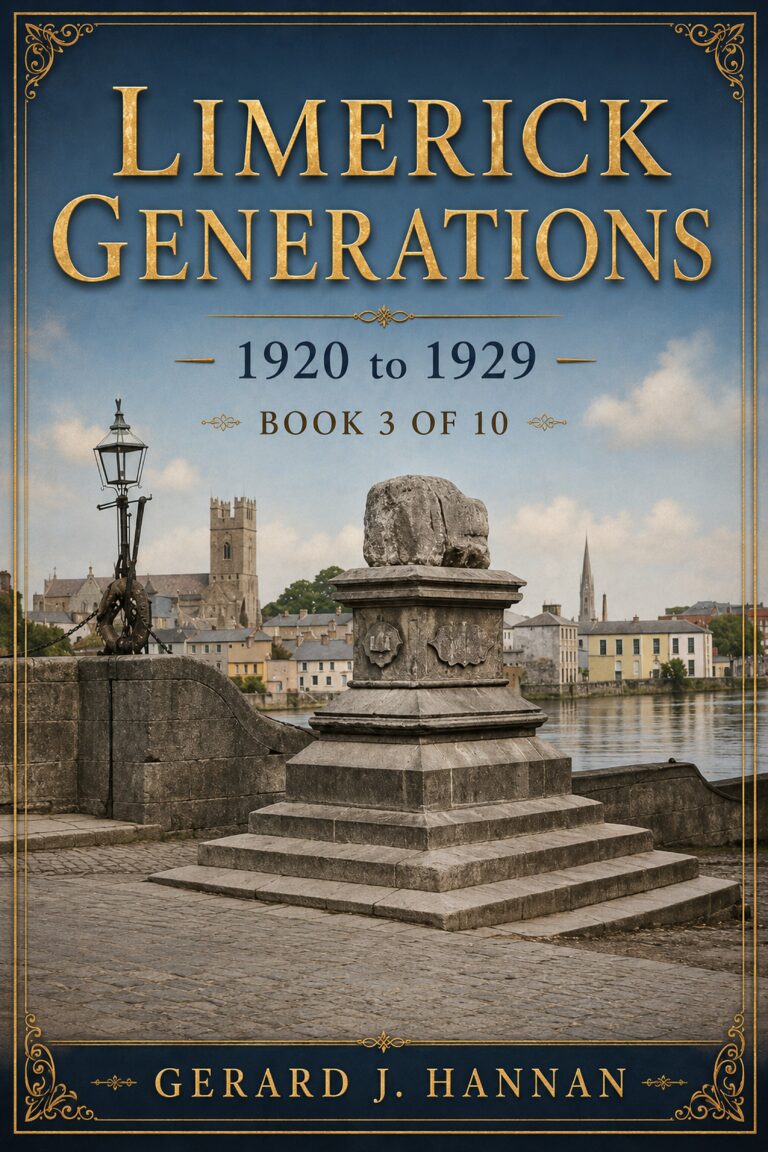
At Thomond Bridge in Limerick in 1923, a soldier stands guard beside a rough barricade near the Treaty Stone, a symbolic landmark now overshadowed by civil conflict. The scene evokes the tense aftermath of the Treaty split, when Anti-Treaty IRA forces and pro-Treaty National Army troops fought for control of the city. Sandbags, timber, stone, and street debris suggest hurried urban fortification, while the soldier’s watchful posture conveys danger and uncertainty. The bridge becomes both military checkpoint and historic threshold, linking Limerick’s medieval memory with the bitter street warfare that marked the Irish Civil War in the city that summer.
View ImageArticle
26 June 2026
Mortgage Fetter
A mortgage dispute involving County Limerick auctioneer John Browne and Patrick Ryan, a farmer of Ryaninch in County Tipperary, reached the Irish courts in 1900 after Browne sought £62 10s in commission from the sale of Ryan’s property. What appeared to be an ordinary contractual claim raised a larger question about the limits placed upon mortgage lenders. Browne relied upon a separate agreement connected with a £200 loan, but Ryan argued that its terms improperly burdened his right to redeem the mortgaged land and recover complete control once the debt had been repaid.
Read ArticleArticle
20 June 2026
Boycott Pressure
Boycotting and organised public pressure are being employed in some Irish districts against landlords, graziers and tenants whose conduct is considered hostile to the land campaign. The methods range from public condemnation and refusal of ordinary dealings to the withdrawal of labour, trade and social contact. Supporters describe such action as a peaceful means of enforcing communal discipline where legal and parliamentary remedies appear ineffective. Opponents call it intimidation imposed upon people who may have broken no law. In County Limerick, the practice carries particular force wherever eviction, disputed holdings or the occupation of grazing land has divided neighbours.
Read ArticleArticle
26 June 2026
Tenancy Dispute
A tenancy dispute involving a Limerick woman came before Cheltenham County Court in March 1900, revealing the uncertainty that could accompany rented accommodation far from home. The proceedings concerned Mrs J. Lestbah and Mrs J. M. Harnett, whose disagreement arose from the letting of two rooms at 2 Queen’s Parade. The tenancy had begun in September 1899, several months before the hearing. For Limerick people living in Britain, such cases formed part of the less visible experience of migration, in which securing rooms, meeting rent and establishing responsibility could become matters for formal legal judgement.
Read ArticleArticle
21 June 2026
Tenants Restored
Evicted tenants remain at the centre of Ireland’s land agitation, with nationalist representatives demanding that families removed during earlier rent disputes be restored to their former farms. The issue returned prominently to Westminster today during debate upon an Evicted Tenants Bill intended to assist those unable to regain their holdings. In County Limerick, memories of eviction continue to influence political loyalties, public meetings and attitudes towards farms subsequently occupied by others. Nationalists argue that no settlement of the land question can be considered honourable while households that sacrificed homes during organised resistance remain excluded from the soil they once worked.…
Read ArticleArticle
19 June 2026
Unity Fractures
The completion of the general election has shown that the reunion of Irish parliamentary nationalism remains incomplete. Although John Redmond’s Irish Parliamentary Party has secured the overwhelming majority of nationalist seats, six supporters of Timothy Michael Healy have been returned outside the disciplined party organisation. The result will attract close attention among nationalists in Limerick city and county, where unity has been presented as essential to advancing Home Rule and land reform. Healy’s surviving parliamentary following demonstrates that the personal, clerical and local rivalries created during the bitter divisions of the 1890s have not been entirely overcome. The nationalist split…
Read Article