1900

Reservist Released

The Limerick Board of Guardians granted six months’ leave without salary to James Ryan, an employee who had been summoned to rejoin the colours during the South African War. The decision, reported on 25 January 1900, allowed Ryan to answer his military obligation without immediately forfeiting his position under the Board. Guardians also agreed that a temporary worker should be appointed during his absence, ensuring that the institution’s daily duties continued without interruption. The arrangement balanced the demands of wartime mobilisation with the Board’s responsibility towards a member of staff called away from civilian employment.

Potato Findings

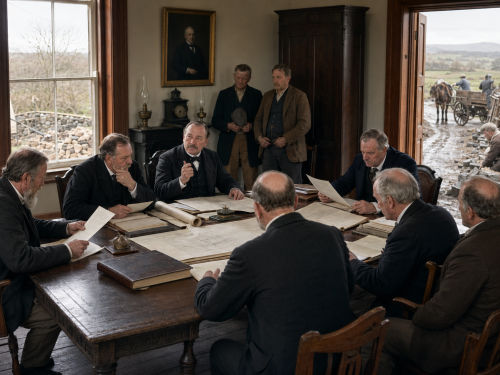
Important results from agricultural experiments conducted across County Limerick were reported on 23 January 1900. The trials examined whether a copper-sulphate solution could protect potato crops against disease and whether freshly introduced seed performed better than potatoes repeatedly grown on the same farms. The findings were encouraging. Even during a season when blight had been comparatively limited, treated plots produced sufficient improvement to repay the expense of spraying. For farmers whose income and household food supply depended heavily upon the potato harvest, the experiments offered practical evidence that preventive treatment could reduce risk rather than merely respond after disease had appeared.

Contracts Shortened

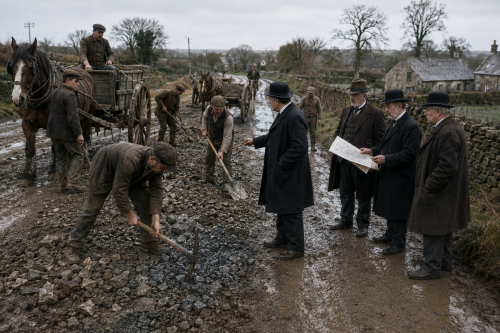
Limerick No. 1 District Council altered the system governing maintenance and repair contracts for public roads when members decided that future agreements would run for twelve months rather than the four-and-a-half-year term previously used. The decision followed an adjourned quarterly meeting held under the chairmanship of William Noonan and reported on 18 January 1900. Road tenders rejected at an earlier sitting had been referred to Limerick County Council, which declined to consider them and returned the entire question to the District Council. Members were therefore required to reconsider both the tenders and the basis upon which future road work would be awarded.

Inquiry Announced

The Inspectors of Irish Fisheries announced that they would hold an official inquiry in Limerick on 30 January 1900 into the works proposed by the Shannon Water and Electric Power Syndicate. Notice of the hearing was sent to Limerick County Council as opposition widened among fishery owners, navigational interests and public authorities. The inquiry offered affected parties an opportunity to place technical evidence and local objections before officials responsible for protecting Irish fisheries. It also moved the controversy beyond public resolutions, requiring the promoters to answer detailed questions about water diversion, river levels and the consequences of their proposed generating works.

Observer Expelled

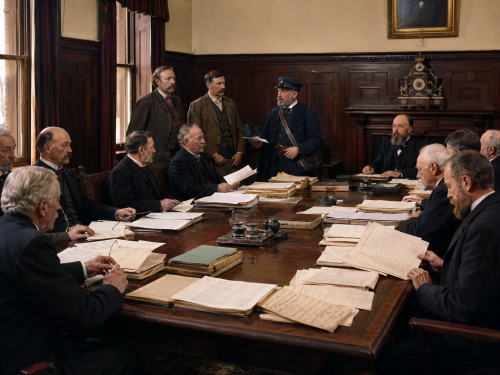
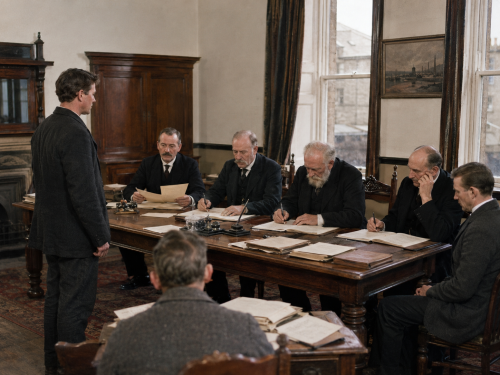
The Limerick Board of Guardians unanimously ordered a police constable to leave its meeting after members discovered that he was taking notes of the proceedings while dressed in civilian clothing. The incident, reported on 13 January 1900, interrupted the ordinary work of the board and immediately raised questions about why a police observer had entered the room without openly declaring his purpose. Mr Fitzgerald drew attention to the constable’s presence and proposed that the chairman require him to withdraw. Mr Kelly seconded the motion, which passed without dissent, leaving the officer no choice but to depart.

Claims Approved

The Treasury approved compensation claims submitted by two former deputy cess collectors whose employment had been affected by the transfer of local administration from the Grand Jury system. The decision, reported on 13 January 1900, reached Limerick County Council by telegram. Councillors had previously concluded that they possessed no legal authority under the Local Government (Ireland) Act of 1898 to compensate deputies who had not been formally appointed by the Grand Jury. The successful applicants therefore carried their cases beyond the Council, asking the Treasury to recognise the financial loss created when the older machinery of county taxation was replaced.

Electric Lighting

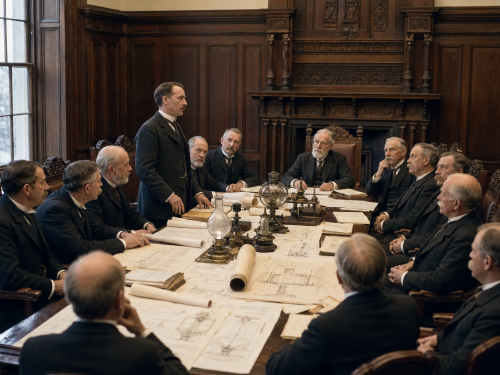
Limerick Corporation voted by twenty-four members to four to adopt J. Enright’s proposal for lighting the city by electricity. The decision, reported on 12 January 1900, authorised a scheme designed to provide an installation meeting the technical requirements administered by the Board of Trade. Enright was described as being from London, suggesting that the Corporation had sought outside expertise for a modern undertaking of considerable engineering and financial importance. The decisive majority indicated that most councillors accepted electric lighting as a necessary civic improvement, despite continuing disagreement over how power should be produced and supplied.

Labour Sanctioned

The Local Government Board approved Limerick County Council’s decision to undertake certain road works by direct labour where contractors had failed to tender. The ruling, reported on 5 January 1900, allowed the Council to place such roads under the County Surveyor and employ labourers without relying upon the customary contracting system. Approval did not introduce direct labour across every county road. It applied to works for which satisfactory private tenders had not been received, giving the newly established local authority a practical means of maintaining routes that might otherwise remain neglected.

Takeover Opposed

Limerick Corporation unanimously authorised formal opposition to the proposed sale of the Waterford, Limerick and Western Railway to the Great Southern and Western Railway. At a special meeting reported on 5 January 1900, William L. Stokes, JP, moved that the Corporation’s solicitor be empowered to resist the scheme and take every necessary step on the city’s behalf. Councillor O’Brien seconded the motion. Several interested citizens attended beyond the council barrier, reflecting the strength of public concern surrounding the renewed amalgamation bill. The resolution was carried unanimously and received applause from those observing the proceedings.

Kincora Committees

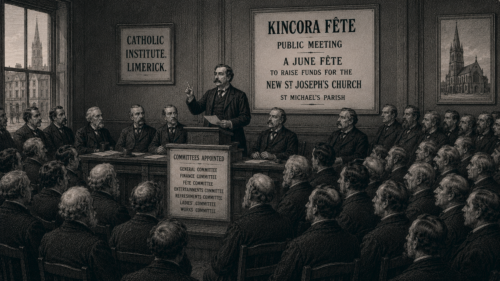
A large public meeting assembled in the Lecture Hall of Limerick’s Catholic Institute to organise a fête and fancy fair for the new church of St Joseph then rising within St Michael’s Parish. The gathering, reported on 4 January 1900, was promoted by the parish clergy and presided over by Bishop Edward Thomas O’Dwyer. Clergy, women and men attended in considerable numbers, demonstrating broad interest in completing the additional parochial church. The meeting agreed that the fundraising celebration would take place in June and established committees to undertake the detailed work required before the event could open.