
Year by Year
Explore Year by Year articles from the most modern historical year back to the oldest.
3,295 Articles Archived
Kildare Eclipse
Archived: 28 October 2026
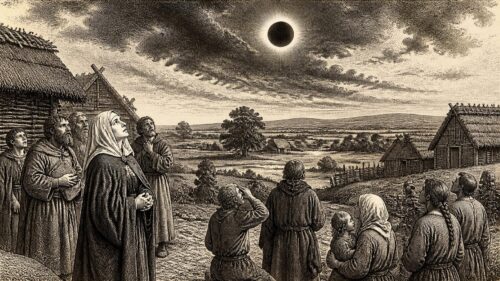
On 16 June 885, a total solar eclipse, recorded as daylight darkening and stars appearing, provides a secure chronological anchor for conflicting Irish annalistic dates. The year also brought major losses at Kildare: Abbess Tuileflaith, Bishop Scannal and Muiredach son of Bran, king of Leinster and abbot, died, while a secret killing was reported without explanation. Máel Pátraic, king of Airgialla, was slain by associates. Other royal and ecclesiastical deaths affected Brega, Meath, Clonfert and Glasnevin. No campaign or Viking raid is attested. An alleged speaking infant at Craeb Laisre shows annalists preserved marvels alongside wider political and religious change.
Domnall Muirecáin
Archived: 28 October 2026
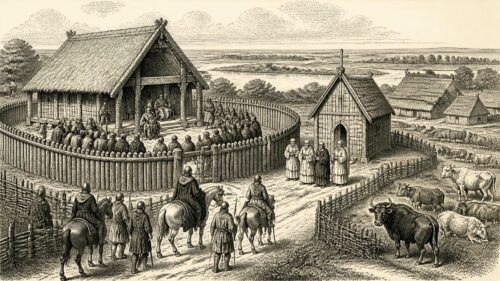
In 884, Domnall mac Muirecáin, king of the Leinstermen and member of the Uí Fháeláin branch of Uí Dúnlainge, was killed by his associates in circumstances unrecorded by the annals. His death destabilised Leinster’s contested overkingship; Muiredach mac Brain succeeded briefly, while Domnall’s brother Cerball later gained power. Cairpre mac Dúnlaing, ruler of western Life, also died, though no connection is known. Scannlán, bishop of Kildare, died, affecting a major ecclesiastical institution. These changes occurred amid pressure from Osraige, Tara and Dublin’s Scandinavian power. The sparse records reveal political vulnerability but provide no evidence for a wider campaign or conspiracy.
Lismore Burning
Archived: 28 October 2026
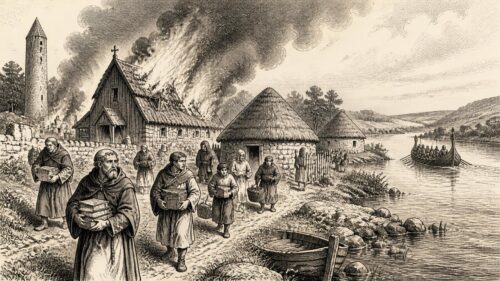
In 883, Les Mór (Lismore), an important Munster monastery on the Blackwater, was burned by an unnamed son of Ímar, illustrating the reach of Scandinavian dynastic violence beyond coastal centres. The annals provide no details of casualties, damage or motive, but the attack threatened a community dependent on religious prestige, land, stores and local support. Elsewhere, Eochucán of Ulaid was killed, Aengus, heir designate of the North, was beheaded, and rulers in Brega and Meath died or were slain. Deaths of bishops at Armagh and Lusca also mattered. These fragmentary records depict contested local kingship, interconnected Irish-Scandinavian politics, and insecurity.
Flann’s Hostages
Archived: 28 October 2026
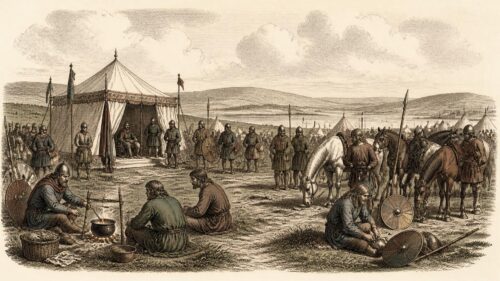
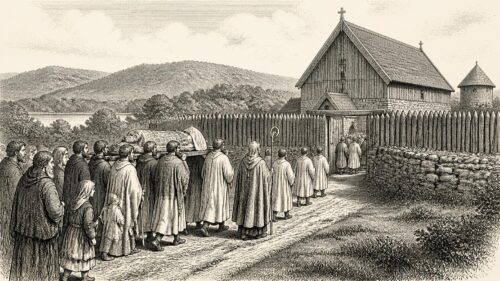
In 882, annalistic sources record Flann Sinna, king of Tara, asserting authority through campaigns, alliances and hostage-taking. With a mixed Irish and Scandinavian army, he entered northern Fochla, camped at Mag Eitir dí Glais, invaded Armagh and reportedly secured hostages from Cenél Conaill and Cenél nEógain. He also raided Munster and took hostages there. Elsewhere, the Conaille defeated the Ulaid, killing King Ainfíth and other nobles, while Scannlán of Dún Lethglaise was killed. Deaths included Connacht’s king Conchobor and several prominent churchmen. The records portray fragmented politics, where military power, ecclesiastical prestige and shifting alliances shaped rule across Ireland broadly.
Flann’s Expedition
Archived: 28 October 2026
In 881, the Annals of Inisfallen record the death of Aed of In tAilén, described as bishop and confessor of Ireland, though his church and byname remain uncertain. Corrected annalistic chronology also places Flann Sinna’s northern expedition in this year. Leading Irish and Scandinavian forces, he camped at Mag Eitir dí Glais, invaded Armagh, and received hostages from Cenél Conaill and Cenél nEógain, asserting overlordship through military pressure and negotiation. The evidence highlights churches as influential, vulnerable centres of learning and wealth, Scandinavian participation in politics, and the limits of medieval records, which reveal no securely dated crises or conditions.
Duleek Raid
Archived: 28 October 2026
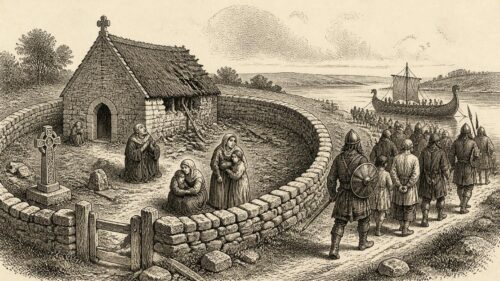
In the annalistic sequence assigned to AD 880, Scandinavian raiders destroyed Cianán’s oratory at Duleek, County Meath, and carried away many people. The attack struck a wealthy, well-connected ecclesiastical community, demonstrating the continuing vulnerability of Irish churches despite growing Scandinavian settlement around Dublin. Bárid, a prominent Norse leader probably linked to Dublin and perhaps son of Ímar, died soon afterwards; annalists attributed his death to Cianán’s supernatural vengeance, though its circumstances remain uncertain. Occurring early in Flann Sinna’s reign, the raid illustrates limited royal control, Irish Sea power, captivity’s human cost, and the overlap of raiding, settlement, religion, and politics.
Tara Succession
Archived: 28 October 2026
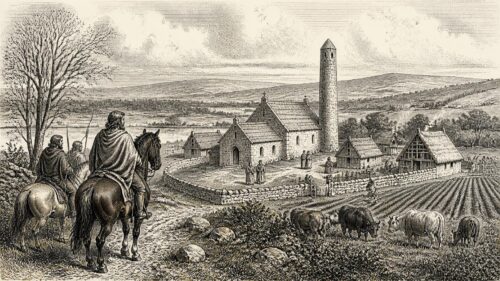
In 879, Áed Findliath, northern Uí Néill ruler and king of Tara, died at Druim Inasclainn, modern Dromiskin. His death brought Murchad son of Máel Dúin to the northern kingship and Flann Sinna of Clann Cholmáin to Tara, reviving a northern-southern Uí Néill alternation. Annals also record deaths among regional chiefs and church leaders, exposing widespread succession uncertainties. Foreigners captured Armagh’s superior Máel Coba and lector Mochta, demonstrating ecclesiastical vulnerability amid Scandinavian maritime activity. Spring fodder scarcity, followed by autumn abundance, highlighted cattle’s economic importance. The year revealed decentralised politics, influential churches, local instability, and relationships renegotiated after royal change.
Columban Relics
Archived: 28 October 2026
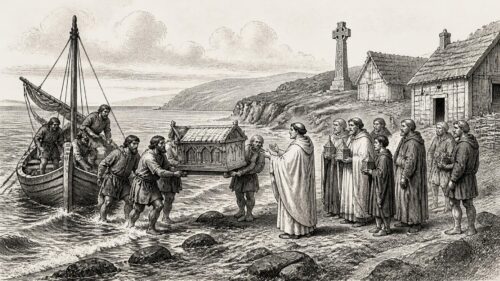
In 878, whose annalistic dating requires caution, Ireland experienced local political instability, disrupted public ceremony, unusual weather reports and significant religious refuge. Gairbíth of Conaille and Cumuscach of Uí Chremthainn were killed in northern conflicts, while Congal of Ciarraige Luachra died in Munster. Tailtiu’s major fair was cancelled without stated justification, signalling a failure of collective order and lost opportunities for trade and negotiation. Annals recorded a great wind, lightning, supposed blood-rain, and lunar and solar eclipses in October. Most notably, Colum Cille’s shrine and relics reached Ireland, removed from danger posed by Scandinavian foreigners, affirming Columban resilience and continuity.
Rhodri’s Flight
Archived: 28 October 2026
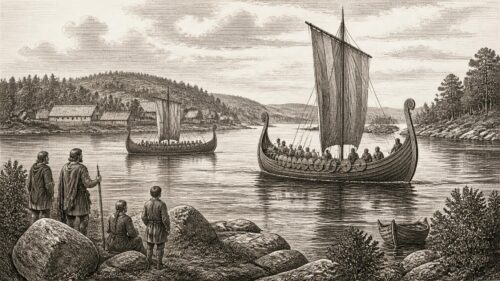
In 877, Ireland stood at the centre of a volatile Irish Sea world. The most striking notice for the year is not an Irish battle or royal assembly, but the arrival of an overseas king in flight: Rhodri son of Merfyn, ruler of the Britons, came to Ireland to escape the Dubgaill, or “dark foreigners”. The wording of the Irish annals is brief, but its implications are considerable. A king from Gwynedd and the wider Welsh political sphere could seek safety across the sea, while Scandinavian rivalries reached from Dublin and northern Ireland into Wales, Northumbria and beyond.
Rechtabra Eógan
Archived: 28 October 2026
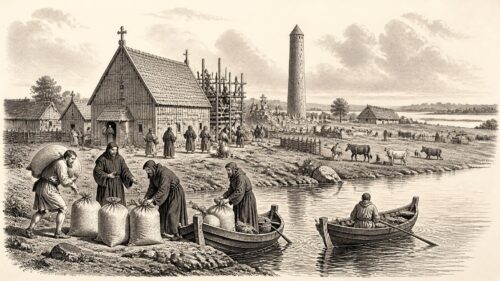
In 876, the Annals of Inisfallen record the deaths of Rechtabra son of Bran, king of Leinster, and Eógan, abbot of Clonmacnoise. Rechtabra’s death potentially unsettled Leinster’s contested kingship, where succession depended upon kinship, alliances and support rather than primogeniture. Eógan’s death affected a major church whose religious, economic and political influence extended across Ireland. Rural production, estate obligations and riverine communications nevertheless continued. Uncertain Annals of Ulster notices, conventionally placed in 877 but internally dated 876, describe Rhodri of Gwynedd’s flight to Ireland and Scandinavian conflict at Strangford Lough. Records portray institutional transition within a changing Irish Sea world.
Some records do not yet have a verified historical year and are awaiting chronological placement.