Forbidden Schools(c.1690s)
Limerick’s Catholic families entered the post-treaty period believing that their religion would receive protection, yet the education of their children soon became a target of Parliament. The 1695 Act to Restrain Foreign Education prohibited Irish subjects from sending children abroad to Catholic colleges, schools, religious houses or private families. It also penalised anyone who supplied money for their maintenance. This struck communities whose educational choices were already limited at home. In Limerick, a city connected through trade and migration with continental Europe, the measure threatened both family strategy and the preparation of future clergy, teachers, merchants and professional men alike.
The penalties extended well beyond a fine. A person convicted of sending or supporting a student abroad could lose the ability to bring legal actions, act as guardian or executor, receive a legacy, hold public office or enjoy lands and estates during life. The student could suffer corresponding disabilities. Informers received part of the forfeiture, giving private individuals a financial reason to report suspected journeys or remittances. Justices were directed to investigate allegations promptly. Education therefore became linked with surveillance, property loss and civic exclusion. A family’s attempt to secure instruction could endanger its entire legal standing and economic survival.
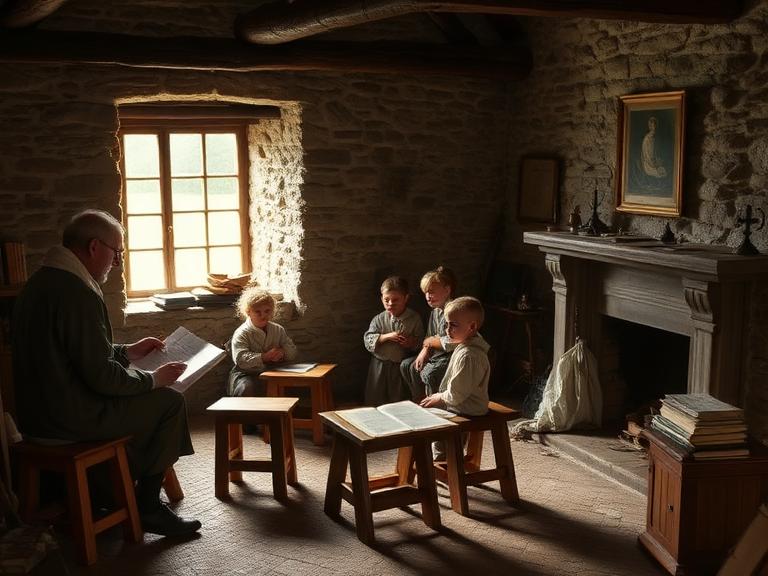
The statute also attacked Catholic teaching within Ireland. No Catholic was permitted to keep a public school or instruct young people privately, except the children belonging to the household where teaching occurred. A convicted schoolmaster faced a twenty-pound penalty and three months in prison for each offence. Courts, assizes and quarter sessions were instructed to enforce the law through grand juries. This pressure encouraged teaching to become discreet, mobile and dependent upon trusted networks. Later remembered as hedge schooling, illegal Catholic education survived because parents continued to value literacy, classical learning and religious formation despite the risks imposed upon teachers.
The law’s preamble presented foreign Catholic education as a source of disloyalty and rebellion. It claimed that students trained in France, Spain and other territories might return attached to foreign interests and hostile to Ireland’s established religion and government. This reasoning treated education not as a family matter but as a question of state security. Catholic culture itself became suspect because schools transmitted language, belief, memory and social connections. By controlling where young people learned and who could teach them, legislators hoped to shape future allegiance. The classroom became another field upon which the political settlement of 1691 was contested.
For Limerick, educational restriction represented another narrowing of the settlement made at the city walls. Religious exercise could not remain secure when families were denied lawful means of transmitting belief and learning. The legislation sought to isolate Catholics from continental institutions while preventing them from creating an independent system at home. Nevertheless, clandestine teachers and determined parents preserved educational traditions throughout the penal era. Their survival demonstrates the limits of coercive law, but it should not conceal hardship involved. Careers were blocked, families risked forfeiture and teachers faced imprisonment because instruction had been transformed into an offence against the state.
Primary Sources
- An Act to Restrain Foreign Education, 7 William III, chapter 4, 1695.
- An Act to Prevent the Further Growth of Popery, 2 Anne, chapter 6, 1704.
- An Act for Explaining and Amending the Act to Prevent the Further Growth of Popery, 8 Anne, chapter 3, 1709.
- An Act for Regulating the Admissions of Barristers, Attorneys and Other Officers, 1 George II, chapter 20, 1727.
- An Act for the More Effectual Prevention of His Majesty’s Subjects Entering Foreign Service, 19 George II, chapter 7, 1745.