Castle Defiance(c.1640s)
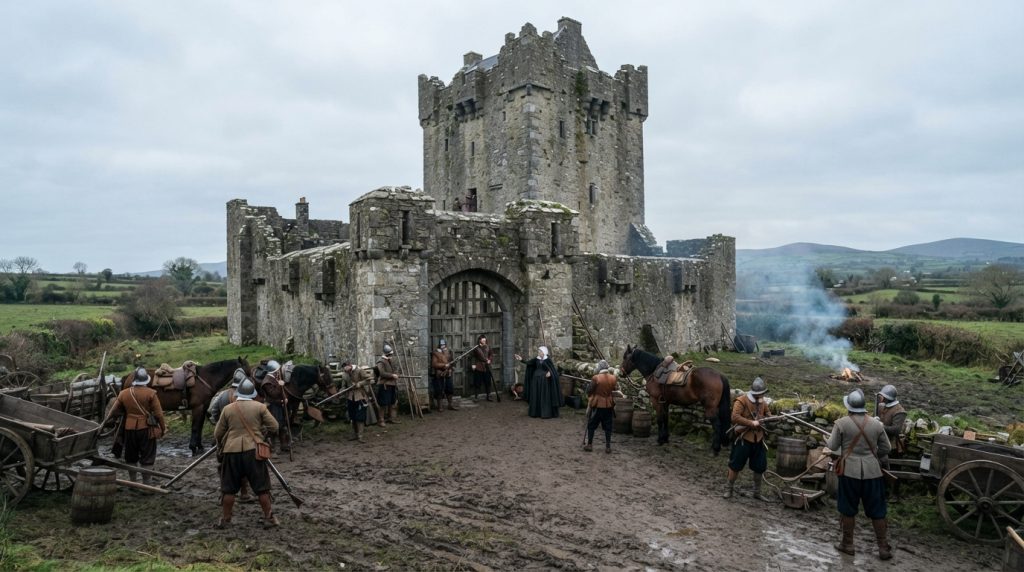
In County Limerick, Kilfinny Castle became the setting for one of the most striking episodes of the Irish Rebellion of 1641. Lady Elizabeth Dowdall, an English-born noblewoman married into the Dowdall family, commanded the castle’s defence during 1642. Her surviving accounts place a woman at the centre of military decision-making in a period usually narrated through male commanders. She organised resistance against repeated assaults, directed those within the stronghold, and refused demands for surrender until artillery made continued defence impossible. Kilfinny therefore occupies an unusual place in Limerick history: a rural fortress remembered chiefly through its female defender and writer.
The rebellion began amid political, religious and territorial tensions across Ireland, exposing Munster settlements and landed households to attack, confiscation and displacement. Castles remained both residences and defensive centres, offering protection to families, servants and dependants when ordinary authority collapsed. Elizabeth had remained in Ireland after her father, Sir Thomas Southwell, died in 1626 and her mother returned to England. She married Sir John Dowdall and raised five daughters, establishing connections with County Limerick society. When violence reached the district, personal survival, property and local power became inseparable, forcing household leaders to make military choices with little certainty of relief.
Dowdall’s defence was remembered through two accounts written in 1642. Her deposition, recorded by a scribe and signed by her, identified attackers and described losses suffered during the rebellion. A second narrative, written in her own hand three days later, presented her as an active commander confronting attacks upon Kilfinny. The article states that she resisted four assaults and endured a prolonged siege before surrendering when cannon entered the battle. It also reports a reputation that she personally hanged opposing rebels; this remains a claim requiring cautious attribution rather than unquestioned repetition. Her writings nevertheless reveal deliberate leadership under pressure.
For Limerick, the siege demonstrates how the rebellion reached beyond towns and formal armies into estates, farms and family networks. Kilfinny’s defenders faced not merely a contest for one building, but the collapse of security throughout the surrounding countryside. Elizabeth’s husband, Sir John Dowdall, died during the rebellion after being ambushed while travelling to defend Newcastle West. His death intensified the family’s losses and left Elizabeth confronting military danger alongside widowhood. The castle’s surrender marked the end of organised resistance there, while the accounts preserved names, damage and remembered actions that might otherwise have disappeared from Limerick’s seventeenth-century historical record.
Kilfinny Castle’s importance now rests as much upon testimony as upon warfare. Elizabeth Dowdall did not simply survive long enough to report events; she shaped how later generations encountered them. The contrast between her dictated deposition and handwritten narrative shows how form could alter historical representation, moving from an inventory of losses towards a first-person account of command. Nothing certain is known about her life after 1642, and her only credited writing concerns the castle. That surviving record has contributed to her neglect, yet it also makes Kilfinny central to recovering women’s authorship, authority and experience within Limerick’s seventeenth-century past.
Primary Sources
- Dame Elizabeth Dowdall, sworn deposition concerning Kilfinny Castle and losses during the rebellion, 3 October 1642, Trinity College Dublin, 1641 Depositions, IE TCD MS 829, folios 138r–139v, identifier 829138r082.
- Lady Elizabeth Dowdall, handwritten first-person narration of her defence of Kilfeney Castle, County Limerick, 1642; transcribed in John T. Gilbert, editor, History of the Irish Confederation and the War in Ireland, 1641–1643, Volume II, 1882, pages 69–73. Original manuscript location requires further verification.
- Dowdall family estate settlement concerning Sir John Dowdall and Kilfinny, dated 25 April 1623. Primary source requiring further verification.
- Civil Survey of Ireland, 1654–1656, County Limerick returns relating to Kilfinny and the barony of Connello. Precise manuscript entry and archival reference require further verification.
- William Petty, Down Survey parish maps for County Limerick, attested in 1657, including the Kilfinny district; National Library of Ireland map volume, surviving copy made by Daniel O’Brien in 1786–1787. Relevant individual map reference requires further verification.