

Kilfinny Memory(c.1640s)
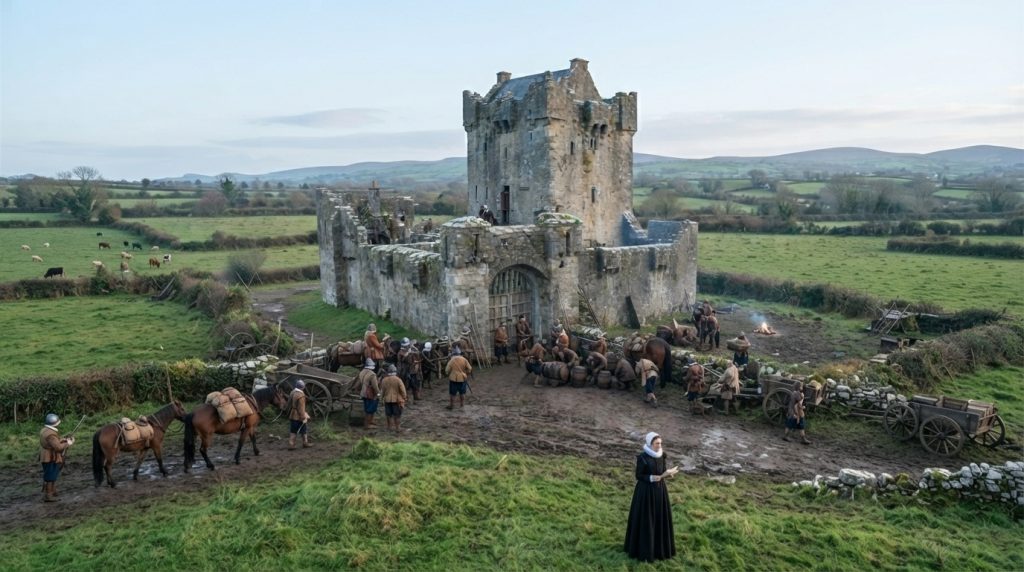
Kilfinny Castle gives Lady Elizabeth Dowdall’s story its enduring place within County Limerick. The building was more than the setting for a dramatic siege; it was the household, estate centre and defensive position around which her surviving testimony was organised. In 1642, Dowdall commanded resistance there against Confederate Irish forces during the upheavals following the rebellion of 1641. Four attacks were reportedly resisted before cannon made surrender unavoidable. Although later retellings emphasise her personality, the castle itself shaped every decision. Its walls offered protection, concentrated authority and turned a rural residence into a military landmark remembered locally across subsequent centuries.
Seventeenth-century castles in Ireland commonly combined residence, storage, administration and defence. Their strength depended upon masonry, controlled entrances, elevated openings and access to provisions rather than upon comfort alone. Kilfinny stood within an agricultural landscape where the security of tenants, servants, livestock and household goods was tied to the fortunes of the estate. When normal government weakened, such buildings became refuges and targets simultaneously. Attackers could isolate them, demand surrender or introduce artillery, while defenders relied upon walls and organised labour. Kilfinny’s transformation from home to stronghold reflects how rebellion altered the practical meaning of architecture throughout rural County Limerick.
Dowdall’s writings allow the castle to be understood as an occupied and contested place rather than an empty ruin. Her deposition recorded losses and accusations, while her handwritten narration described demands, attacks, decisions and resistance. These documents connect physical space with human action: gateways had to be guarded, approaches watched, supplies protected and defenders directed. The account states that the siege continued for forty weeks and ended after cannon entered the confrontation. That reported duration requires comparison with contemporary evidence, but the central sequence remains clear. Kilfinny endured repeated pressure until artillery overcame the defensive value of its traditional construction.
For local communities, the castle’s fall represented more than the surrender of one family residence. It demonstrated how warfare could reorder authority across rural Limerick, exposing households and dependants to confiscation, displacement and death. Sir John Dowdall had already been killed after being ambushed while travelling to defend Newcastle West, leaving Elizabeth responsible during the crisis at Kilfinny. The building consequently became associated with widowhood, female command and the vulnerability of landed society. Its history links separate Limerick places through conflict, showing how events on the roads, within estates and around fortified centres formed one deeply connected prolonged regional emergency.
Kilfinny Castle remains historically significant because documentary memory has preserved what damaged or altered masonry cannot explain alone. Elizabeth Dowdall disappears from confirmed records after 1642, but the place associated with her continues to anchor her biography. Her two accounts transformed a local stronghold into evidence for women’s writing, military leadership and the experience of rebellion in Limerick. The castle’s legacy should therefore avoid both romantic invention and simple ruin worship. Its importance lies in the relationship between surviving structure, landscape and testimony. Together they recover a moment when an ordinary seat of authority became the centre of exceptional resistance.
Primary Sources
- Dame Elizabeth Dowdall, sworn deposition concerning Kilfinny Castle, property losses and events during the rebellion, 3 October 1642, Trinity College Dublin, 1641 Depositions, IE TCD MS 829, folios 138r–139v, identifier 829138r082.
- Lady Elizabeth Dowdall, handwritten first-person narration of her defence of Kilfeney Castle, County Limerick, 1642; transcribed in John T. Gilbert, editor, History of the Irish Confederation and the War in Ireland, 1641–1643, Volume II, 1882, pages 69–73. Original manuscript location requires further verification.
- Civil Survey of Ireland, 1654–1656, County Limerick returns concerning Kilfinny, its ownership, buildings and surrounding lands. Relevant manuscript entry and archival reference require further verification.
- Down Survey maps of County Limerick, 1650s, covering the parish and barony containing Kilfinny. Relevant original map and precise archival reference require further verification.
- Books of Survey and Distribution for County Limerick, recording seventeenth-century landownership and redistribution in the Kilfinny district. Relevant volume, entry and archival reference require further verification.